Automated Material Handling Systems: A Complete Guide for Modern Industries
Automated material handling systems are transforming how manufacturers, warehouses, distribution centers, and industrial facilities move and manage materials. As businesses handle larger production volumes and increasingly complex material flows, manual transportation and handling can create challenges related to productivity, safety, storage, accuracy, and operating costs.
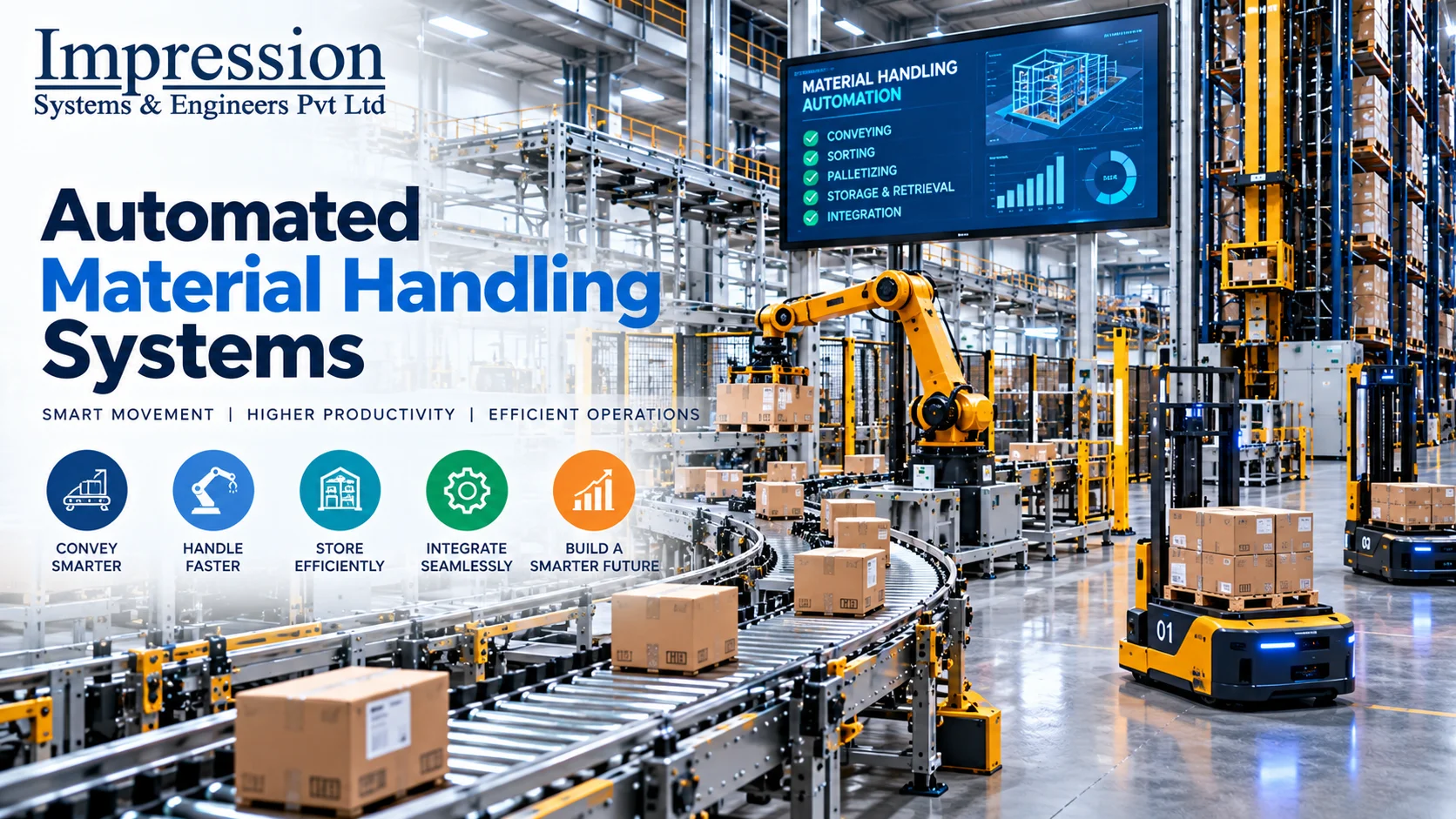
Automated material handling combines mechanical equipment, automation controls, sensors, software, robotics, and transportation technologies to move materials between different locations with limited manual intervention.
Depending on the application, an automated material handling system can include conveyors, Automated Storage and Retrieval Systems (AS/RS), Automated Guided Vehicles (AGVs), Autonomous Mobile Robots (AMRs), Rail Guided Vehicles (RGVs), lifts, pallet handling equipment, robotic systems, and intelligent control software.
These systems are used across automotive, food and beverage, appliances, pharmaceuticals, electronics, metal, engineering, logistics, and other industries.
The objective is not simply to replace manual handling. A well-designed automated material handling system creates a controlled and connected flow of materials from receiving and storage through production, picking, assembly, packing, and dispatch.
This guide explains what automated material handling systems are, how they work, their major technologies, benefits, applications, implementation process, and important considerations for businesses planning automation.
What Are Automated Material Handling Systems?
Automated material handling systems are integrated technologies designed to automatically transport, store, retrieve, sort, position, or manage materials within an industrial or warehouse environment.
Traditional material handling may depend heavily on:
- Forklifts
- Pallet trucks
- Manual carts
- Operators
- Manual storage
- Paper-based tracking
Automated systems use equipment and software to perform many repetitive material movement activities.
A typical automated material handling system may include:
- Conveyor systems
- Pallet handling systems
- AS/RS
- RGVs
- AGVs
- AMRs
- Automated lifts
- Monorail systems
- Robotic handling
- Sensors
- Barcode scanners
- RFID
- PLCs
- HMIs
- Warehouse control systems
- Warehouse management integration
The exact configuration depends on the material, weight, dimensions, throughput, facility layout, storage requirements, and operational objectives.
Why Are Automated Material Handling Systems Important?
Material movement is an important part of manufacturing and logistics operations. A production line cannot operate efficiently if components arrive late. A warehouse cannot fulfill orders effectively if products cannot be retrieved quickly and accurately.
Manual transportation can create unnecessary movement and process delays.
Common challenges include:
- Excessive material travel
- Forklift congestion
- Manual handling
- Inventory errors
- Production line shortages
- Material damage
- Inconsistent transportation
- Limited visibility
- Workplace safety concerns
Automated material handling systems can create defined and controlled transportation routes.
For example, an automotive facility may automatically transport components from a warehouse to a sequencing area and then to a production line. A distribution center may automatically move cartons from receiving to storage, picking, sorting, and dispatch.
How Do Automated Material Handling Systems Work?
Automated material handling works by combining mechanical equipment, sensors, controls, software, and predefined workflows.
A typical process may look like this:
Receiving → Identification → Storage → Retrieval → Transportation → Production/Picking → Packing → Dispatch
For example, when a pallet enters a warehouse, a barcode or RFID system may identify the material. The warehouse software can determine its assigned location.
A conveyor, RGV, AGV, or other transportation system then moves the pallet to the appropriate storage location.
When the material is required, the system receives a retrieval command. Automated equipment retrieves the pallet and transports it to the required destination.
Sensors confirm material position and equipment status throughout the process.
The control system coordinates motors, drives, sensors, safety systems, PLCs, and software.
Major Components of Automated Material Handling Systems
1. Conveyor Systems
Conveyors are among the most widely used material handling technologies.
They transport products continuously or in controlled batches between different locations.
Common conveyor types include:
- Belt conveyors
- Roller conveyors
- Chain conveyors
- Pallet conveyors
- Slat conveyors
- Accumulation conveyors
- Transfer conveyors
- Vertical conveyors
Conveyors can connect receiving areas with storage, production, picking, packing, and dispatch.
2. Automated Storage and Retrieval Systems
AS/RS automatically stores and retrieves products from designated storage locations.
AS/RS can be designed for:
- Pallets
- Cartons
- Bins
- Totes
- Small components
- Industrial products
The system can improve storage density and reduce manual travel.
3. Automated Guided Vehicles
AGVs are automated vehicles used for transporting materials along defined routes.
They can be used for:
- Pallet transportation
- Raw material movement
- Production replenishment
- Finished goods transportation
- Repetitive warehouse routes
AGVs can reduce repetitive forklift or manual transportation.
4. Autonomous Mobile Robots
AMRs use sensors, navigation systems, and software to move through warehouse and manufacturing environments.
They can support:
- Tote movement
- Goods-to-person applications
- Picking
- Replenishment
- Internal transportation
- Material transfer
AMRs can be useful when transportation routes need flexibility.
5. Rail Guided Vehicles
Rail Guided Vehicles, or RGVs, operate on fixed rail tracks.
They are suitable for applications requiring controlled, repeatable transportation.
RGVs can connect multiple locations, including:
- Storage areas
- Production lines
- Assembly areas
- Picking stations
- Buffer zones
They can be designed to transport pallets, containers, components, or specialized loads.
6. Automated Lifts
Vertical lifts can transport materials between different levels.
They are useful in:
- Multi-level warehouses
- Mezzanine systems
- Production facilities
- Vertical storage systems
- Multi-floor material flow
7. Robotic Material Handling
Robots can automate repetitive handling tasks such as:
- Picking
- Palletizing
- Depalletizing
- Case handling
- Machine loading
- Material transfer
Robotic systems can provide consistent movement and handling.
8. Sensors and Identification Systems
Sensors provide information about the location and condition of materials and equipment.
Common technologies include:
- Photoelectric sensors
- Proximity sensors
- Barcode scanners
- RFID
- Vision systems
- Encoders
- Load cells
- Position sensors
Accurate sensing is essential for reliable automation.
9. PLC and HMI Systems
PLCs control the sequence and operation of automated equipment.
HMIs provide operators with information about:
- Equipment status
- Faults
- Alarms
- Operating modes
- Production information
- Manual controls
- Maintenance conditions
A well-designed PLC and HMI architecture helps operators monitor and troubleshoot automated systems.
10. Warehouse and Material Flow Software
Software coordinates material movement and communicates with business systems.
A Warehouse Management System can manage inventory and orders, while a Warehouse Control System can coordinate automated equipment.
Depending on the project, the automation system may also communicate with:
- ERP
- MES
- Production planning systems
- Barcode systems
- RFID platforms
- Transportation management systems
Types of Automated Material Handling Systems
Different material handling applications require different automation technologies.
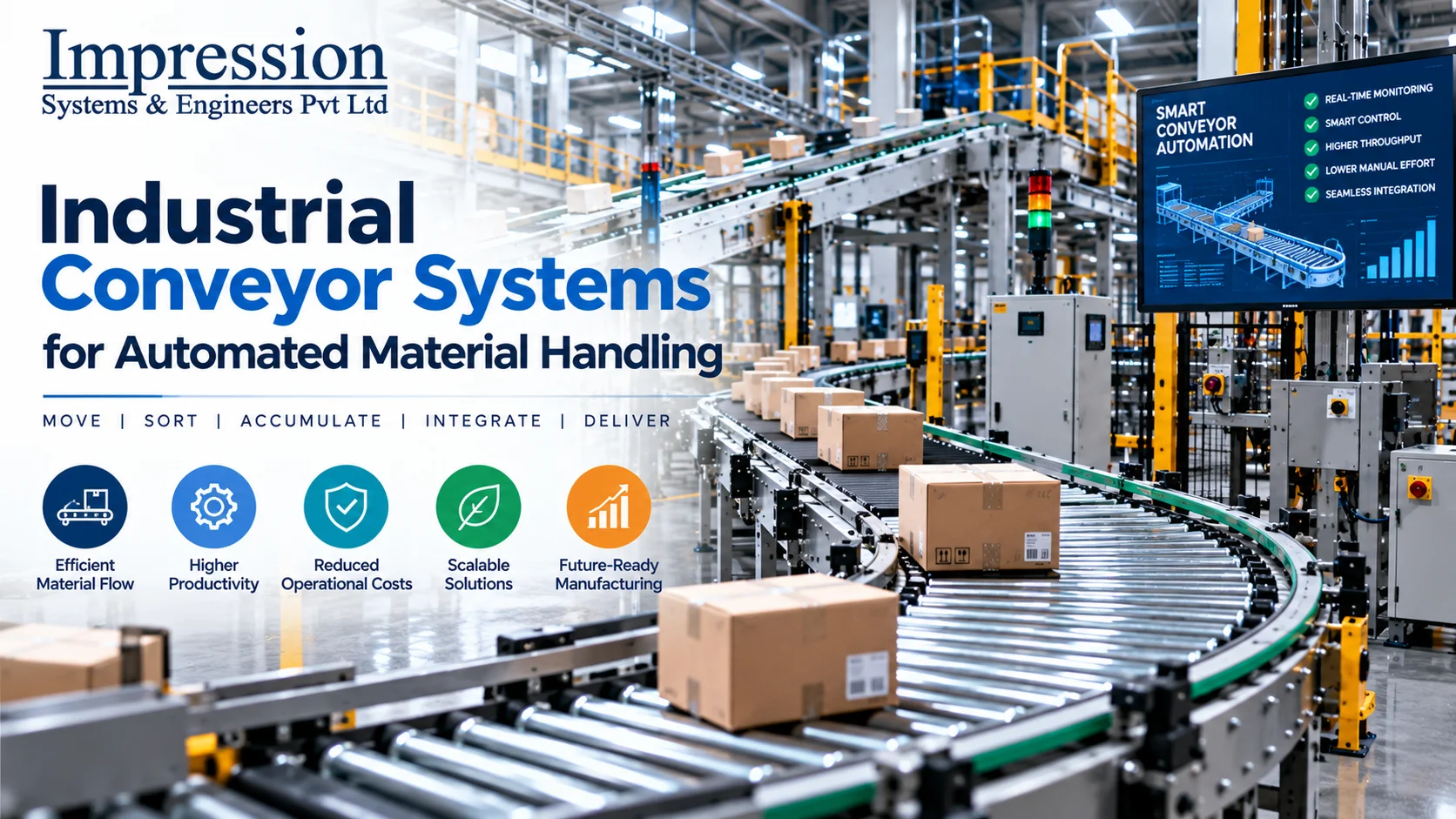
Conveyor-Based Material Handling
Conveyor systems are suitable for repetitive transportation between predefined locations.
They can provide a continuous material flow between:
Receiving → Storage → Production → Picking → Packing → Dispatch
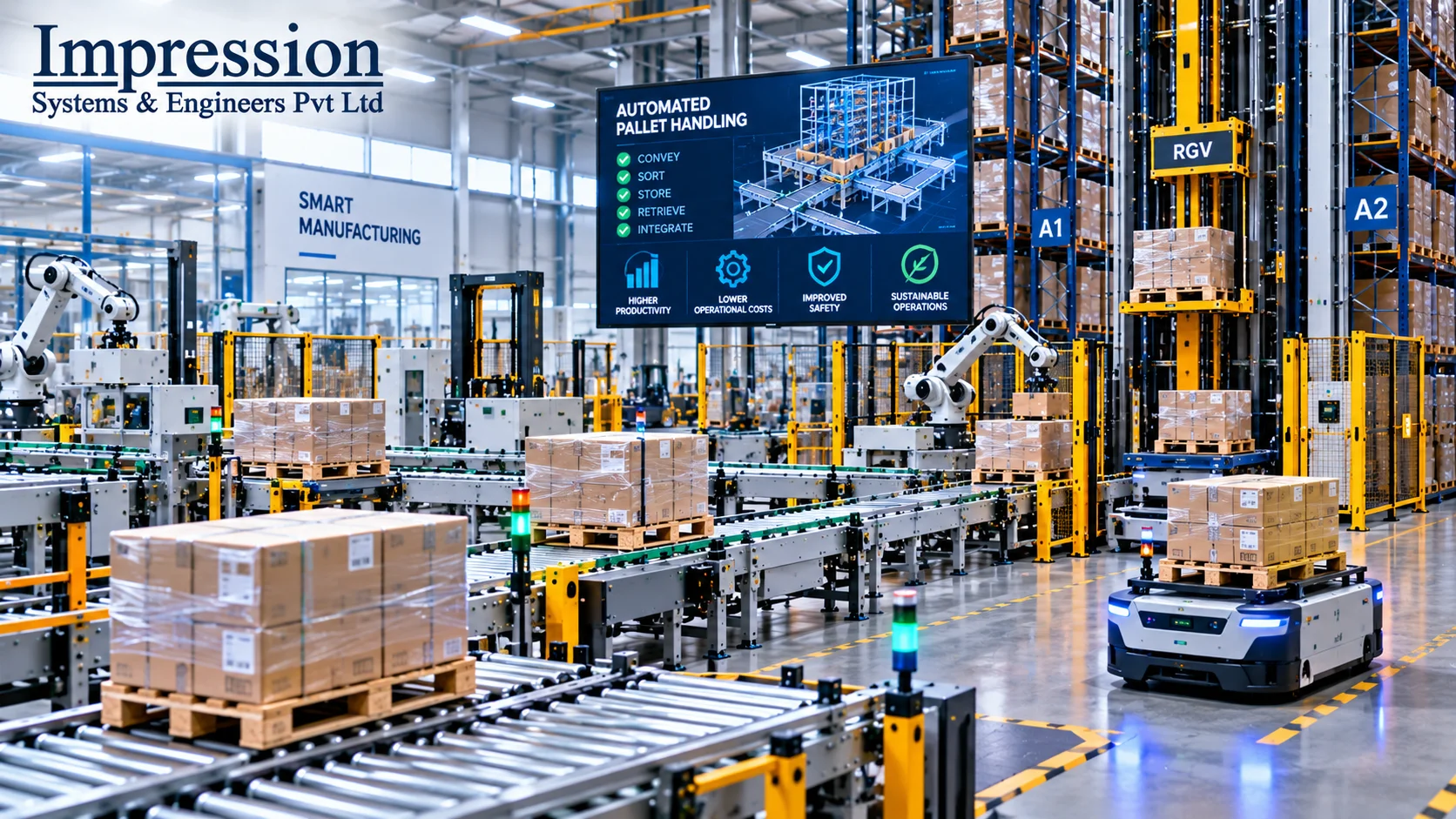
Automated Pallet Handling
Pallet handling systems automate the transportation and storage of palletized products.
They may include:
- Pallet conveyors
- Pallet lifts
- Pallet transfer units
- Pallet stackers
- Automated pallet storage
- Pallet shuttle systems
These systems are commonly used in manufacturing and distribution.
Automated Storage and Retrieval
AS/RS systems automate storage and retrieval activities.
They are particularly useful when facilities require:
- High-density storage
- Accurate inventory control
- Automated retrieval
- High throughput
- Reduced manual transportation
RGV Material Transportation
RGVs are suitable for controlled movement between multiple fixed stations.
They can provide repeatable transportation for high-frequency material flows.
AMR-Based Material Transportation
AMRs can provide flexible material transportation where routes and workflows may change.
They are often suitable for:
- Picking
- Replenishment
- Tote transportation
- Production supply
- Warehouse movement
Automated Sortation
Automated sortation systems direct products toward specific destinations.
They can be used according to:
- Customer order
- Product category
- Dispatch route
- Production requirement
- Storage location
Benefits of Automated Material Handling Systems
Improved Productivity
Automation can perform repetitive transportation activities consistently, allowing employees to focus on supervision, quality, planning, and exception handling.
Faster Material Movement
Automated transportation can reduce unnecessary walking and manual movement between locations.
Improved Inventory Accuracy
Automated identification and software integration can reduce certain types of manual inventory errors.
Better Production Support
Manufacturing facilities can use automated systems to deliver components to production lines according to predefined schedules or requirements.
Reduced Manual Handling
Automation can reduce repetitive lifting, carrying, pushing, and transportation activities.
Improved Workplace Ergonomics
Reducing repetitive physical movement can support better working conditions when the automation system is properly designed.
Improved Traceability
Barcode, RFID, software, and automated equipment can create a record of material movement.
Better Space Utilization
Automated storage and vertical transportation systems can help organizations make more efficient use of available space.
Consistent Material Flow
Automated equipment follows predefined sequences, helping create predictable transportation processes.
Scalability
Automation can be designed to accommodate additional equipment and increased throughput as operational requirements evolve.
Automated Material Handling Applications Across Industries
Automotive Industry
Automotive manufacturing involves complex material flows between warehouses, sequencing areas, assembly lines, and finished goods areas.
Automated material handling can support:
- Component transportation
- Production line feeding
- Pallet movement
- Sequencing
- Returnable container movement
- Finished goods transportation
- Work-in-progress handling
RGVs, conveyors, AMRs, AGVs, and AS/RS can be combined depending on requirements.
Food and Beverage Industry
Food and beverage facilities handle raw materials, packaging, finished goods, and distribution inventory.
Automation can support:
- Pallet transportation
- Carton handling
- Storage
- Retrieval
- Inventory tracking
- Dispatch preparation
Pharmaceutical Industry
Pharmaceutical operations require accurate identification and controlled material movement.
Automated material handling can support:
- Small-item movement
- Batch identification
- Inventory tracking
- Storage
- Retrieval
- Order preparation
Appliances Industry
Appliance manufacturing and distribution often involve large and bulky products.
Automated handling systems can transport:
- Components
- Subassemblies
- Finished appliances
- Packaging materials
- Pallets
Electronics Industry
Electronics manufacturing involves large quantities of small components.
Automated handling can support:
- Component storage
- Small-part transportation
- Production replenishment
- Picking
- Inventory tracking
Metal and Engineering Industry
Heavy industrial components may require specialized material handling.
Automation can be designed for:
- Heavy pallets
- Fabricated parts
- Components
- Work-in-progress
- Finished products
Logistics and Distribution
Distribution facilities can use automated systems to manage high-volume material movement.
Applications include:
- Receiving
- Storage
- Picking
- Sorting
- Order consolidation
- Dispatch
Automated Material Handling and Industry 4.0
Industry 4.0 is making material handling systems increasingly connected and data-driven.
Modern systems can incorporate:
- Industrial IoT
- Artificial intelligence
- Machine learning
- Robotics
- Computer vision
- RFID
- Cloud monitoring
- Predictive maintenance
- Data analytics
- Digital twins
Connected automation can provide information about:
- Equipment status
- Material location
- Throughput
- Downtime
- Inventory
- Maintenance requirements
Predictive maintenance can use equipment data such as vibration, temperature, operating cycles, or electrical parameters to identify potential problems.
Integration with ERP, WMS and MES
Automated material handling becomes more effective when connected to business systems.
A typical architecture may look like:
ERP ↔ WMS/MES ↔ WCS ↔ PLC ↔ Automated Equipment
An ERP can provide business and production information.
A WMS can manage warehouse inventory and orders.
An MES can connect manufacturing processes with production information.
A WCS can coordinate automated equipment.
The PLC controls the machine-level sequence.
This layered approach allows business decisions and machine operations to communicate effectively.
How to Select an Automated Material Handling System
The right system depends on the specific application.
Analyze Material Characteristics
Review:
- Weight
- Dimensions
- Shape
- Packaging
- Fragility
- Handling requirements
Analyze Throughput
Determine:
- Units per hour
- Pallets per hour
- Peak volumes
- Storage cycles
- Retrieval cycles
- Production demand
Study Material Flow
Map the complete movement:
Receiving → Storage → Production/Picking → Packing → Dispatch
Identify bottlenecks, unnecessary movement, and manual intervention points.
Evaluate Facility Layout
Consider:
- Floor area
- Ceiling height
- Aisle width
- Existing equipment
- Production interfaces
- Loading areas
- Future expansion
Evaluate Integration
Determine which systems need to communicate with the automation platform.
Consider Safety
The system should include appropriate:
- Emergency stops
- Safety scanners
- Guarding
- Interlocks
- Access controls
- Safe operating procedures
Customized Automated Material Handling Systems
Standard equipment may not always address a complex industrial application.
Customized automated material handling systems can be designed for:
- Heavy materials
- Unusual product dimensions
- Limited floor space
- Multi-level facilities
- Complex material routes
- Existing machine integration
- Specialized production requirements
Customization may involve mechanical design, electrical design, PLC programming, HMI development, software integration, and safety engineering.
The project should begin with a detailed process and material-flow study.
Implementation Process
1. Requirement Analysis
The automation team studies:
- Current material flow
- Product characteristics
- Throughput
- Existing equipment
- Operational challenges
- Future requirements
2. Concept Design
The proposed material flow and equipment configuration are developed.
3. Detailed Engineering
Mechanical, electrical, controls, software, and safety engineering are completed.
4. Manufacturing
The required equipment is manufactured and assembled.
5. Installation
The automation system is installed and integrated at the facility.
6. Testing and Commissioning
The system is tested for:
- Equipment operation
- Sensors
- Controls
- Safety
- Communication
- Material flow
- Software integration
- Performance
7. Training and Handover
Operators and maintenance teams are trained on operation, safety, troubleshooting, and preventive maintenance.
Maintenance of Automated Material Handling Systems
Maintenance is critical for maintaining system reliability.
Preventive maintenance can include:
- Conveyor inspection
- Motor inspection
- Sensor cleaning
- Roller and chain inspection
- Lubrication
- Electrical panel inspection
- Safety system testing
- PLC backup
- Software backup
- RGV inspection
- AGV/AMR inspection
Predictive maintenance can provide additional information by monitoring equipment condition.
A maintenance program should also include spare parts planning, periodic inspections, technical support, and emergency procedures.
Common Mistakes to Avoid
Automating Without Studying the Process
Automation should solve a specific operational requirement rather than simply add technology.
Designing Only for Average Throughput
Peak demand should be considered when determining system capacity.
Ignoring Software Integration
Mechanical equipment and business systems must communicate correctly.
Not Considering Future Expansion
Future production and warehouse requirements should be considered during initial design.
Choosing Equipment Without Considering the Material
Product weight, size, packaging, and handling requirements must influence equipment selection.
Neglecting Employee Training
Employees need appropriate training to operate and maintain automated systems.
Ignoring Maintenance
Automation requires preventive maintenance and technical support to maintain reliable performance.
Future Trends in Automated Material Handling
AI-Based Optimization
AI can support route planning, demand forecasting, inventory management, and maintenance strategies.
Autonomous Mobile Robots
AMRs can provide flexible transportation for warehouses and production environments.
Computer Vision
Vision systems can identify products, inspect materials, verify labels, and support robotic handling.
Digital Twins
Digital twins can model material flow and test proposed automation configurations before physical implementation.
Predictive Maintenance
Connected sensors can identify changes in equipment condition and provide early warnings.
Energy-Efficient Systems
Efficient motors, drives, route optimization, and energy monitoring can support more efficient operations.
Why Choose an Experienced Automation Partner?
Automated material handling requires more than individual machines. A complete project can involve mechanical engineering, electrical controls, software, safety systems, material-flow engineering, installation, commissioning, and maintenance.
An experienced automation partner can support:
- Process analysis
- Material-flow design
- Equipment selection
- Customized machine development
- PLC programming
- HMI development
- Software integration
- Safety engineering
- Installation
- Commissioning
- Training
- Maintenance
An integrated approach helps ensure that transportation, storage, controls, software, and production processes work together.
Automated Material Handling Systems from Imensys
Imensys provides industrial automation and material handling capabilities that can support automated transportation, storage, and production-related material flow.
Depending on the application, an automated material handling project can incorporate:
- Conveyor systems
- Material transportation systems
- Automated storage solutions
- RGV systems
- AMR-based transportation
- Vertical transportation
- PLC and HMI controls
- Customized automation
- System integration
The appropriate system should be selected based on material characteristics, throughput, facility layout, storage requirements, production processes, and future expansion requirements.
Businesses evaluating automated material handling can begin with a detailed assessment of their existing material flow to identify bottlenecks, repetitive activities, and opportunities for automation.
Frequently Asked Questions About Automated Material Handling Systems
What are automated material handling systems?
Automated material handling systems are technologies used to automatically transport, store, retrieve, sort, or manage materials in warehouses, factories, and distribution facilities.
What are the main types of automated material handling systems?
Common systems include conveyors, AS/RS, AGVs, AMRs, RGVs, automated pallet handling, lifts, robotic systems, and automated sortation.
What are the benefits of automated material handling?
Benefits can include improved productivity, faster material movement, better traceability, reduced manual handling, improved space utilization, and more consistent material flow.
Where are automated material handling systems used?
They are used in automotive, food and beverage, pharmaceutical, electronics, appliances, metal, engineering, logistics, warehousing, and other industrial environments.
What is an RGV in material handling?
RGV stands for Rail Guided Vehicle. It is an automated vehicle that travels along a fixed rail to transport materials between predefined locations.
What is the difference between AGV and AMR?
AGVs typically operate using predefined guidance or routes, while AMRs use navigation technologies that allow them to adapt routes around obstacles and changing environments.
Can automated material handling systems connect with ERP and WMS?
Yes. Automated material handling systems can integrate with ERP, WMS, MES, WCS, barcode, RFID, and other software platforms.
Are automated material handling systems suitable for manufacturing?
Yes. Manufacturing facilities can use automation to transport components, raw materials, work-in-progress, pallets, containers, and finished goods.
How do I select the right automated material handling system?
Start by analyzing material characteristics, throughput, material flow, facility layout, storage requirements, software integration, safety requirements, and future expansion.
Conclusion
Automated material handling systems are becoming an important part of modern manufacturing, warehousing, logistics, and industrial operations. By combining conveyors, AS/RS, RGVs, AGVs, AMRs, robotics, sensors, PLCs, and software, businesses can create more controlled and efficient material flows.
The appropriate solution depends on the specific application. Product characteristics, throughput, layout, storage requirements, safety, software integration, and future growth should all be considered before selecting the technology.
A successful automation project goes beyond equipment installation. It requires process analysis, engineering, controls, integration, commissioning, employee training, and ongoing maintenance.
For businesses looking to improve internal material movement and reduce repetitive manual handling, a detailed material-flow assessment is a practical starting point for identifying suitable automation opportunities.