Material Handling Automation: A Complete Guide for Modern Industries
Material handling automation is transforming how factories, warehouses, distribution centers, and industrial facilities move, store, retrieve, and manage materials. As businesses face increasing production volumes, labor challenges, space limitations, faster delivery expectations, and the need for better operational efficiency, automated material handling systems have become an important part of modern industrial operations.
Material handling automation uses technologies such as conveyors, automated storage and retrieval systems, rail guided vehicles, autonomous mobile robots, lifts, transfers, sensors, programmable logic controllers, warehouse software, and industrial communication systems to reduce unnecessary manual movement and improve the flow of materials.
Unlike traditional material handling methods that depend heavily on manual transportation, automated systems are designed to create predictable, repeatable, and coordinated material movement between different stages of an operation.
For example, an automated system can move raw materials from receiving to storage, deliver components to production lines, transport finished goods to packaging, and transfer pallets to dispatch or warehouse locations.
The objective is not simply to replace manual labor with machines. The larger goal is to create a more efficient, connected, scalable, and measurable industrial workflow.
This guide explains what material handling automation is, how it works, its major technologies, benefits, applications, implementation considerations, and how businesses can select the right automation solution.
What Is Material Handling Automation?
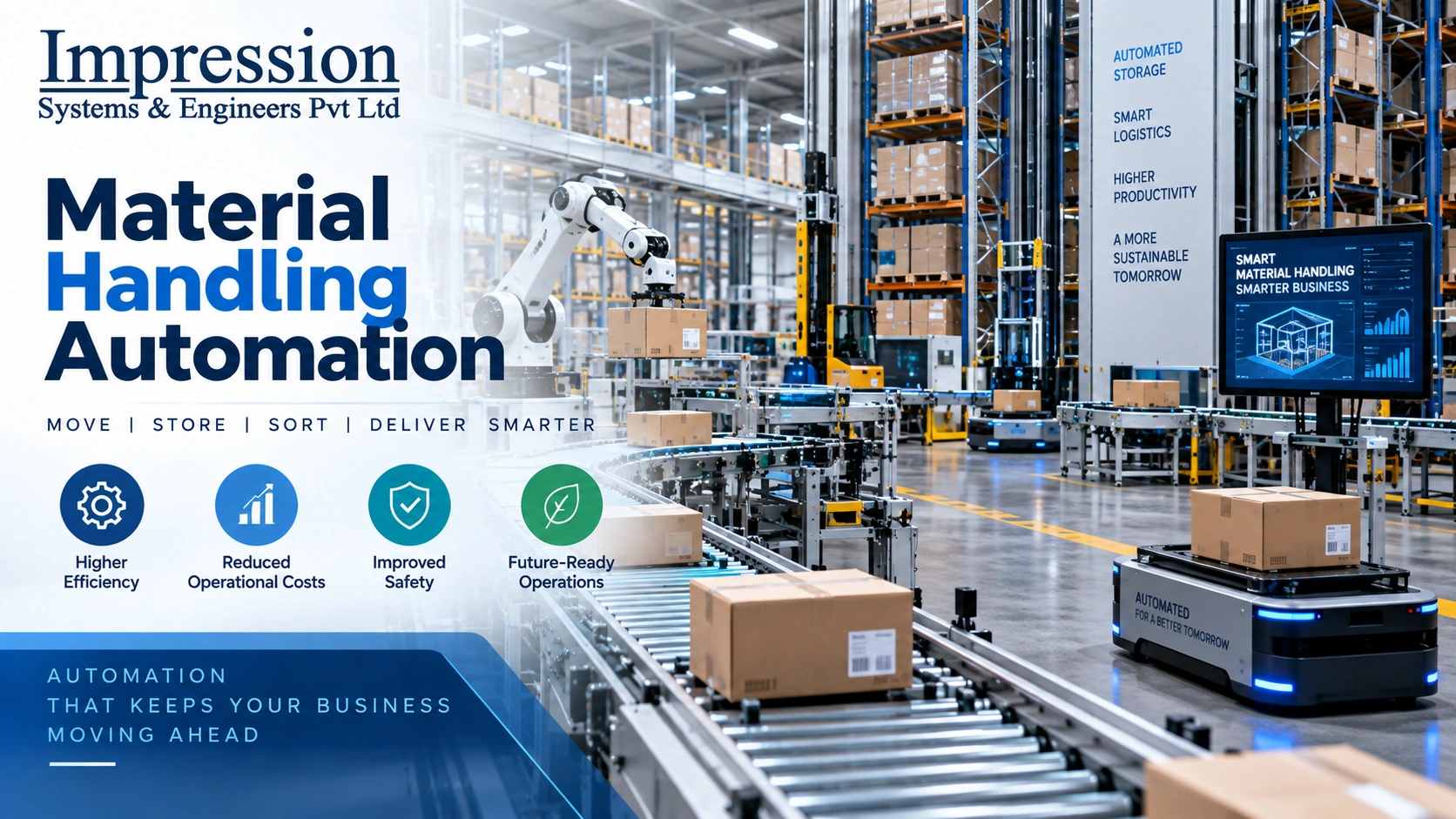
Material handling automation is the use of automated equipment, control systems, software, and connected technologies to move, store, retrieve, sort, or manage materials within a facility with reduced manual intervention.
It is commonly used in:
- Manufacturing plants
- Warehouses
- Distribution centers
- Automotive factories
- Food and beverage facilities
- Pharmaceutical operations
- Appliance manufacturing
- Metal industries
- Logistics facilities
- Packaging and dispatch operations
A material handling automation system may include mechanical equipment, electrical controls, software integration, sensors, motors, conveyors, storage systems, and transportation technologies.
Depending on the application, automated material handling can support:
- Raw material movement
- Component transportation
- Production-line feeding
- Assembly-line handling
- Pallet movement
- Automated storage
- Automated retrieval
- Packaging transportation
- Finished-goods movement
- Internal logistics
- Warehouse-to-production transportation
The correct system depends on the type of material, facility layout, throughput, storage requirements, process sequence, and business objectives.
Why Material Handling Automation Is Important for Modern Industries
Material movement is an essential part of almost every industrial operation.
Even when production equipment is highly advanced, inefficient material transportation can create bottlenecks.
For example, a production line may be capable of producing more units, but if components are not delivered on time, the line may experience interruptions.
Similarly, a warehouse may have sufficient storage capacity but still face delays if materials cannot be retrieved or transported efficiently.
Traditional material handling processes may create challenges such as:
- Excessive manual movement
- Inconsistent transportation times
- Material handling errors
- Limited visibility
- Unnecessary travel distances
- Higher dependence on labor availability
- Poor space utilization
- Production interruptions
- Difficulties in tracking materials
- Limited scalability
Material handling automation addresses these challenges by creating structured and coordinated movement systems.
The goal is to ensure that the right material reaches the right location at the right time.
How Material Handling Automation Works
A typical automated material handling workflow may include several connected stages.
1. Material Receiving
Materials enter the facility through receiving areas.
The system may identify, inspect, register, or route materials according to predefined requirements.
2. Automated Transportation
Conveyors, RGVs, AMRs, lifts, or other transportation systems move materials to the next location.
3. Storage or Production Delivery
Materials may be transferred to automated storage, staging areas, assembly lines, or production stations.
4. Retrieval and Movement
When materials are required, the system retrieves or transports them to the designated destination.
5. Packaging and Finished-Goods Handling
After production, finished goods can be transported toward packaging, storage, or dispatch.
6. Dispatch
Materials are moved to the required dispatch or loading area.
A simplified automated material flow can be represented as:
Receiving → Storage → Retrieval → Production → Packaging → Finished Goods → Dispatch
The actual configuration varies according to the facility and application.
Key Components of Automated Material Handling Systems
Material handling automation is not a single machine. It is a combination of equipment and control technologies working together.
Conveyors
Conveyors are widely used for transporting materials between fixed locations.
They can handle:
- Cartons
- Pallets
- Components
- Boxes
- Industrial products
- Packaged goods
Conveyor selection depends on product weight, dimensions, speed, accumulation requirements, and transfer conditions.
Transfers and Lifts
Transfers and lifts help move materials between different conveyor lines, levels, or process zones.
They can be useful in facilities where materials need to change direction, elevation, or transportation route.
Sensors
Sensors provide information about material position, presence, movement, and equipment conditions.
They help the control system determine when an item has arrived, whether a location is occupied, or whether a process can continue.
PLC Control Systems
Programmable Logic Controllers coordinate automated equipment according to programmed logic.
A PLC can control motors, conveyors, lifts, transfers, and transportation equipment.
For example, a PLC may receive a signal that a pallet has reached a station and then initiate the next movement sequence.
HMI Systems
Human-Machine Interfaces allow operators to monitor equipment and interact with the system.
An HMI can display:
- Equipment status
- Alarms
- Fault information
- Operating conditions
- Process information
- Diagnostic details
Drives and Motors
Drives and motors provide controlled movement for conveyors, rollers, lifts, and other mechanical equipment.
Motion control is important for accurate positioning, smooth transportation, and repeatable operation.
Software Integration
Modern material handling automation often needs to communicate with software systems.
Potential integration platforms include:
- Warehouse Management Systems
- Warehouse Control Systems
- Enterprise Resource Planning systems
- Manufacturing systems
- Production databases
- Industrial IoT platforms
Software integration helps coordinate physical material movement with operational requirements.
Major Types of Material Handling Automation
Different facilities require different automation technologies.
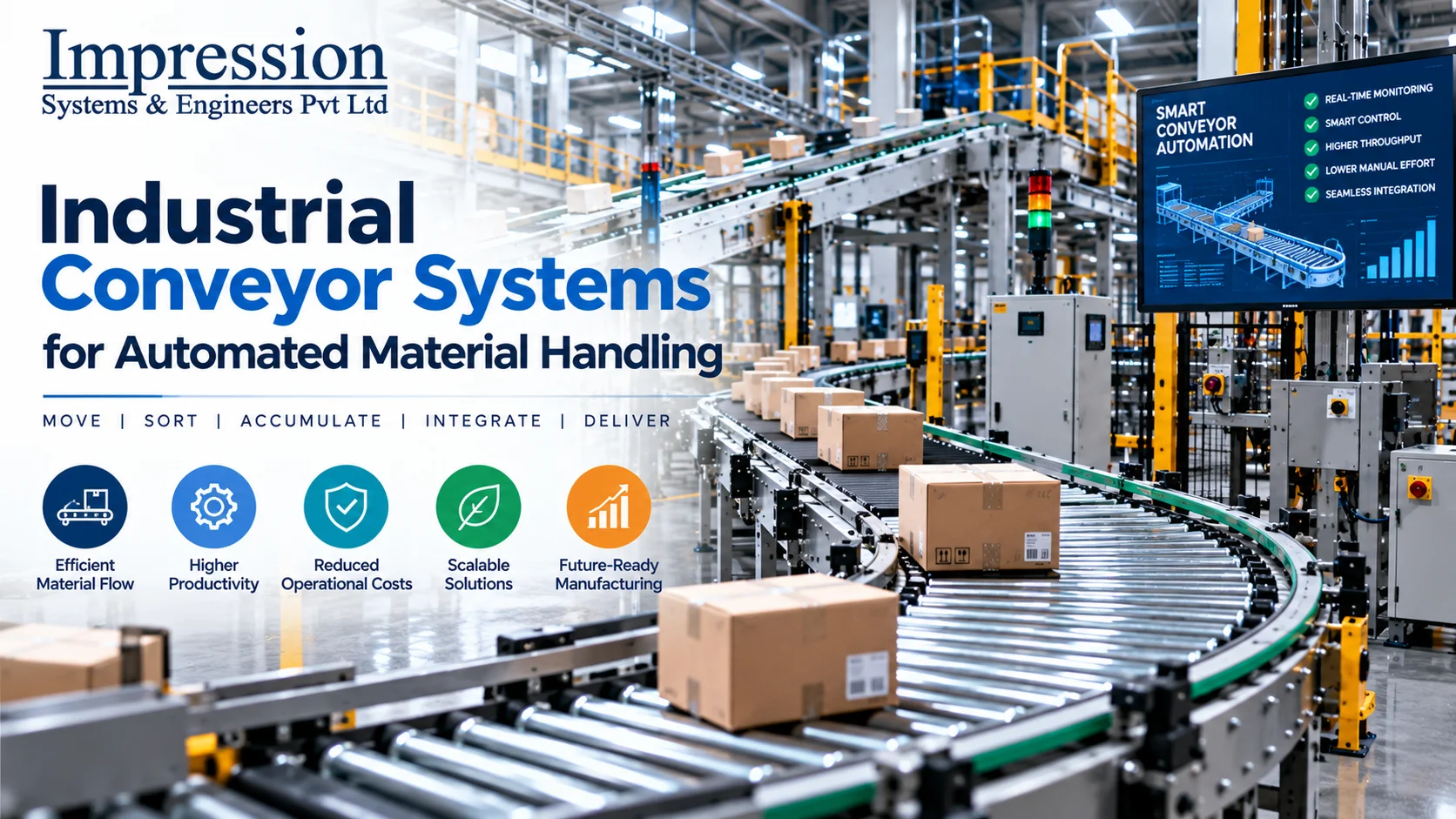
Conveyor-Based Material Handling Automation
Conveyor systems are among the most common material handling automation technologies.
They are suitable for applications involving repeatable movement between fixed locations.
Common applications include:
- Production-line transportation
- Packaging lines
- Pallet movement
- Warehouse transportation
- Assembly-line handling
- Finished-goods transfer
Conveyors can be designed in different configurations depending on the material and facility layout.
Automated Storage and Retrieval Systems
Automated Storage and Retrieval Systems, commonly called AS/RS, automate the storage and retrieval of materials.
AS/RS can help businesses improve storage organization and make better use of available space.
Applications may include:
- Raw material storage
- Component storage
- Finished-goods storage
- Pallet storage
- High-density warehouse storage
The right AS/RS design depends on storage capacity, material dimensions, load weight, throughput, and retrieval frequency.
Rail Guided Vehicle Systems
Rail Guided Vehicles, or RGVs, are automated transportation systems that move materials along predefined rail-guided routes.
RGVs can be suitable for industrial environments requiring repeatable and controlled transportation.
Potential applications include:
- Pallet movement
- Production transportation
- Warehouse transportation
- Storage-system integration
- Inter-zone material transfer
RGV systems are especially useful when transportation routes and destinations are clearly defined.
Autonomous Mobile Robots
Autonomous Mobile Robots, or AMRs, are mobile robotic systems used to transport materials within suitable industrial environments.
AMRs can support:
- Component delivery
- Line-side material supply
- Warehouse transportation
- Internal logistics
- Repetitive material movement
AMRs may offer flexibility in environments where transportation routes change or where fixed infrastructure is less practical.
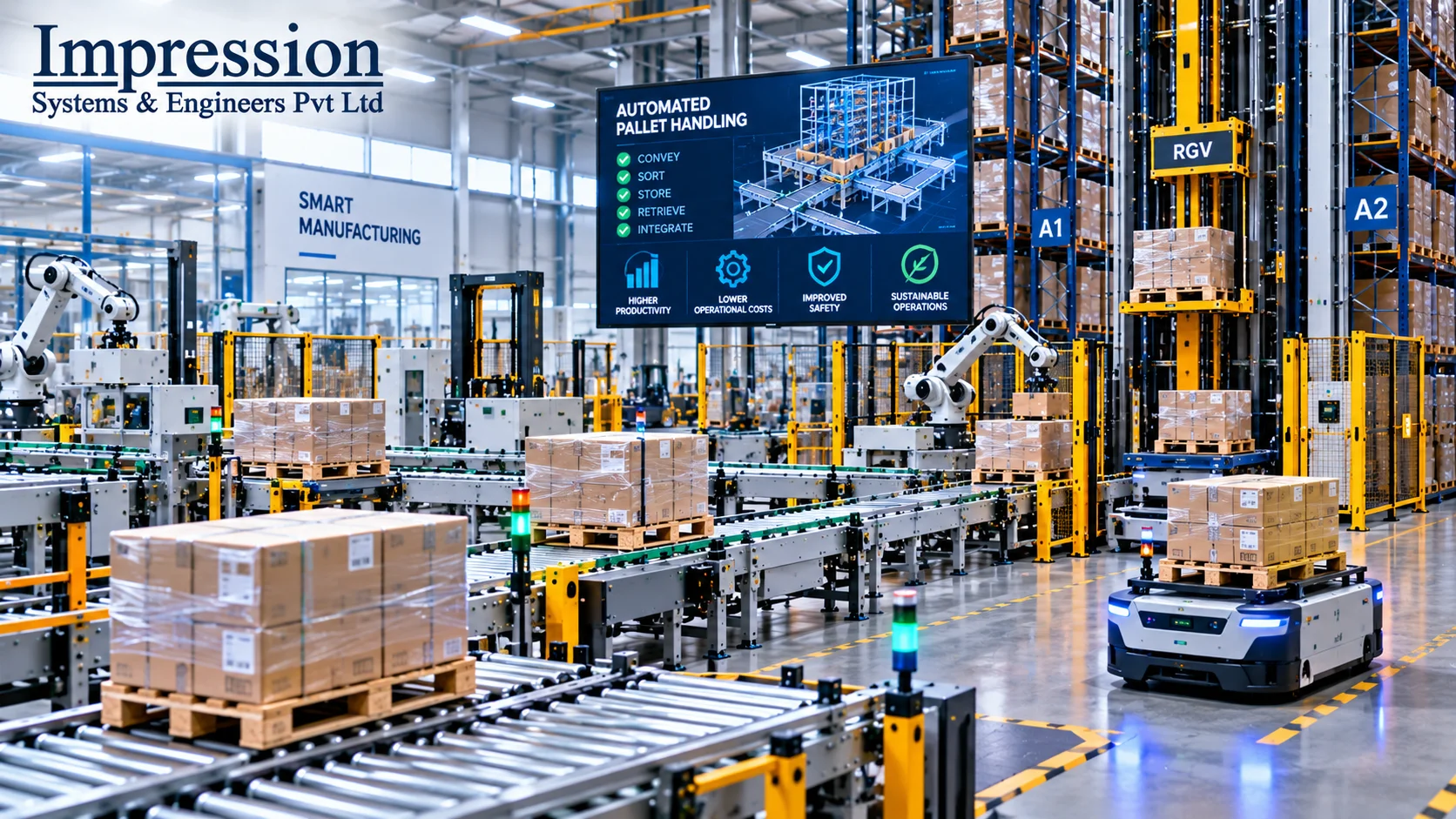
Automated Pallet Handling Systems
Pallet handling automation focuses on the movement, accumulation, transfer, and storage of pallets.
It is commonly used in:
- Food and beverage facilities
- Manufacturing plants
- Distribution centers
- Packaging operations
- Warehouses
Automated pallet handling can help reduce repetitive manual transportation and improve end-of-line efficiency.
Automated Lifting and Vertical Transportation
Vertical transportation systems move materials between different levels of a facility.
They may be used in:
- Multi-level warehouses
- Production facilities
- Storage systems
- Vertical material movement
- Automated retrieval applications
Vertical automation can help businesses make better use of building height and available space.
Benefits of Material Handling Automation
1. Improved Material Flow
Automated systems can create more predictable movement between different process stages.
This can reduce unnecessary transportation delays and improve coordination between production, storage, and dispatch.
2. Increased Productivity
Automation can perform repetitive transportation tasks consistently.
This allows industrial operations to handle material movement more efficiently and support higher throughput where the system is properly designed.
3. Reduced Manual Handling
Automated material handling systems can reduce the need for employees to perform repetitive transportation activities.
This allows personnel to focus on supervision, maintenance, quality control, process improvement, and other higher-value activities.
4. Better Process Consistency
Automated systems operate according to predefined control logic.
This can improve repeatability in material transportation and reduce variations caused by manual handling.
5. Improved Warehouse Space Utilization
Storage automation can help organizations use available floor area and vertical space more efficiently.
High-density storage solutions can be particularly valuable when warehouse space is limited.
6. Improved Safety
Automation can reduce exposure to certain repetitive, physically demanding, or high-traffic material handling activities.
Safety must still be incorporated into equipment design, operating procedures, installation, and maintenance.
The Occupational Safety and Health Administration provides workplace safety resources relevant to industrial environments.
7. Better Material Traceability
When automated systems are integrated with software, businesses can improve visibility into material movement and storage locations.
This can support:
- Inventory tracking
- Material identification
- Process visibility
- Retrieval coordination
- Operational reporting
8. Reduced Operational Bottlenecks
Material handling automation can help address bottlenecks caused by manual transportation, delayed component delivery, inefficient storage, or disconnected processes.
9. Greater Scalability
A well-designed automation system can support future increases in production volume, storage requirements, or material movement.
Scalability should be considered during the initial design stage.
Material Handling Automation in Manufacturing
Manufacturing facilities depend on the timely movement of materials between different production stages.
Even a highly automated production line can be affected by inefficient material transportation.
Material handling automation can connect:
Raw Material Storage → Production Line → Assembly → Testing → Packaging → Finished Goods
Applications may include:
- Component feeding
- Assembly-line transportation
- Production-line transfers
- Pallet handling
- Testing-loop transportation
- Packaging movement
- Finished-goods handling
By coordinating material movement with production requirements, automation can help improve overall workflow efficiency.
Material Handling Automation in Warehouses
Warehouse operations involve receiving, storage, retrieval, picking, packing, and dispatch.
Manual transportation between these stages can create delays and unnecessary movement.
Warehouse material handling automation can use:
- Conveyors
- AS/RS
- RGVs
- AMRs
- Lifts
- Transfers
- Warehouse control systems
- Warehouse management integration
A typical automated warehouse workflow may look like:
Receiving → Identification → Storage → Retrieval → Picking → Packing → Dispatch
The right system depends on product type, order volume, storage capacity, warehouse layout, and operational requirements.
Material Handling Automation for Automotive Manufacturing
Automotive manufacturing requires coordinated movement of components, assemblies, and finished products.
Automation can support:
- Component transportation
- Production-line handling
- Assembly operations
- Testing loops
- Pallet movement
- Storage and retrieval
- End-of-line transportation
Automotive facilities often require systems that provide reliable movement, controlled positioning, and integration with production processes.
Imensys states that it provides automation solutions for both passenger vehicle and commercial vehicle segments.
Material Handling Automation for Food and Beverage Industries
Food and beverage facilities often handle palletized goods and require efficient transportation between production, packaging, storage, and dispatch.
Material handling automation can support:
- End-of-line pallet transfer
- Pallet accumulation
- Warehouse transportation
- Storage
- Finished-goods movement
Imensys highlights end-of-line automation and warehouse automation for palletized goods in the food and beverage industry.
Material Handling Automation for Appliance Manufacturing
Appliance manufacturing involves large products that may require careful handling to prevent damage.
Automation can support:
- Production-line transportation
- Assembly-line handling
- Testing loops
- Packaging
- Finished-product movement
Handling systems should be designed around product dimensions, weight, surface characteristics, and protection requirements.
Imensys describes its appliance-industry solutions as covering production, assembly, testing, and packaging-line handling.
Material Handling Automation for Metal Industries
Metal industries often handle heavy and large materials such as:
- Plates
- Pipes
- Coils
- Slabs
These materials may require specialized handling systems designed around weight, dimensions, surface conditions, and transportation requirements.
Material handling automation can help improve controlled movement within industrial facilities.
Imensys identifies material movement solutions for metal-industry applications involving plates, pipes, coils, slabs, and related materials.
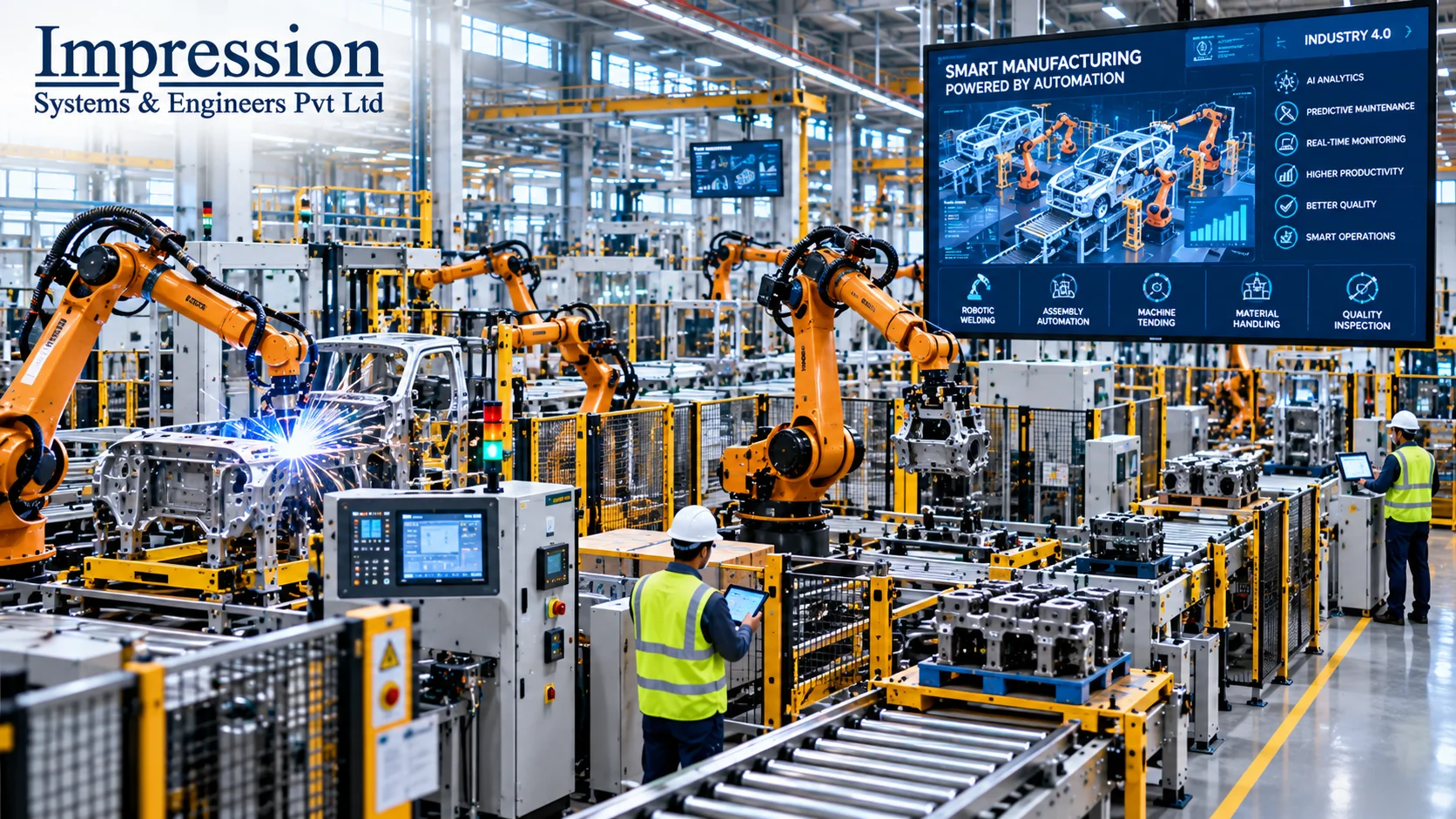
Material Handling Automation and Industry 4.0
Industry 4.0 is driving the development of more connected and intelligent industrial environments.
Material handling automation provides the physical infrastructure needed to move materials, while connected control systems and software provide visibility and coordination.
When integrated with industrial IoT and software platforms, automated material handling systems can support:
- Real-time equipment monitoring
- Material movement tracking
- Operational data collection
- System diagnostics
- Process optimization
- Predictive maintenance
- Digital integration
The National Institute of Standards and Technology (NIST) provides research and resources related to smart manufacturing and advanced manufacturing systems.
Industry 4.0 should not be viewed simply as installing new equipment. The objective is to create a connected system that solves real operational problems.
How to Choose the Right Material Handling Automation System
Selecting the right system requires detailed process analysis.
Step 1: Understand the Material
Analyze the material characteristics.
Consider:
- Weight
- Dimensions
- Shape
- Packaging
- Fragility
- Surface characteristics
- Pallet size
- Handling requirements
The material determines which technologies are suitable.
Step 2: Analyze Material Flow
Map how materials currently move through the facility.
Identify:
- Receiving points
- Storage areas
- Production stations
- Packaging zones
- Dispatch areas
- Bottlenecks
- Manual transportation routes
This helps determine where automation can provide the greatest value.
Step 3: Define Throughput Requirements
Determine how much material needs to move through the system.
Important questions include:
- How many units per hour?
- What is the peak demand?
- What cycle time is required?
- How many destinations are involved?
- What future volume is expected?
Step 4: Evaluate Facility Layout
The facility layout influences the automation design.
Consider:
- Available floor area
- Building height
- Existing machinery
- Production lines
- Storage locations
- Maintenance access
- Emergency access
- Material entry and exit points
Step 5: Determine the Required Automation Technology
Based on the process, the appropriate combination may include:
- Conveyors
- AS/RS
- RGVs
- AMRs
- Lifts
- Transfers
- Pallet handling systems
- PLC controls
- Software integration
The best solution is the one that fits the process—not necessarily the most advanced technology available.
Step 6: Plan Integration
Determine how the automation system will communicate with existing equipment and software.
Potential systems include:
- WMS
- WCS
- ERP
- Production systems
- PLC networks
- HMI systems
- IoT platforms
Integrated systems can improve coordination between physical material movement and business operations.
Step 7: Consider Future Expansion
Automation should be designed with future requirements in mind.
Businesses may need to accommodate:
- Higher production volumes
- Additional storage
- New product types
- More destinations
- Expanded operating hours
- New software systems
A scalable design can reduce the difficulty of future upgrades.
Customized Material Handling Automation vs Standard Systems
Some industrial applications can use standardized automation equipment.
Standard systems may be suitable when:
- Material characteristics are predictable
- The layout is straightforward
- Throughput requirements are common
- The application fits an established design
Customized material handling automation may be more appropriate when:
- The facility has a complex layout
- Materials have unusual dimensions
- Existing machinery must be integrated
- Throughput requirements are specialized
- Multiple processes must be connected
- Product protection is important
- Future expansion is expected
Imensys highlights custom-built automation designed around plant layout, workflow, and performance objectives.
The Role of System Integration in Material Handling Automation
A material handling system should not operate as an isolated machine.
Consider a facility containing:
- Production lines
- Conveyors
- Storage systems
- Transportation equipment
- Packaging machines
- PLCs
- Warehouse software
If these systems do not communicate properly, material flow can become fragmented.
System integration helps coordinate equipment and software so that materials move according to defined workflows.
Integration can involve:
- Equipment communication
- Control-system coordination
- Warehouse software
- Production systems
- Inventory information
- Material routing
- Monitoring platforms
Imensys describes end-to-end integration with WMS, ERP, and production lines as part of its automation approach.
Installation, Commissioning, and Training
Successful material handling automation requires more than equipment manufacturing.
Installation
Equipment must be installed according to engineering drawings, safety requirements, and approved project specifications.
Commissioning
The system should be tested to verify mechanical, electrical, controls, software, and safety functions.
Operator Training
Operators should understand normal operation, alarms, basic troubleshooting, and safety procedures.
Maintenance Training
Maintenance personnel should be trained to inspect, troubleshoot, and support the equipment.
Handover
Documentation, operating procedures, technical information, and training should be included in the handover process.
Imensys lists installation and commissioning, maintenance support, and training and handover among its services.
Maintenance Requirements for Automated Material Handling Systems
Automation systems are long-term operational assets.
Maintenance planning should begin during the design stage.
Important maintenance considerations include:
- Accessibility of components
- Preventive maintenance schedules
- Spare parts availability
- Equipment diagnostics
- Software support
- Inspection requirements
- Replacement procedures
- Emergency response
Regular maintenance can help reduce unexpected downtime and maintain system performance.
A well-designed automation system should be reliable not only during operation but also during inspection, servicing, and repair.
Common Mistakes in Material Handling Automation Projects
Automating Without Process Analysis
Automation should solve a clearly identified operational problem.
If the existing process is inefficient, automating it without redesign may simply reproduce the same inefficiency.
Selecting Technology Before Defining Requirements
Businesses should first understand material characteristics, throughput, layout, and integration needs.
Technology selection should follow process analysis.
Ignoring Peak Throughput
A system designed only for average demand may struggle during peak periods.
Peak throughput should be considered during design.
Focusing Only on Initial Purchase Cost
The lowest equipment price may not represent the lowest lifecycle cost.
Businesses should also consider:
- Installation
- Integration
- Maintenance
- Energy
- Downtime
- Training
- Spare parts
- Future expansion
Poor Integration Planning
Disconnected systems can create delays and manual workarounds.
Integration should be planned from the beginning.
Ignoring Maintenance Access
Equipment must be accessible for inspection, servicing, and replacement.
Maintenance access should be part of the layout and engineering design.
Future Trends in Material Handling Automation
Material handling automation is continuing to evolve as industrial facilities become more connected and data-driven.
Industrial IoT
Connected sensors and equipment can provide operational data for monitoring and analysis.
Autonomous Transportation
AMRs and other autonomous systems can provide flexible transportation in suitable environments.
Intelligent Storage
Automated storage systems are becoming increasingly integrated with warehouse software and inventory platforms.
Predictive Maintenance
Equipment data can potentially help identify abnormal operating conditions before failures occur.
AI-Assisted Optimization
Artificial intelligence may support routing, scheduling, demand analysis, and process optimization.
Flexible Automation
Modern businesses increasingly require systems that can adapt to changing materials, production volumes, and workflows.
The future of material handling automation is moving toward systems that are:
- Connected
- Flexible
- Scalable
- Data-driven
- Efficient
- Easier to monitor
- Better integrated
Why Choose an Experienced Material Handling Automation Company?
Material handling automation projects often involve mechanical engineering, electrical engineering, controls, software, safety, installation, commissioning, and maintenance.
An experienced automation partner can help coordinate these requirements.
When evaluating a material handling automation company, consider:
- Relevant industry experience
- Engineering capabilities
- Customized design capability
- Material handling expertise
- Controls and automation knowledge
- Software integration
- Installation support
- Commissioning experience
- Maintenance services
- Training capabilities
- Long-term support
An integrated approach can simplify project coordination and improve the likelihood of developing a solution that fits the actual facility.
Material Handling Automation Solutions from Imensys
Impression Systems & Engineers Pvt. Ltd. (Imensys) provides industrial automation products and solutions focused on material handling, storage automation, transportation, and industrial process requirements.
The company describes its capabilities as including turnkey and standalone automation solutions for different industrial segments.
Its portfolio includes:
- Material handling solutions
- Storage automation solutions
- Advanced transportation solutions
- Standard industrial automation products
- Custom-built automation
- End-to-end system integration
- Smart control systems
Imensys describes its material handling solutions as designed to streamline the movement of goods, while its storage automation solutions focus on high-density storage, faster retrieval, and integration with WMS/WCS platforms.
Its advanced transportation solutions include RGVs, AMRs, monorails, intelligent controls, and IoT-enabled technologies for industrial intralogistics.
For businesses evaluating automation, the first step is to understand the existing material flow, identify bottlenecks, define throughput requirements, and select a system designed around the facility’s operational objectives.
Frequently Asked Questions About Material Handling Automation
What is material handling automation?
Material handling automation is the use of automated equipment, control systems, software, and connected technologies to move, store, retrieve, and manage materials within a facility with reduced manual intervention.
What are the benefits of material handling automation?
Benefits can include improved material flow, increased productivity, reduced manual handling, better process consistency, improved safety, better space utilization, improved traceability, and greater scalability.
What equipment is used in material handling automation?
Common equipment includes conveyors, AS/RS, RGVs, AMRs, lifts, transfers, pallet handling systems, sensors, PLCs, HMIs, motors, drives, and software integration platforms.
What is the difference between material handling automation and warehouse automation?
Material handling automation is a broader concept covering material movement and management across industrial facilities. Warehouse automation focuses specifically on automated storage, retrieval, transportation, picking, sorting, and dispatch within warehouse environments.
What is an AS/RS system?
AS/RS stands for Automated Storage and Retrieval System. It is an automated system used to store and retrieve materials from designated storage locations.
What is an RGV in material handling?
RGV stands for Rail Guided Vehicle. It is an automated transportation system that moves materials along predefined rail-guided routes.
What are AMRs used for?
Autonomous Mobile Robots are used for flexible material transportation in suitable warehouses, factories, and industrial facilities.
Can material handling automation be customized?
Yes. Systems can be customized according to material characteristics, plant layout, throughput, storage requirements, integration needs, safety considerations, and future expansion plans.
Is material handling automation suitable for manufacturing plants?
Yes. It can support component movement, production-line feeding, assembly operations, testing, packaging, pallet handling, and finished-goods transportation.
How do I choose the right material handling automation system?
Analyze the material, throughput, process flow, facility layout, storage requirements, safety needs, software integration, and future expansion requirements before selecting the technology.
How does material handling automation support Industry 4.0?
Automation provides the equipment and control infrastructure needed for connected industrial operations. When integrated with software, sensors, and industrial IoT platforms, it can support monitoring, data collection, diagnostics, and optimization.
What should I consider when selecting a material handling automation company?
Consider industry experience, engineering capabilities, customization, system integration, installation, commissioning, maintenance, training, and long-term technical support.
Conclusion
Material handling automation is becoming an important part of modern manufacturing, warehousing, logistics, and industrial operations.
By automating the movement, storage, retrieval, and transportation of materials, businesses can improve productivity, process consistency, safety, space utilization, and operational visibility.
Technologies such as conveyors, AS/RS, RGVs, AMRs, lifts, transfers, PLCs, HMIs, industrial IoT, and warehouse software can work together to create efficient and connected material flow systems.
However, successful automation starts with understanding the process.
Businesses should analyze material characteristics, throughput, facility layout, bottlenecks, integration requirements, maintenance needs, and future growth before selecting a system.
The right material handling automation solution is not necessarily the most complex or expensive technology. It is the solution that best fits the facility’s operational requirements and long-term business objectives.
For organizations planning to modernize their material movement, storage, production, or warehouse operations, working with an experienced automation partner can help create a more reliable and scalable industrial environment.
Imensys provides material handling automation, storage automation, advanced transportation, custom-built systems, and integration solutions for industrial applications. Contact the Imensys team to discuss your material handling requirements and explore a solution designed around your facility and business goals.