Warehouse Automation Solutions: A Complete Guide to Smarter Warehousing
Modern warehouses are no longer limited to manually storing products, moving materials, and preparing orders. With rising customer expectations, faster delivery requirements, increasing labor costs, and growing inventory complexity, businesses are adopting warehouse automation solutions to create faster, safer, and more accurate operations.
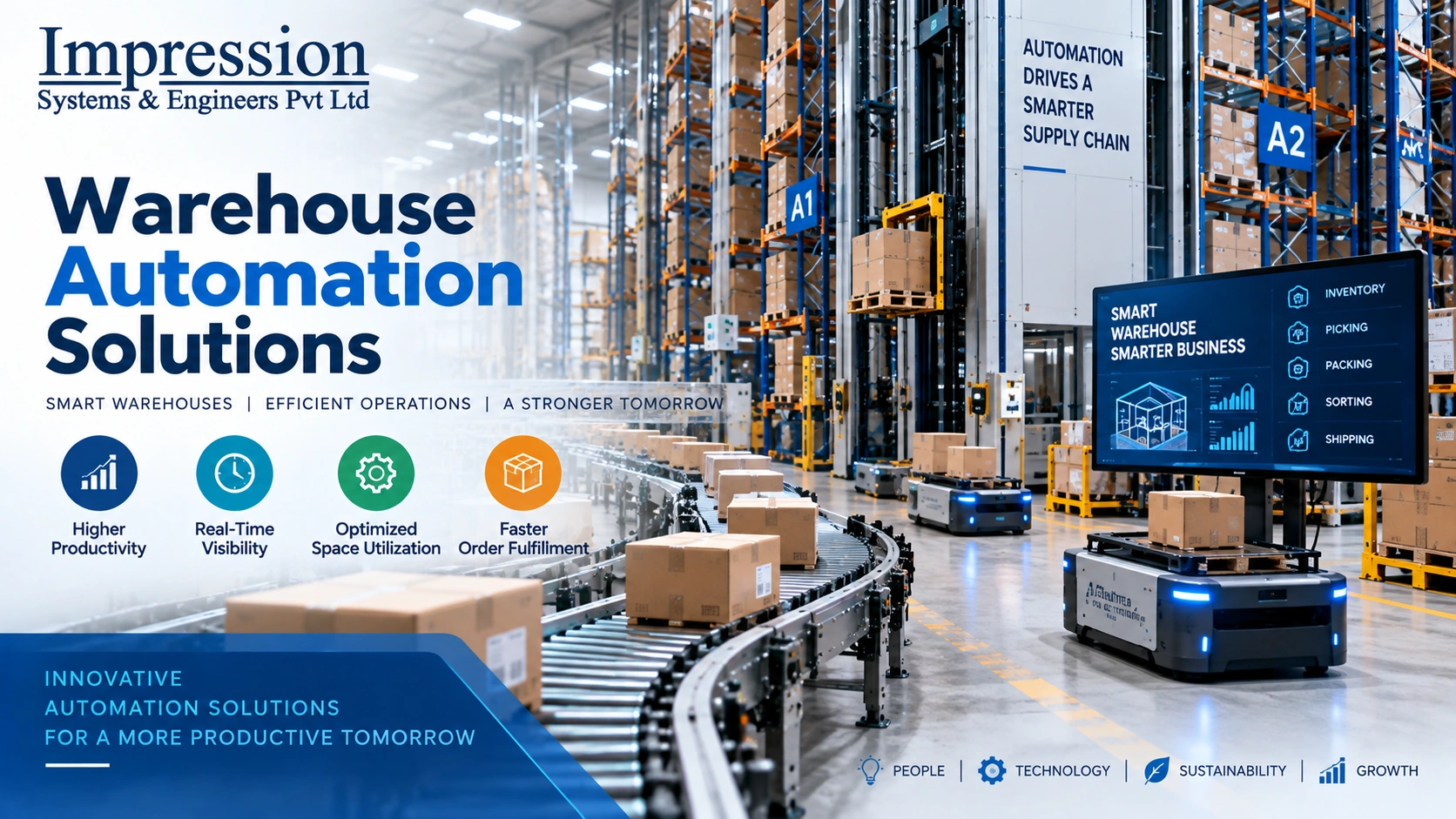
Warehouse automation combines mechanical systems, software, sensors, robotics, controls, and data-driven technologies to automate the movement, storage, retrieval, sorting, and tracking of goods. These solutions help warehouses reduce manual handling, optimize available space, improve inventory visibility, and increase overall productivity.
From automated storage and retrieval systems to conveyor systems, robotic transporters, vertical lifts, and warehouse control software, automation can be customized according to the size, layout, industry, and operational requirements of a facility.
This complete guide explains what warehouse automation solutions are, how they work, their major types, benefits, applications, implementation process, challenges, and how businesses can select the right system.
What Are Warehouse Automation Solutions?
Warehouse automation solutions are integrated technologies and systems designed to automate repetitive warehouse activities such as:
- Receiving materials
- Moving goods between warehouse zones
- Storing products
- Retrieving inventory
- Picking and sorting orders
- Pallet transportation
- Loading and unloading
- Inventory tracking
- Dispatch preparation
- Data collection and reporting
These solutions may involve simple conveyor automation or advanced systems that combine robotics, automated storage, warehouse management software, sensors, and real-time monitoring.
The main objective is not always to eliminate human involvement. Instead, warehouse automation is designed to reduce repetitive manual work and allow employees to focus on activities that require decision-making, supervision, quality control, and exception handling.
A warehouse automation system may operate independently or connect with existing ERP, WMS, MES, barcode, RFID, and production systems.
Why Warehouse Automation Is Important for Modern Businesses
Warehouses are under constant pressure to handle more products in less time while maintaining accuracy and controlling operating costs. Manual processes often create delays, inventory errors, space limitations, and safety risks.
Warehouse automation solutions address these challenges by improving the way products move through the facility.
Key reasons businesses are adopting warehouse automation include:
- Increasing order volumes
- Shorter delivery expectations
- Higher labor costs
- Difficulty finding skilled warehouse workers
- Limited warehouse space
- Need for real-time inventory visibility
- Greater product variety
- Higher accuracy requirements
- Demand for scalable operations
- Improved workplace safety
An automated warehouse can operate with more predictable performance because material movement, storage locations, and retrieval processes are controlled through predefined workflows and intelligent software.
How Do Warehouse Automation Solutions Work?
Warehouse automation generally works through coordination between mechanical equipment, control systems, software, and warehouse operators.
A typical automated workflow may include the following steps:
- Products arrive at the receiving area.
- Barcodes, RFID tags, or other identification systems capture product information.
- The warehouse management system assigns a storage location.
- Conveyors, robots, RGVs, or other transport systems move the material.
- An automated storage system places the product in the assigned location.
- Inventory information is updated automatically.
- When an order is received, the system identifies the required product.
- The storage or retrieval system delivers the product to the picking or dispatch area.
- Sorting, packing, and dispatch activities are completed.
- The system updates inventory and order status in real time.
This connected process helps reduce unnecessary travel, manual data entry, and delays between warehouse activities.
Main Components of Warehouse Automation Systems
A complete warehouse automation solution may contain several integrated components. The exact combination depends on warehouse requirements, product type, throughput, available space, and budget.
1. Conveyor Systems
Conveyors are among the most common warehouse automation technologies. They transport cartons, bins, totes, pallets, and other materials between different warehouse zones.
Common conveyor types include:
- Belt conveyors
- Roller conveyors
- Chain conveyors
- Pallet conveyors
- Slat conveyors
- Flexible conveyors
- Accumulation conveyors
- Vertical conveyors
Conveyor systems reduce manual transportation and create a continuous material flow between receiving, storage, picking, packing, and dispatch areas.
2. Automated Storage and Retrieval Systems
Automated Storage and Retrieval Systems, commonly called AS/RS, use automated machines to store and retrieve goods from designated storage locations.
AS/RS solutions may be designed for:
- Pallets
- Cartons
- Totes
- Bins
- Small parts
- Heavy components
- High-density inventory
These systems improve storage density and reduce the need for manual forklift operations.
3. Automated Guided Vehicles
Automated Guided Vehicles, or AGVs, are mobile systems that transport materials along predefined routes. They may use magnetic guidance, laser navigation, QR codes, wires, or other navigation technologies.
AGVs are useful for:
- Pallet transportation
- Raw material movement
- Repetitive warehouse routes
- Production line replenishment
- Movement between storage and dispatch areas
4. Autonomous Mobile Robots
Autonomous Mobile Robots, or AMRs, use sensors, cameras, mapping systems, and software to navigate dynamically through warehouse environments.
Unlike traditional guided systems, AMRs can often adapt their routes based on obstacles, traffic, and changing workflows.
They are commonly used for:
- Goods-to-person picking
- Tote movement
- Order consolidation
- Internal transportation
- Picking assistance
- Warehouse replenishment
5. Rail Guided Vehicles
Rail Guided Vehicles, or RGVs, operate on fixed rails and are used for fast, controlled transportation of pallets, bins, containers, or components.
RGV systems are suitable for facilities requiring:
- High repeatability
- Accurate positioning
- High-speed transportation
- Multiple loading and unloading stations
- Controlled movement between warehouse zones
6. Vertical Lifts and Vertical Conveyors
Vertical transportation systems move products between different floor levels or elevated platforms.
They are useful in multi-level warehouses and facilities where floor space is limited.
Applications include:
- Connecting mezzanine floors
- Moving pallets between levels
- Vertical carton transportation
- Automated storage access
- Multi-floor order fulfillment
7. Sensors and Identification Systems
Sensors help monitor the position, movement, presence, weight, and condition of materials.
Common technologies include:
- Photoelectric sensors
- Proximity sensors
- Barcode scanners
- RFID readers
- Vision systems
- Load cells
- Safety scanners
- Encoders
These technologies improve tracking accuracy and system reliability.
8. PLC and HMI Control Systems
Programmable Logic Controllers, or PLCs, control machines, conveyors, motors, sensors, and automated sequences.
Human Machine Interfaces, or HMIs, allow operators to monitor equipment status, identify faults, control operating modes, and review system information.
A properly designed PLC and HMI system improves operational control and simplifies troubleshooting.
9. Warehouse Control Software
Warehouse Control Systems, or WCS, coordinate automated equipment and ensure that materials move according to operational priorities.
A WCS may manage:
- Conveyor routing
- Equipment coordination
- Storage and retrieval commands
- Order prioritization
- Traffic management
- Fault monitoring
- System performance data
The WCS may communicate with a Warehouse Management System, ERP, or other business software.
Major Types of Warehouse Automation Solutions
Different warehouses require different levels of automation. The right solution depends on product characteristics, throughput, storage requirements, and process complexity.
1. Conveyor-Based Warehouse Automation
Conveyor-based automation is suitable for warehouses with repetitive and predictable material movement.
It can connect:
- Receiving to inspection
- Inspection to storage
- Storage to picking
- Picking to packing
- Packing to dispatch
Conveyors are commonly used in e-commerce, retail distribution, manufacturing, automotive, and consumer goods warehouses.
2. Automated Storage and Retrieval Solutions
AS/RS is designed to maximize storage density while reducing manual retrieval operations.
Typical benefits include:
- Better use of vertical space
- Reduced forklift movement
- Improved inventory accuracy
- Faster retrieval
- Controlled storage locations
- Reduced product damage
AS/RS can be customized for pallets, cartons, bins, or specialized industrial components.
3. Pallet Automation
Pallet automation focuses on the movement, storage, stacking, and retrieval of pallets.
It may include:
- Pallet conveyors
- Pallet lifts
- Pallet dispensers
- Pallet stackers
- Pallet shuttles
- Automated pallet storage
- Robotic pallet handling
These systems are especially useful in heavy-duty warehouses and distribution centers.
4. Goods-to-Person Automation
In a goods-to-person system, products are automatically brought to an operator rather than requiring the operator to walk through the warehouse.
This approach can improve:
- Picking speed
- Employee productivity
- Order accuracy
- Ergonomics
- Space utilization
Goods-to-person solutions may use AMRs, shuttle systems, vertical lifts, or automated storage equipment.
5. Sortation Automation
Automated sortation systems direct products to the correct destination based on order, route, customer, product type, or dispatch schedule.
Sortation technologies include:
- Sliding shoe sorters
- Cross-belt sorters
- Pop-up wheel sorters
- Tilt-tray sorters
- Divert conveyors
- Robotic sorting systems
Sortation automation is important in high-volume distribution and e-commerce operations.
6. Robotic Picking and Handling
Robots can be used for picking, palletizing, depalletizing, case handling, and product movement.
Robotic systems are especially useful where tasks are repetitive, physically demanding, or require consistent cycle times.
7. Warehouse Transportation Automation
Warehouse transportation systems move materials between storage, production, picking, and dispatch areas.
Examples include:
- RGV systems
- AGVs
- AMRs
- Monorails
- Transfer cars
- Automated trolleys
- Pallet conveyors
These systems reduce manual transportation and improve internal logistics.
Benefits of Warehouse Automation Solutions
Implementing warehouse automation can provide operational, financial, and safety-related benefits.
Improved Productivity
Automated systems can operate continuously and perform repetitive tasks at consistent speeds. This helps warehouses process more materials without proportionally increasing labor requirements.
Higher Inventory Accuracy
Automated identification, storage assignment, and retrieval reduce the possibility of misplaced products and manual data-entry errors.
Better Space Utilization
Automated storage systems can use vertical space and compact layouts more efficiently than traditional storage methods.
Faster Order Fulfillment
Automation reduces travel time, retrieval delays, and unnecessary material handling. This supports faster order processing and dispatch.
Reduced Manual Handling
Employees spend less time moving heavy or repetitive loads, reducing fatigue and improving workplace ergonomics.
Improved Workplace Safety
Automation can reduce forklift traffic, manual lifting, collision risks, and exposure to hazardous warehouse activities.
Better Traceability
Connected software and identification systems make it easier to track products from receiving to dispatch.
Lower Long-Term Operating Costs
Although automation requires an initial investment, it can reduce labor dependency, errors, product damage, and operational inefficiencies over time.
Scalable Operations
Automated systems can be expanded through additional equipment, software upgrades, storage modules, or new process integrations.
Consistent Performance
Automation provides predictable movement and processing, helping businesses maintain stable operational performance during peak periods.
Warehouse Automation Applications Across Industries
Warehouse automation solutions are used in many industries because almost every supply chain requires storage, movement, retrieval, and tracking.
Automotive Industry
Automotive warehouses handle heavy components, assemblies, spare parts, and production materials.
Automation can support:
- Engine component storage
- Sequencing of parts
- Line-side material supply
- Pallet transportation
- Heavy-load handling
- Returnable container movement
- Production warehouse integration
RGVs, conveyors, AS/RS, and automated transport systems are often used in automotive facilities.
Food and Beverage Industry
Food and beverage warehouses require accurate inventory management, hygienic handling, and efficient product movement.
Automation may be used for:
- Carton transportation
- Pallet storage
- Cold-chain logistics
- Batch tracking
- FIFO and FEFO management
- Dispatch sorting
- High-volume order fulfillment
- Pharmaceutical Industry
Pharmaceutical warehouses require traceability, controlled storage, and high accuracy.
Automation can help manage:
- Small-item storage
- Batch identification
- Secure inventory
- Controlled retrieval
- Temperature-sensitive products
- Order verification
- Consumer Goods and Retail
Retail and consumer goods businesses often manage large product varieties and high order volumes.
Warehouse automation supports:
- Carton handling
- Goods-to-person picking
- Automated sorting
- E-commerce fulfillment
- Inventory replenishment
- Dispatch consolidation
- Metal and Engineering Industries
Metal and engineering warehouses often handle heavy, long, or irregular materials.
Automation can be designed for:
- Heavy components
- Steel products
- Industrial parts
- Pallets
- Fabricated assemblies
- Work-in-progress materials
- Electronics and Appliances
Electronics and appliance warehouses require careful handling and accurate product identification.
Automation can reduce product damage and improve the movement of finished goods, components, and packaged products.
Logistics and Third-Party Warehousing
Third-party logistics providers benefit from automation because they must handle multiple customers, product categories, and order profiles.
Automated systems help improve:
- Throughput
- Customer service
- Inventory visibility
- Space utilization
- Order accuracy
- Labor planning
- Role of Industry 4.0 in Warehouse Automation
Industry 4.0 is transforming warehouses into connected, intelligent, and data-driven environments.
Modern warehouse automation solutions may integrate:
- Industrial IoT
- Cloud platforms
- Artificial intelligence
- Machine learning
- Digital twins
- Predictive maintenance
- Real-time analytics
- Robotics
- RFID
- Computer vision
- Advanced warehouse software
Connected systems can provide live information about equipment status, inventory movement, energy usage, order processing, and system performance.
For example, predictive maintenance can identify unusual motor vibration or rising equipment temperature before a major failure occurs. This helps reduce unplanned downtime.
Data analytics can also identify warehouse bottlenecks and reveal opportunities to improve layout, staffing, storage allocation, and order sequencing.
Warehouse Management System and Automation Integration
Warehouse automation works best when equipment is integrated with warehouse management and business systems.
A Warehouse Management System can manage:
- Inventory records
- Storage locations
- Order information
- Picking instructions
- Replenishment
- Dispatch status
- Product identification
- Stock availability
The Warehouse Control System communicates with automated equipment and converts warehouse instructions into machine-level commands.
Integration may also include:
- ERP systems
- Manufacturing Execution Systems
- Production planning software
- Transportation management systems
- Barcode systems
- RFID platforms
- E-commerce platforms
- Enterprise reporting tools
Effective integration prevents data silos and improves visibility across the complete supply chain.
How to Select the Right Warehouse Automation Solution
Choosing a warehouse automation system requires careful analysis. A solution that works well for one facility may not be suitable for another.
Evaluate Material Characteristics
Consider:
- Product dimensions
- Product weight
- Packaging type
- Fragility
- Shape
- Temperature requirements
- Storage life
- Handling restrictions
- Understand Throughput Requirements
Calculate:
- Units received per hour
- Units dispatched per hour
- Peak order volume
- Number of storage and retrieval cycles
- Required processing time
- Seasonal demand variations
- Analyze Warehouse Layout
Review:
- Available floor space
- Ceiling height
- Aisle width
- Loading and unloading points
- Existing equipment
- Structural limitations
- Future expansion possibilities
- Define Accuracy Requirements
Some industries require extremely high inventory accuracy and traceability. This may influence the selection of barcode, RFID, vision, and software systems.
Consider Integration Requirements
The automation system should communicate with existing ERP, WMS, production, and reporting platforms.
Evaluate Safety Requirements
The design should include:
- Emergency stops
- Safety scanners
- Guarding
- Interlocking systems
- Access control
- Safe operating zones
- Operator training
- Consider Future Scalability
The system should be capable of supporting increased order volumes, additional product categories, and future warehouse expansion.
Customized Warehouse Automation Versus Standard Systems
Standard automation systems are useful when warehouse processes are simple and repeatable. However, many industrial facilities require customized solutions because of unique layouts, products, workflows, or production requirements.
Standard Systems
Standard systems may provide:
- Faster implementation
- Predictable configurations
- Lower design complexity
- Common replacement parts
- Established operating methods
- Customized Systems
Customized warehouse automation solutions may be required for:
- Irregular product sizes
- Heavy materials
- Limited space
- Multi-level facilities
- Special storage conditions
- Existing machine integration
- Complex material flow
- Unique production requirements
A customized solution should begin with process analysis, layout planning, equipment selection, control design, and integration planning.
Implementation Process for Warehouse Automation
A successful automation project requires structured planning from concept to operation.
Step 1: Requirement Study
The automation provider studies:
- Current warehouse processes
- Material flow
- Product categories
- Throughput
- Storage requirements
- Operational challenges
- Future growth plans
Step 2: Concept and Layout Design
The proposed system layout defines the location of conveyors, storage systems, transport equipment, workstations, safety zones, and access routes.
Step 3: Technical Design
This stage includes:
- Mechanical design
- Electrical design
- Control architecture
- PLC programming
- HMI development
- Software integration
- Safety design
Step 4: Manufacturing and Assembly
Equipment is manufactured, assembled, tested, and prepared for installation.
Step 5: Installation
The system is installed at the customer’s facility while coordinating with existing operations.
Step 6: Testing and Commissioning
Testing verifies:
- Equipment movement
- Sensor functionality
- Communication
- Safety systems
- Throughput
- Fault handling
- Product tracking
- System integration
Step 7: Training and Handover
Operators and maintenance teams are trained on:
- System operation
- Troubleshooting
- Safety procedures
- Preventive maintenance
- Emergency handling
- Software usage
- Maintenance of Warehouse Automation Systems
Preventive maintenance is essential for reliable warehouse operations.
Maintenance activities may include:
- Motor inspection
- Conveyor belt checks
- Chain and roller inspection
- Sensor cleaning
- Electrical panel inspection
- Lubrication
- PLC backup
- Software health checks
- Safety device testing
- Battery inspection for mobile robots
- Calibration of identification systems
Predictive maintenance technologies can monitor vibration, temperature, current consumption, and operating cycles to identify potential failures early.
A comprehensive maintenance strategy should include:
- Preventive maintenance schedules
- Spare parts planning
- Emergency support
- Remote diagnostics
- Periodic system audits
- Operator training
- Performance monitoring
- Common Mistakes to Avoid When Automating a Warehouse
Warehouse automation projects can face problems when planning is incomplete.
Automating a Poorly Designed Process
Automation should improve a process, not simply reproduce inefficiencies. Businesses should first analyze and simplify workflows.
Ignoring Peak Demand
A system designed only for average volume may fail during seasonal or promotional peaks.
Failing to Plan for Expansion
The design should consider future product growth, additional storage, and increased order volumes.
Underestimating Integration Complexity
Mechanical equipment must communicate properly with WMS, ERP, and other software systems.
Neglecting Employee Training
Operators and maintenance teams must understand how to operate and troubleshoot the system.
Ignoring Maintenance Requirements
Automation reliability depends on planned maintenance, spare parts, and technical support.
Choosing Technology Without Process Analysis
The latest technology is not always the right technology. Equipment should be selected based on actual material flow and operational requirements.
Future Trends in Warehouse Automation
Warehouse automation will continue to evolve as businesses demand faster and more intelligent operations.
Collaborative Robotics
Collaborative robots can work alongside people in picking, packing, inspection, and handling applications.
Artificial Intelligence
AI can improve demand forecasting, route planning, order batching, inventory allocation, and predictive maintenance.
Computer Vision
Vision systems can identify products, inspect packaging, verify labels, and detect damaged goods.
Digital Twins
Digital twins create virtual models of warehouse systems to simulate layouts, traffic, throughput, and operational changes before implementation.
Cloud-Based Warehouse Monitoring
Cloud platforms provide remote access to performance dashboards, alerts, inventory information, and maintenance data.
Energy-Efficient Automation
Modern systems increasingly focus on regenerative drives, efficient motors, optimized routes, and lower energy consumption.
Flexible Mobile Robotics
AMRs and mobile robotic platforms are becoming more adaptable for warehouses with changing layouts and product profiles.
Why Work with an Experienced Warehouse Automation Partner?
Warehouse automation is not only about purchasing equipment. It involves process engineering, system integration, controls, safety, software, installation, commissioning, and long-term support.
An experienced automation partner can help with:
- Requirement analysis
- Warehouse layout planning
- Material flow design
- Equipment selection
- Customized automation
- PLC and HMI development
- WMS and ERP integration
- Safety engineering
- Installation and commissioning
- Operator training
- Preventive maintenance
- Technical support
The right partner should understand both the technical and operational aspects of warehouse management.
Warehouse Automation Solutions from Imensys
Imensys provides industrial automation and material handling solutions designed to improve internal logistics, storage, transportation, and production-related material flow.
Warehouse automation projects may involve a combination of:
- Automated material transportation
- Conveyor systems
- Storage automation
- RGV-based transportation
- AMR and mobile automation
- Vertical transportation
- Smart PLC and HMI controls
- System integration
- Customized automation equipment
- Production and warehouse connectivity
The right warehouse automation solution depends on the customer’s product characteristics, throughput requirements, available space, operational processes, and future expansion plans.
Businesses looking to improve warehouse productivity, reduce manual material handling, increase inventory accuracy, or optimize storage space can evaluate automation as a long-term operational improvement strategy.
For more information, explore the relevant industrial automation and material handling capabilities through the Imensys website.
Frequently Asked Questions About Warehouse Automation Solutions
What are warehouse automation solutions?
Warehouse automation solutions are technologies used to automate the storage, movement, retrieval, sorting, tracking, and handling of goods inside a warehouse or distribution facility.
What are the main types of warehouse automation?
The main types include conveyor systems, AS/RS, pallet automation, AGVs, AMRs, RGVs, vertical lifts, robotic picking, automated sortation, and warehouse control software.
What are the benefits of warehouse automation?
Warehouse automation can improve productivity, storage density, inventory accuracy, order fulfillment speed, workplace safety, traceability, and long-term operational efficiency.
Is warehouse automation suitable for small warehouses?
Yes. Small warehouses can use targeted automation such as conveyors, vertical lifts, barcode systems, compact storage solutions, or mobile robots. Automation does not always require a fully automated facility.
How much does warehouse automation cost?
The cost depends on warehouse size, product type, throughput, equipment selection, software integration, customization, installation, and maintenance requirements. A detailed technical study is required for accurate estimation.
What is the difference between AGVs and AMRs?
AGVs generally follow predefined routes or guidance systems, while AMRs use sensors and navigation software to dynamically select routes and respond to obstacles.
What is AS/RS in warehouse automation?
AS/RS stands for Automated Storage and Retrieval System. It automatically stores and retrieves products from designated storage locations, improving space utilization and inventory control.
Can warehouse automation integrate with ERP and WMS?
Yes. Modern warehouse automation systems can integrate with ERP, WMS, MES, barcode, RFID, e-commerce, and other business software platforms.
Does warehouse automation eliminate warehouse employees?
Warehouse automation usually reduces repetitive manual work rather than eliminating all employees. Human workers are still required for supervision, exception handling, maintenance, quality control, and decision-making.
How can a company start a warehouse automation project?
The first step is to conduct a warehouse process study covering material flow, product characteristics, throughput, storage requirements, layout, current challenges, and future business needs.
Conclusion
Warehouse automation solutions are becoming an important part of modern logistics, manufacturing, distribution, and supply chain operations. By combining conveyors, AS/RS, robotics, RGVs, AMRs, sensors, control systems, and warehouse software, businesses can create faster, safer, more accurate, and more scalable warehouse processes.
The most effective automation strategy is not necessarily the most complex one. It is the solution that matches the warehouse’s material flow, product characteristics, throughput, available space, integration requirements, and long-term goals.
With proper planning, customized engineering, reliable controls, software integration, and ongoing maintenance, warehouse automation can deliver measurable improvements in productivity, inventory accuracy, storage capacity, order fulfillment, and operational consistency.