Warehouse Automation Solutions: The Complete 2026 Guide for Indian Manufacturers
A shift supervisor short two loaders on a Monday. A pallet that got forked wrong and now has a dented SKU nobody wants to ship. A mezzanine that looked like it had room to grow three years ago and doesn’t anymore. If any of that sounds familiar, you’re not alone – it’s the same starting point for most of the warehouse automation solutions conversations we have with Indian manufacturers, whether they’re running a 15,000 square foot unit in an industrial estate or a multi-building facility with its own dispatch fleet.
This guide covers what warehouse automation solutions actually include, the benefits for smaller factories specifically, the difference between AGVs and AMRs (a question that comes up in nearly every consultation), the main system types, how to choose between them, and realistic costs in India. Imensys has designed and commissioned these systems since 2005, across 1,500+ projects, so most of what follows reflects what we’ve seen work on the floor rather than what looks good on a spec sheet.
What Are Warehouse Automation Solutions?
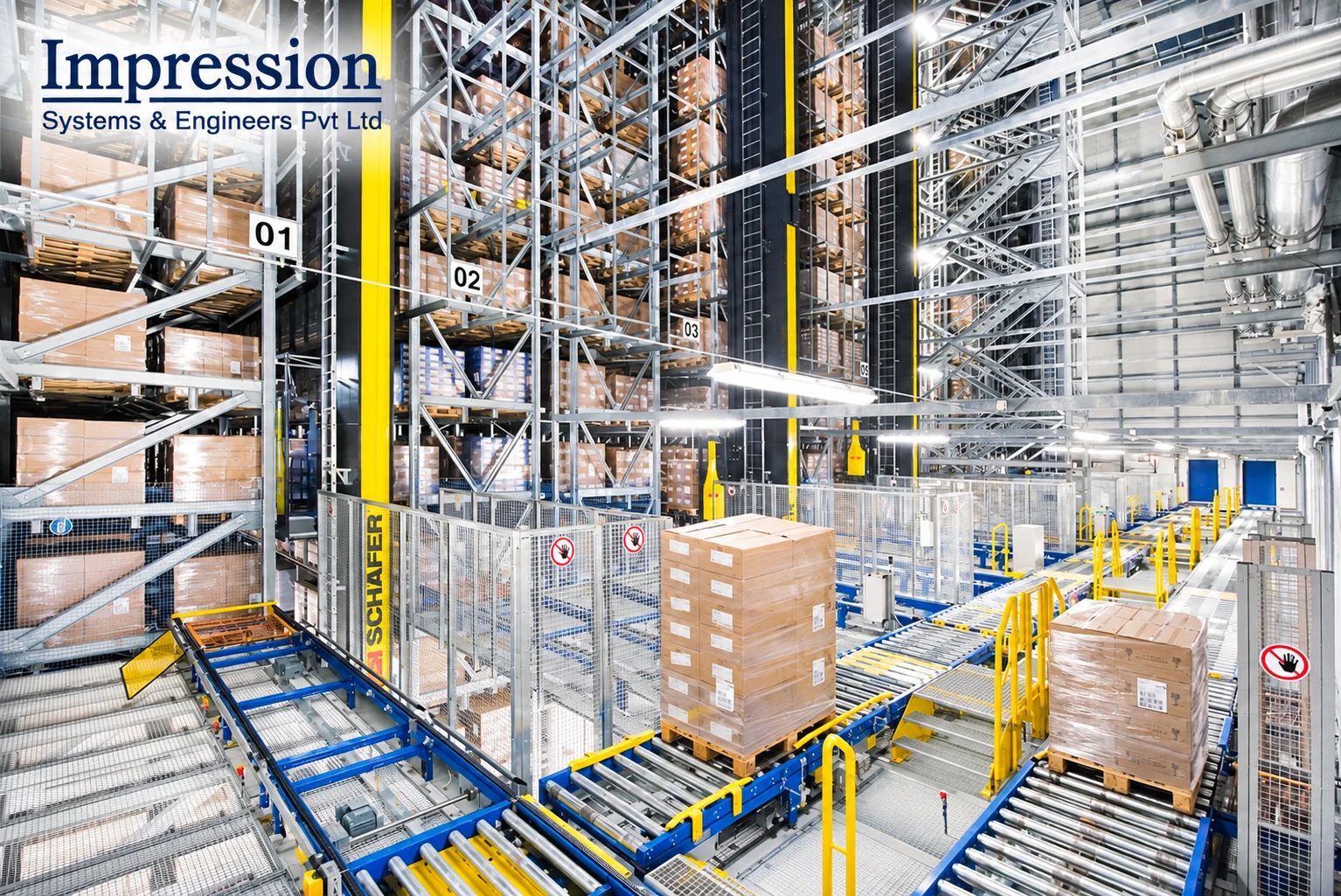
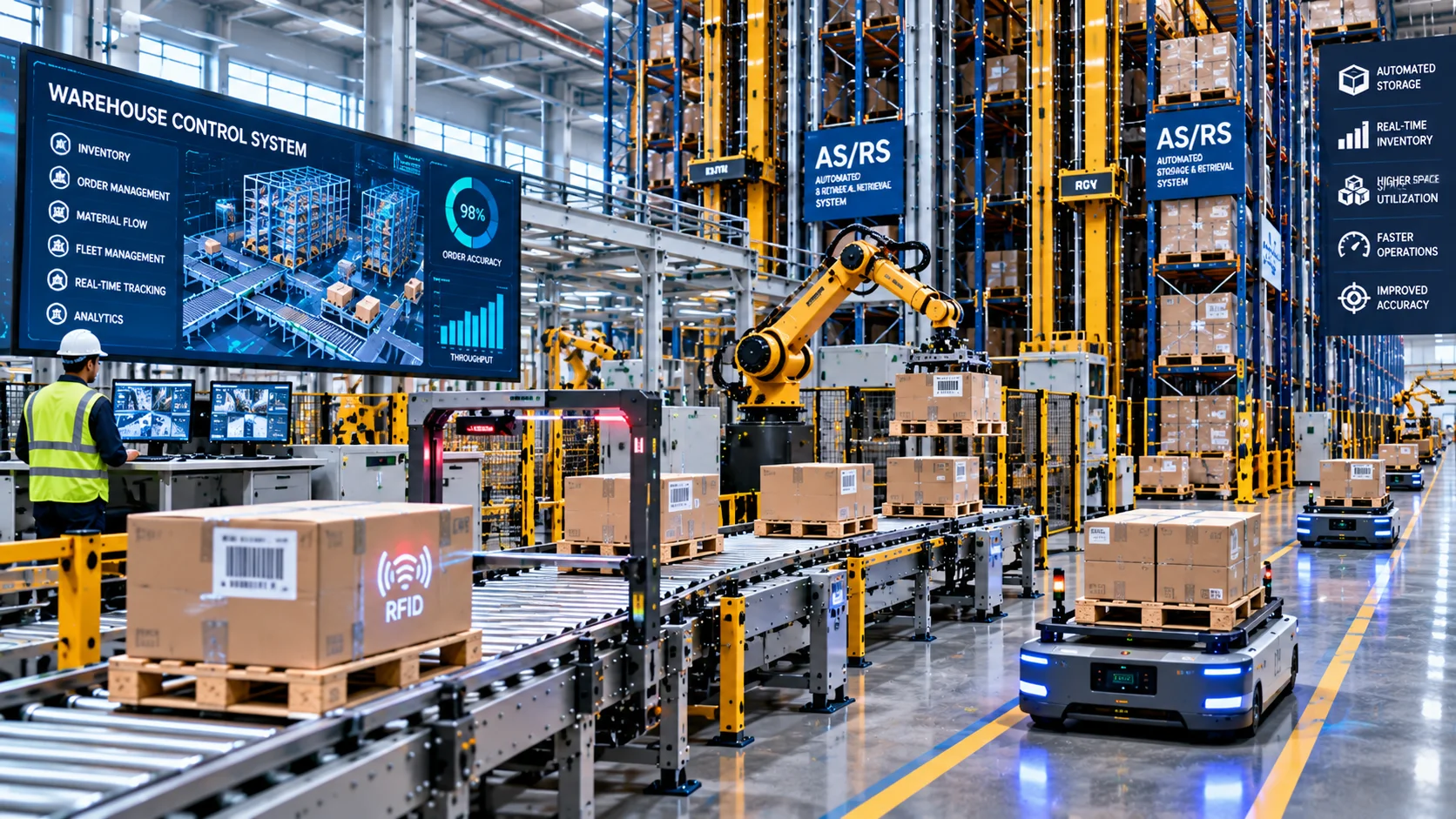
Warehouse automation solutions are the equipment and software systems – conveyors, automated storage and retrieval systems (AS/RS), guided vehicles, and control software – that move, store, and track goods within a warehouse with minimal manual intervention, replacing tasks traditionally done by forklift operators and manual pickers.
The category spans a wide range of investment sizes. On one end sits a simple powered roller conveyor replacing a manual carry-and-stack task. On the other sits a fully integrated AS/RS synchronised with a WMS, tracking thousands of SKUs in real time across multiple aisles. Most warehouses don’t start at either extreme – they automate the single process costing the most in labour, damage, or lost throughput, and expand from there once that first phase proves itself.
Why Are Indian Manufacturers Investing in Warehouse Automation Solutions Now?
Three forces are converging at once. Government-backed research into India’s Industry 4.0 roadmap projects manufacturing’s share of GDP could climb toward 25% – adding roughly a trillion dollars to the economy by 2035 – if manufacturers adopt automation and digital technologies at scale, with the same analysis warning that share could shrink toward 9-10% if adoption stalls instead.
Independent market research values India’s industrial automation market at roughly USD 17.28 billion in 2025, projected to reach around USD 19.19 billion in 2026 and approximately USD 28.73 billion by 2031, growing at an 8.41% compound annual rate – driven largely by modular retrofits with sub-two-year payback windows rather than large greenfield projects. Warehouse and material handling automation is one of the fastest-moving categories within that broader figure, since it typically attacks the most visible bottleneck in a plant: end-of-line palletising or a congested dispatch dock.
Underneath the market numbers is a more practical shift: labour for repetitive, physically demanding warehouse work has become genuinely harder to staff reliably in India’s industrial clusters, where multiple plants compete for the same shift workers. Automation doesn’t remove people from the floor in most of the projects we’ve delivered – it moves them from repetitive lifting and walking into monitoring, quality checks, and exception handling, where they’re generally more useful anyway.
Falling hardware costs are compounding that shift. Sensor and controller prices have dropped enough that brownfield retrofits – automating a section of an existing warehouse rather than building new – are now the dominant project type in India, which matters for smaller operators who don’t have the capital or the floor space for a greenfield build. It’s also worth being upfront that automation isn’t mandatory for every warehouse: a stable, well-staffed operation running fine on manual or semi-manual processes doesn’t need to change just because a market report says the category is growing. It becomes worth acting on once labour reliability, damage rates, or space constraints start showing up as a recurring cost, not a one-off bad week.
What Are the 8 Benefits of Warehouse Automation for Small Factories?
Warehouse automation isn’t only for large enterprises with dedicated capital budgets – smaller factories often see faster, more visible returns precisely because a single bottleneck typically represents a larger share of their total operating friction. Here’s what tends to matter most at smaller scale.
- Lower dependency on hard-to-staff manual labour. A single automated transfer station can absorb work that previously needed two or three loaders per shift, reducing exposure to absenteeism and seasonal staffing shortages.
- Fewer damaged goods and returns. Manual forklift handling is the most common source of pallet and product damage in small plants; automated transfer and stacking removes much of that variability.
- Better use of limited floor space. Vertical storage automation and tighter conveyor layouts free up floor area that a small factory can’t easily expand outward into, especially in built-up industrial estates.
- More accurate inventory counts. Even a modest WMS-integrated system removes the manual counting errors that are disproportionately costly for a small operation running tighter margins.
- Faster order fulfilment without adding headcount. Automating the slowest single step in a pick-pack-dispatch flow often does more for turnaround time than hiring additional staff at the same step.
- Lower entry cost than most owners assume. Standard, pre-engineered products – a transfer unit, a short conveyor run – let a small factory automate one process for a fraction of a full system’s cost, rather than needing a large capital outlay upfront.
- Improved workplace safety. Removing repetitive manual lifting and forklift movement in congested areas reduces the injury risk that’s harder for a small factory to absorb, both in cost and in lost shift-floor capacity.
- A credible growth story for customers and lenders. A documented automation investment, even a small one, is often a meaningful signal to larger customers auditing supplier capability, and can support financing conversations tied to expansion.
The common thread across all eight is that small factories don’t need to automate everything to benefit meaningfully – a single, well-chosen automation project, sized to the actual bottleneck, is usually enough to show up in next year’s numbers.
What Are the Main Types of Warehouse Automation Solutions?
There’s no single “right” system – the right mix depends on what you’re moving, how fast, and how often your layout or SKU mix changes.
| Solution Type | Best For | Typical Lead Time | Relative Cost |
| Conveyor Systems | High-volume, linear product flow (packing, dispatch) | 8-14 weeks | Low-Medium |
| Storage Automation (AS/RS) | High SKU count, limited floor space | 16-24 weeks | Medium-High |
| AGV / AMR / RGV | Variable layouts, inter-zone transport | 12-20 weeks | Medium-High |
| Standard Products | Single, well-defined handling task | 4-8 weeks | Low |
What Is the Difference Between AGV and AMR in Warehouses?
An AGV (Automated Guided Vehicle) follows a fixed physical path – magnetic tape, embedded wire, or laser reflectors – and stops when an obstacle blocks that path. An AMR (Autonomous Mobile Robot) navigates using onboard sensors and mapping software, so it can reroute around obstacles dynamically without any fixed guide infrastructure.
| Factor | AGV (Automated Guided Vehicle) | AMR (Autonomous Mobile Robot) |
| Navigation | Fixed path – magnetic tape, wire, or laser reflectors | Onboard sensors and mapping software, no fixed infrastructure |
| Obstacle handling | Stops and waits until the path clears | Reroutes dynamically around the obstacle |
| Layout changes | Requires reinstalling guide infrastructure | Reprogrammed in software, no physical rework |
| Typical cost | Generally lower per unit | Generally higher per unit, offset by flexibility |
| Best fit | Stable, repetitive routes – e.g. line-side feeding | Facilities with changing layouts or mixed foot/vehicle traffic |
In practice, the choice usually comes down to how stable your layout is. A warehouse with a consistent, repeatable route – moving pallets from a fixed production line to a fixed storage zone – often gets equal reliability from an AGV at a lower cost. A warehouse that shares floor space with foot traffic, changes its layout seasonally, or is still finalising its process flow generally gets more value from an AMR’s flexibility, even at a higher upfront cost per unit.
How Do You Choose the Right Warehouse Automation Solution?
Before comparing vendors or products, it’s worth working through four questions on your own floor – most of the misfires we’ve seen come from skipping this step.
- What’s your actual throughput need, not your peak-day fantasy? Size the system for realistic sustained volume plus a 20-30% growth buffer, rather than for the one chaotic week before a festival or model launch. Oversizing early is one of the most expensive mistakes we see.
- How many SKUs are you handling, and how often does that list change? A plant running a handful of stable SKUs usually gets more value from conveyor-led automation. A plant with hundreds of SKUs and frequent mix changes tends to lean toward AS/RS, where the software handles variability a fixed conveyor layout can’t.
- What’s your budget, and are you funding this in one phase or several? Most plants we work with phase automation over 18-36 months, starting with the highest-friction bottleneck and expanding once that phase is proven on the floor.
- What does your existing WMS/ERP and floor layout actually support? A system that can’t talk to your existing WMS creates a second source of truth for inventory, which is worse than no automation at all – and a layout with narrow aisles won’t accept certain AS/RS shuttle widths without civil rework.
The right answer also shifts by industry. Food & beverage plants tend to prioritise palletised goods transfer and end-of-line automation, since hygiene and damage-avoidance requirements push manual handling out early. Automotive and appliance manufacturers more often combine conveyor systems with precision handling to avoid scratches and marks on finished units. Metal industry plants handling plates, pipes, coils, and slabs treat weight and load-stability as the first constraint, which shapes equipment choice from the outset.
One mistake worth calling out directly: buyers often shortlist equipment before a proper site walk-through, when it should be the other way around. Floor loading capacity, ceiling height, column spacing, and power availability all constrain what’s physically possible before a single conveyor spec gets discussed, and reworking a proposal after a site visit contradicts it costs everyone weeks. We generally recommend against signing off on any automation scope without a physical walk-through first, even if an initial layout drawing looks workable on paper.
How Much Does Warehouse Automation Cost in India?
Costs vary enough by scope that a single number without a proper site assessment is a guess – but useful planning ranges exist. A standard-products retrofit (a transfer unit, turntable, or short conveyor run added to an existing line) typically runs from the low tens of lakhs up to around ₹50-70 lakh, depending on load capacity and control integration.
A mid-sized conveyor system covering a full production-to-dispatch flow, including sortation and basic PLC/HMI controls, generally falls in the ₹80 lakh to ₹3 crore range, driven mainly by conveyor length, number of transfer points, and control complexity. A full AS/RS installation, including racking, stacker cranes or shuttles, and WMS/WCS integration, is the largest single investment category – commonly ₹3 crore to ₹15+ crore for a mid-to-large facility, with rack height, aisle count, and required movements per hour as the biggest cost drivers. AGV or AMR fleets scale by unit count and navigation complexity, typically ₹15-40 lakh per vehicle including fleet management software, with per-unit cost dropping meaningfully at higher fleet sizes.
A few factors push these ranges up or down more than most buyers expect going in: civil work (foundation, flooring load rating), electrical infrastructure upgrades, integration effort with legacy WMS/ERP systems, and – the one people underestimate most consistently – the cost and timeline of operator training and change management. A system that’s technically commissioned but that operators don’t trust yet isn’t delivering ROI; budget time and money for that adoption curve, not just for the steel and software.
It’s also worth asking any vendor for a phase-by-phase cost breakdown rather than a single lump sum, especially on a multi-category project. Separating conveyor work, storage automation, and software integration into distinct line items makes it far easier to identify where a quote is padded, where it’s genuinely justified by scope, and where a phased rollout could defer spend without stalling the project entirely.
What Results Can You Expect from Warehouse Automation?
Government and industry data point to a consistent pattern: factories implementing automation solutions report productivity increases in the range of 15% to 30%, largely from streamlined processes and reduced waste, while manufacturers adopting smart technologies more broadly report operational cost reductions of around 20%.
On one recent end-of-line pallet transfer project for a food & beverage client, moving from manual forklift-based palletising to an automated transfer and stacking system cut average pallet-handling time at that station by roughly 35%, while also reducing product damage claims tied to mishandling. (Figures are representative of typical project outcomes in this category; ask us for a client-specific reference relevant to your industry.)
Across our 1,500+ delivered projects, throughput gains tend to be the headline number clients ask about upfront, but damage reduction and inventory accuracy are usually what clients say mattered most a year after commissioning – because those costs were invisible before automation and painfully visible after, once they stopped happening.
Frequently Asked Questions
Q1. How long does it take to implement a warehouse automation solution?
A1. Standard products can be installed in 4-8 weeks. Full conveyor systems typically take 8-14 weeks, and AS/RS installations run 16-24 weeks depending on rack height, aisle count, and WMS integration complexity.
Q2. Do I need to replace my existing WMS or ERP to automate my warehouse?
A2. Usually not. Most modern automation systems, including ours, are built to integrate with your existing WMS/ERP through a WCS (Warehouse Control System) layer rather than replacing it – though older or heavily customised systems sometimes need an integration audit first.
Q3. Is AS/RS worth it for a mid-sized MSME, or only for large plants?
A3. It depends more on SKU count and floor space constraints than on company size. A mid-sized plant with high SKU variety and limited floor area often sees a faster payback from AS/RS than a larger plant with just a handful of stable SKUs, which may do better with conveyor-led automation instead.
Q4. Can warehouse automation be added in phases, or does it need a full overhaul?
A4. Phasing is the norm, not the exception. Most of our clients start with a single high-friction bottleneck – commonly end-of-line palletising or dispatch – and expand once that phase is running and its ROI is visible on the floor.
Q5. What ongoing maintenance does warehouse automation equipment need?
A5. This depends on the system, but typically includes scheduled mechanical checks (bearings, drive chains, rollers), PLC/software updates, and periodic recalibration of sensors and guidance systems. Unplanned downtime on a live line is far costlier than scheduled maintenance, which is why most vendors, including us, offer maintenance support contracts specifically to avoid it.
Q6. Should a small factory start with AGVs, AMRs, or conveyors?
A6. Most small factories get the fastest payback from conveyors or standard products first, since they usually address the single biggest bottleneck at lower cost and shorter lead time. AGVs and AMRs tend to make more sense once a factory has multiple zones or buildings to connect, which is typically a later-stage investment.
Getting Started
Choosing the right warehouse automation solution comes down to matching real throughput needs, SKU variety, budget, and existing infrastructure to the right combination of conveyors, storage automation, and guided vehicles – not to picking the most advanced system available. Start with your biggest bottleneck, phase the investment, and make sure whatever you install actually talks to the systems you already run.
If you’d like a second opinion on what your warehouse actually needs before you commit to a system, or . You can also explore our , , and product pages, or see how we’ve approached automation in , , , and plants specifically.
Written by Imensys. Imensys has led commissioning on warehouse automation projects across the automotive, food & beverage, and appliance sectors, working directly with plant teams from initial site layout through go-live and operator handover. Connect on .