RGV vs AMR: Which Automated Material Handling System Fits Your Factory?
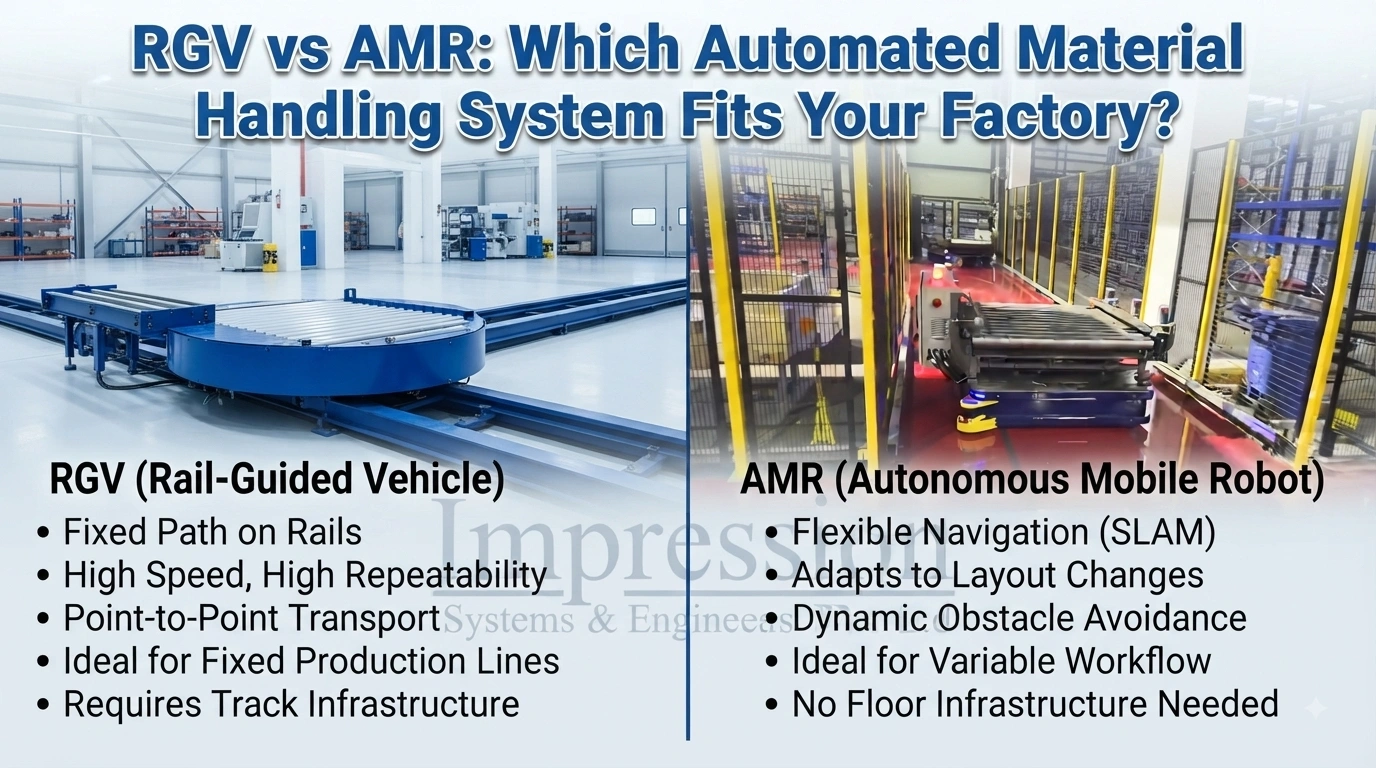
Rail Guided Vehicles (RGVs) and Automated Mobile Robots (AMRs) are both automated material handling systems, but they solve different problems. RGVs run on fixed tracks and deliver high-speed, high-throughput movement for repetitive, high-volume routes, while AMRs navigate freely using sensors and software, making them better suited for flexible, changing layouts. The right choice depends on your production volume, layout stability, and budget.
If you’re evaluating automated material handling for your factory or warehouse, this comparison will walk you through exactly how RGVs and AMRs differ, what each one costs to own and run, which industries they fit best, and how to decide between them — or whether you actually need both.
What Is a Rail Guided Vehicle (RGV)?
A Rail Guided Vehicle (RGV) is an automated transport system that moves along a fixed track or rail, typically embedded in or mounted on the factory floor. RGVs are engineered for repetitive point-to-point movement — think shuttling parts between a stamping line and an assembly station, or transferring pallets between a production line and a storage buffer.
Because the vehicle’s path is physically constrained by the rail, RGVs are known for:
- Precision — they arrive at the exact same position every time, which matters for automated loading/unloading interfaces
- High load capacity — RGVs are often built to carry heavier, larger, or more awkward loads than a typical AMR
- Consistent, predictable cycle times — since the route never changes, cycle times are easy to calculate and rarely vary
- Minimal onboard intelligence required — navigation is handled by the track itself, not by cameras or LiDAR, which keeps the vehicle mechanically simpler
The trade-off is flexibility. Once a rail is installed, changing the route means physically relocating the track — a civil and mechanical job, not a software update.
At Imensys, our Rail Guided Vehicles (RGVs) are built for exactly this kind of high-throughput, fixed-route material transfer, commonly deployed in automotive BIW lines, metal handling, and heavy pallet transfer applications.
What Is an Automated Mobile Robot (AMR)?
An Automated Mobile Robot (AMR) is a self-navigating vehicle that moves through a facility using onboard sensors, cameras, LiDAR, and software-based mapping — without any physical track. AMRs build a live map of their environment and plan routes dynamically, which means they can:
- Reroute around obstacles in real time (a forklift, a pallet, a person)
- Change routes through software, not construction — ideal for facilities that reconfigure layouts often
- Scale incrementally — you can typically add one more AMR to a fleet without touching existing infrastructure
- Work safely alongside people using built-in collision-avoidance sensors
AMRs generally carry lighter to medium loads compared to RGVs and are better suited to environments where flexibility matters more than raw throughput.
Imensys’ Automated Mobile Robots (AMRs) are designed for exactly this — dynamic, sensor-guided material movement across warehouses, food & beverage facilities, and appliance production lines where layouts shift and new product lines get introduced regularly.
RGV vs AMR: Quick Comparison Table
| Criteria | RGV (Rail Guided Vehicle) | AMR (Automated Mobile Robot) |
|---|---|---|
| Navigation | Fixed rail/track | Sensor + software-based (LiDAR, cameras, SLAM) |
| Route Flexibility | Low — route change requires physical rework | High — route change is a software update |
| Upfront Cost | Higher (civil work, rail installation, fixed infrastructure) | Lower to moderate (no fixed infrastructure needed) |
| Cost to Reconfigure | High (physical relocation of track) | Low (remap and redeploy) |
| Throughput | Very high, consistent, predictable | Moderate to high, can vary with traffic/obstacles |
| Load Capacity | Higher — suited to heavy, large, or awkward loads | Lower to moderate — suited to standard pallets, totes, carts |
| Best-Fit Layout | Fixed, stable production lines | Dynamic, frequently changing layouts |
| Scalability | Harder — each new route needs new track | Easier — add more units to existing fleet |
| Safety Around People | Requires guarding/zoning since path is fixed | Built-in dynamic obstacle avoidance |
| Best-Fit Industry | Automotive BIW, metal handling, heavy pallet transfer | Warehousing, food & beverage, appliances, mixed SKU environments |
| Typical ROI Horizon | Longer, but lower cost-per-cycle at high volume | Faster for facilities needing flexibility over raw speed |
Route Flexibility: Fixed Path vs Dynamic Navigation
This is the single biggest differentiator between the two systems.
An RGV’s rail defines its entire operating envelope. If your production layout is stable — the same line, the same stations, running the same process for years — this isn’t a limitation at all; it’s a strength, because the vehicle never has to “decide” anything. It simply executes the same movement, thousands of times, with mechanical precision.
An AMR, by contrast, is built for change. If you’re regularly adding new product lines, reconfiguring warehouse zones for seasonal demand, or running a facility where forklifts, pedestrians, and other equipment share the floor unpredictably, an AMR’s ability to replan its route on the fly becomes essential rather than optional.
Ask yourself: Has your factory layout changed in the last two years, or is it likely to change in the next two? If the answer is no, RGVs are worth serious consideration. If the answer is yes, AMRs will save you significant rework costs down the line.
Cost: Upfront Investment vs Long-Term Value
Cost comparisons between RGVs and AMRs need to separate upfront capital cost from cost over the system’s lifetime.
RGV cost structure:
- Higher upfront investment due to civil work (trenching, rail installation, floor modification)
- Lower cost-per-cycle at high volumes because the vehicle and route are optimized for one specific task
- Reconfiguration costs are significant — moving a rail is closer to a construction project than an IT project
AMR cost structure:
- Lower upfront investment since there’s no fixed infrastructure to install
- Fleet-based pricing means you can start with 2–3 units and scale as demand grows
- Reconfiguration is nearly free from a hardware standpoint — it’s a mapping and software exercise
- Ongoing costs can include fleet management software licensing and periodic sensor calibration
For a factory running one high-volume product line for the foreseeable future, an RGV often has a better long-term cost-per-unit-moved. For a facility managing multiple product lines, seasonal SKU changes, or growth uncertainty, an AMR fleet typically has a lower total cost of ownership because you’re not paying to rebuild infrastructure every time something changes.
Throughput and Speed
RGVs are purpose-built for throughput. Because the route, speed, and stopping points are fixed and known in advance, engineers can tune the system for maximum cycle speed with very little variability — this is why RGVs remain the standard in automotive BIW (Body-in-White) transfer lines, where a few seconds of variability per cycle compounds into major losses across a shift.
AMRs, while fast, share the floor with variables outside their control — other traffic, temporary obstructions, and the time needed to replan a route around them. In a busy, mixed-traffic warehouse, this usually isn’t a meaningful bottleneck. But in a high-speed, high-volume single-product line, an AMR’s flexibility comes at a small throughput cost compared to a purpose-built RGV.
Rule of thumb: If throughput consistency is your top priority and the route never changes, RGVs generally win. If your priority is adaptable capacity across multiple, changing tasks, AMRs generally win.
Safety and Floor Interaction
RGVs operate on a defined path, which means safety planning is largely a matter of physical guarding — fencing, light curtains, and zoning to keep personnel away from the rail during operation. This is a well-understood, mature approach, and it works reliably when the path is genuinely fixed and traffic patterns are controlled.
AMRs are designed from the ground up to operate in dynamic, people-populated environments. Onboard sensors detect obstacles — including people — and the robot slows, reroutes, or stops accordingly. This makes AMRs the more natural fit for facilities where automated and human-operated equipment (forklifts, pallet jacks, pedestrians) regularly share the same floor space.
Scalability and Future-Proofing
Scaling an RGV system means adding more track, more vehicles tuned to that track, and more civil work — a deliberate, planned capital project each time.
Scaling an AMR fleet is largely incremental: add units to the existing fleet management software, and the new robots start operating within the same mapped environment almost immediately. This is a meaningful advantage for companies anticipating growth but uncertain about exactly how their floor layout will evolve.
Integration With WMS, ERP, and Existing Systems
Both RGVs and AMRs can integrate with Warehouse Management Systems (WMS), Enterprise Resource Planning (ERP) platforms, and Warehouse Control Systems (WCS) — but the integration profile differs slightly:
- RGVs typically integrate through PLC-level communication with upstream/downstream equipment (conveyors, robotic arms, storage systems), since they operate as one link in a tightly synchronized line.
- AMRs typically integrate through fleet management software that communicates with your WMS/ERP at the task level — “move this pallet from Zone A to Zone C” — giving warehouse operators more granular, on-demand control.
Imensys designs both systems with end-to-end integration in mind, ensuring smooth data exchange with your existing production or warehouse software rather than operating as a disconnected “island” of automation.
Which Industries Fit RGVs Best?
Based on real deployment patterns, RGVs consistently perform best in:
- Automotive (BIW / Skid Transfer): Fixed, high-speed transfer between stamping, welding, and assembly stations — see our Automotive BIW – Skid Transfer Solutions
- Metal Industry: Moving plates, coils, pipes, and slabs along a defined, repeatable path
- Heavy Pallet Transfer: End-of-line palletized goods movement where the route rarely changes — see our End of Line Pallet Transfer Solutions
- High-Volume, Single-SKU or Low-Mix Production: Any line where the same process repeats thousands of times a day
Which Industries Fit AMRs Best?
AMRs tend to outperform RGVs in:
- Warehousing and Distribution: Multi-zone facilities with changing pick paths, seasonal layouts, and mixed SKU handling — see our Warehouse Automation Solution
- Food & Beverage: Facilities that shift between product lines or run multiple packaging formats
- Appliances: Assembly and testing loops where product mix or line configuration changes periodically
- Facilities With Shared Human/Robot Floor Space: Where safety and adaptability matter more than raw fixed-route speed
Can RGVs and AMRs Work Together?
Yes — and in many real-world factories, the best solution isn’t RGV or AMR, it’s a hybrid deployment.
A common pattern: use an RGV for the high-volume, fixed backbone of a process (for example, moving parts between a stamping line and a buffer zone at high speed), and use AMRs for the flexible, last-mile movement around that backbone (for example, distributing components from the buffer zone to multiple, occasionally-reconfigured assembly stations).
This combination gives you:
- The throughput and precision of a fixed-track system where volume is highest and predictable
- The adaptability of a mobile robot fleet where flexibility is genuinely needed
- A phased automation roadmap — many facilities start with an RGV backbone and add AMRs later as they identify flexible zones that would benefit from dynamic routing
If you’re planning a new facility or retrofitting an existing one, it’s worth mapping out which parts of your material flow are truly fixed and repetitive versus which parts change regularly — that map alone often reveals where an RGV, an AMR, or both make the most sense.
A Practical Cost Scenario: RGV vs AMR Over 5 Years
Numbers help make this comparison concrete. Consider two hypothetical but realistic scenarios based on typical mid-size Indian manufacturing facilities:
Scenario A — Fixed high-volume line (favors RGV): A facility running one automotive sub-assembly line, moving the same part between two fixed stations roughly 500 times per shift, with no planned layout changes for at least five years. Here, the upfront cost of rail installation is spread across a very high number of cycles, and the RGV’s precision keeps rework and misalignment losses near zero. Over five years, the cost-per-cycle is typically lower than an equivalent AMR deployment would achieve, because the AMR would need continuous route planning and obstacle handling for a task that never actually changes.
Scenario B — Multi-zone warehouse with seasonal SKU shifts (favors AMR): A distribution facility that adds new pick zones every peak season and reconfigures shelving layouts twice a year. Installing and relocating RGV track for this facility would mean repeated civil work — new trenching, realignment, and downtime — every time the layout shifts. An AMR fleet, by contrast, is remapped in days rather than weeks, and additional units can be added incrementally as volume grows. Over five years, the avoided reconfiguration cost alone often outweighs the AMR’s marginally higher cost-per-cycle.
The takeaway: don’t compare RGV and AMR purely on sticker price. Model the cost across the expected lifetime of your layout, including how many times you’re likely to reconfigure, add capacity, or shift product lines. That single variable — layout stability — is usually the strongest predictor of which system delivers better economics for your specific facility.
Common Mistakes Companies Make When Choosing Between RGV and AMR
After working across automotive, food & beverage, appliance, and metal handling facilities, a few recurring mistakes stand out:
1. Choosing based on initial cost alone. An AMR’s lower upfront price can look attractive, but if your process is genuinely fixed and high-volume, you may end up paying more per cycle over time than a properly sized RGV would have cost.
2. Underestimating future layout changes. Facilities often install RGV track assuming a line will “never change,” only to redesign the process 18 months later. If there’s any realistic chance of reconfiguration, that risk needs to be priced into the decision, not treated as a footnote.
3. Ignoring load characteristics. AMRs are sometimes selected for tasks involving heavy, oversized, or irregular loads — like metal coils or automotive skids — where their payload and stability limits create bottlenecks or safety concerns that a properly rated RGV wouldn’t have.
4. Treating it as an either/or decision. As covered above, many of the best-performing facilities blend both systems. Companies that assume they must pick one system for the entire facility often end up over-engineering flexible zones with RGV infrastructure, or under-engineering high-volume zones with AMR fleets that can’t keep pace.
5. Skipping the integration conversation. Both systems need to talk to your WMS, ERP, or line PLCs to deliver real value. Choosing a system without confirming integration compatibility with your existing software stack is one of the most common causes of automation projects underperforming their business case.
What to Ask Before You Commit
Before finalizing a decision, it’s worth walking through these questions with your automation partner:
- What is the expected lifespan of the current layout, and how confident are we in that estimate?
- What is the true cost of downtime if this route needs to be physically reconfigured later?
- What load types, weights, and dimensions does this system need to handle — today and over the next 3–5 years?
- How will this system integrate with our existing WMS, ERP, or line-level PLC controls?
- Do we have zones where a hybrid RGV + AMR approach would outperform a single-system deployment?
- What is the realistic timeline from order to full operational deployment for each option?
Getting clear, specific answers to these questions — ideally backed by a site assessment rather than a generic catalog comparison — is what separates automation projects that hit their ROI targets from ones that don’t.
Decision Checklist: How to Choose Between RGV and AMR
Use this checklist to guide your decision:
- Is your production layout stable and unlikely to change for 3+ years? → Lean RGV
- Do you expect to reconfigure zones, add product lines, or scale unpredictably? → Lean AMR
- Is raw throughput and cycle-time consistency your top priority? → Lean RGV
- Do you need automation to share floor space safely with people and forklifts? → Lean AMR
- Are you moving heavy, large, or awkward loads (e.g., BIW skids, metal coils)? → Lean RGV
- Are you moving standard pallets, totes, or cartons across a warehouse? → Lean AMR
- Is your budget more sensitive to upfront capital cost than long-term cost-per-cycle? → Lean AMR
- Do you have both a fixed high-volume core process and flexible surrounding tasks? → Consider a hybrid RGV + AMR deployment
Conclusion
Neither RGVs nor AMRs are universally “better” — they’re built to solve different problems. RGVs deliver unmatched throughput, precision, and load capacity on fixed, high-volume routes, making them the standard choice in automotive and metal handling. AMRs deliver flexibility, faster deployment, and safer operation in dynamic, shared, and evolving environments, making them the standard choice in modern warehousing and mixed-SKU production.
The right starting point is an honest look at your layout stability, volume, and growth plans — not the technology itself. Many of the most efficient factories we’ve worked with use both, in combination, rather than treating it as an either/or decision.
Not sure which system — or combination — fits your specific factory layout and volume? Our engineers can assess your process and recommend the right mix of RGV and AMR automation for your facility.
Frequently Asked Questions
Is an AMR more expensive than an RGV?
Not necessarily — it depends on the comparison basis. AMRs typically have a lower upfront cost since they don’t require fixed track installation or civil work. RGVs, however, often have a lower cost-per-cycle at high production volumes because the system is optimized for one specific, repetitive task. For facilities with stable, high-volume needs, an RGV can be more cost-effective long-term. For facilities needing flexibility or planning to scale gradually, an AMR fleet is usually the lower total-cost option.
Can RGVs and AMRs work together?
Yes. A common and effective approach is to use an RGV for the fixed, high-throughput backbone of a process and AMRs for flexible, last-mile movement around it. This hybrid model combines the speed and precision of a fixed-track system with the adaptability of a mobile robot fleet, and many facilities adopt it in phases as their automation needs evolve.
Which is safer around workers — an RGV or an AMR?
AMRs are generally better suited to environments where people and machines share floor space, since they use onboard sensors to detect and avoid obstacles, including people, in real time. RGVs can operate safely around people too, but this typically requires additional physical guarding, fencing, or zoning since the vehicle’s path is fixed and doesn’t dynamically reroute.
How long does it take to install an RGV vs deploy an AMR?
RGV installation involves civil work — track installation, floor modification, and integration with the surrounding line — which typically takes longer to plan and install. AMR deployment is generally faster since it doesn’t require fixed infrastructure; once the facility is mapped, robots can often be operational within a shorter timeframe.
What load capacity can an RGV handle compared to an AMR?
RGVs are generally engineered for heavier, larger, or more awkward loads — such as automotive BIW skids or metal coils — because the fixed rail and mechanical design support higher load ratings. AMRs typically handle standard pallets, totes, or carts, with load capacities suited to warehousing and general material transport rather than heavy industrial loads.
Do I need a Warehouse Management System (WMS) to use an AMR?
While an AMR can technically operate with standalone fleet management software, most facilities get the most value by integrating it with an existing WMS or ERP system, allowing tasks to be assigned and tracked automatically rather than manually.
Have questions about which automated material handling system fits your facility? Contact the Imensys team for a tailored recommendation based on your layout, volume, and industry.