Industrial Automation Solutions: A Complete Guide for Modern Industries
Industrial automation solutions are transforming the way modern factories, warehouses, manufacturing plants, and material handling facilities operate. By combining automation equipment, control systems, software, sensors, conveyors, storage technologies, and intelligent transportation systems, businesses can streamline processes, improve productivity, reduce unnecessary manual intervention, and build more scalable industrial operations.
For companies looking to modernize their facilities, industrial automation is no longer limited to automating a single machine or repetitive task. Today’s automation systems can connect production lines, material handling equipment, warehouse storage, transportation systems, control platforms, and business software into one coordinated operating environment.
This makes industrial automation solutions increasingly important for organizations working toward greater efficiency, improved material flow, better operational visibility, and Industry 4.0 readiness.
In this guide, we explain what industrial automation solutions are, how they work, the technologies involved, their benefits, industry applications, implementation considerations, and how businesses can choose the right automation partner.
What Are Industrial Automation Solutions?
Industrial automation solutions are integrated systems designed to automate, control, monitor, and optimize industrial processes with reduced dependence on manual intervention.
An automation solution can combine mechanical equipment, electrical systems, sensors, programmable logic controllers (PLCs), human-machine interfaces (HMIs), drives, conveyors, automated storage systems, robotics, transportation systems, industrial IoT technologies, and software.
Depending on the application, industrial automation solutions can be used for:
- Manufacturing processes
- Production-line automation
- Material handling
- Warehouse automation
- Automated storage and retrieval
- Packaging
- Pallet transportation
- Assembly operations
- Testing and inspection
- End-of-line operations
- Internal logistics
- Industrial data monitoring
The objective is not simply to install machines. A successful automation project connects equipment and processes in a way that solves specific operational challenges.
For example, a manufacturing facility may use automated conveyors to move components between production stations, an automated storage system to manage inventory, and an RGV or AMR to transport materials between different zones.
The result can be a more coordinated flow of materials throughout the facility.
Why Industrial Automation Solutions Matter for Modern Industries
Industrial facilities are becoming increasingly complex.
Manufacturers and warehouse operators need to manage higher production volumes, shorter delivery expectations, increasing product variety, space constraints, labor requirements, quality expectations, and the need for better operational information.
Traditional manual processes can become difficult to scale when material volumes and process complexity increase.
Industrial automation solutions can help businesses address these challenges by creating more structured and repeatable workflows.
Common automation objectives include:
- Increasing throughput
- Improving process consistency
- Reducing unnecessary material movement
- Improving storage utilization
- Supporting workplace safety
- Improving traceability
- Reducing process interruptions
- Increasing operational visibility
- Connecting production and warehouse operations
- Preparing facilities for future growth
The right automation strategy depends on the specific process rather than simply selecting the newest technology.
Key Technologies Used in Industrial Automation Solutions
Modern industrial automation solutions can combine several technologies. Each technology performs a specific role within the overall system.
PLC-Based Industrial Automation Systems
A Programmable Logic Controller, commonly called a PLC, is a fundamental component in many industrial automation systems.
A PLC receives information from sensors and other devices, processes programmed logic, and sends commands to machines and equipment.
PLCs can control applications involving:
- Conveyors
- Motors
- Transfers
- Lifts
- Actuators
- Automated transportation systems
- Production machinery
For example, sensors may detect that a pallet has reached a particular position. The PLC can process that information and instruct the appropriate equipment to perform the next operation.
This enables repeatable and controlled industrial processes.
HMI in Industrial Automation Solutions
A Human-Machine Interface, or HMI, allows operators to interact with automated equipment.
An HMI can provide information such as:
- Machine status
- Production status
- System alarms
- Fault information
- Operating conditions
- Diagnostic information
Operators can use the interface to monitor equipment and perform permitted control functions.
A well-designed HMI can make complex industrial automation systems easier to operate and troubleshoot.
Sensors and Industrial Automation Equipment
Sensors provide information about equipment and materials.
Depending on the application, sensors can detect:
- Product presence
- Position
- Distance
- Speed
- Temperature
- Pressure
- Object orientation
- Machine conditions
The information generated by sensors allows automation systems to respond to actual process conditions.
This is an important part of creating reliable automated workflows.
Industrial Drives and Motion Control
Many industrial automation solutions depend on precise movement.
Motors and drives can control the movement of conveyors, rollers, lifts, transportation equipment, and production machinery.
Motion-control requirements depend on the application.
A high-speed production line may require precise speed control, while a material handling application may prioritize controlled acceleration, positioning, and safe transportation.
Industrial Communication and Connectivity
Modern automation systems increasingly require communication between different machines and software platforms.
Industrial communication allows equipment to exchange information and coordinate operations.
Depending on the project, automation systems may need to communicate with:
- PLCs
- HMIs
- SCADA systems
- Warehouse Management Systems
- Warehouse Control Systems
- ERP platforms
- Manufacturing systems
- Industrial IoT platforms
Connectivity is especially important when businesses want to create integrated Industry 4.0 environments.
Types of Industrial Automation Solutions
Industrial automation covers a broad range of applications.
Manufacturing Automation Solutions
Manufacturing automation focuses on automating production and manufacturing processes.
Applications may include:
- Assembly-line automation
- Production-line handling
- Component movement
- Testing loops
- Product inspection
- Packaging
- Pallet handling
- End-of-line transportation
Automation can help manufacturers create repeatable processes and coordinate material movement between different production stages.
Material Handling Automation Solutions
Material handling automation focuses on the movement of products, components, pallets, and other materials inside industrial facilities.
Automated material handling solutions can include:
- Conveyor systems
- Transfers
- Lifts
- Pallet handling systems
- RGVs
- AMRs
- Automated storage systems
The objective is to create an efficient flow of material between different areas.
For example:
Receiving → Storage → Production → Packaging → Finished Goods → Dispatch
Automation can connect these stages and reduce unnecessary manual transportation.
Warehouse Automation Solutions
Warehouse automation solutions use automated equipment, control systems, and software to improve storage and movement within warehouses.
Applications can include:
- Automated storage
- Automated retrieval
- Material transportation
- Sorting
- Pallet movement
- Production-to-warehouse transportation
- Warehouse-to-production transportation
Warehouse automation can become particularly valuable when businesses face limited floor space, high material volumes, or increasing requirements for faster retrieval.
Storage Automation Solutions
Storage automation is designed to improve how materials are stored and retrieved.
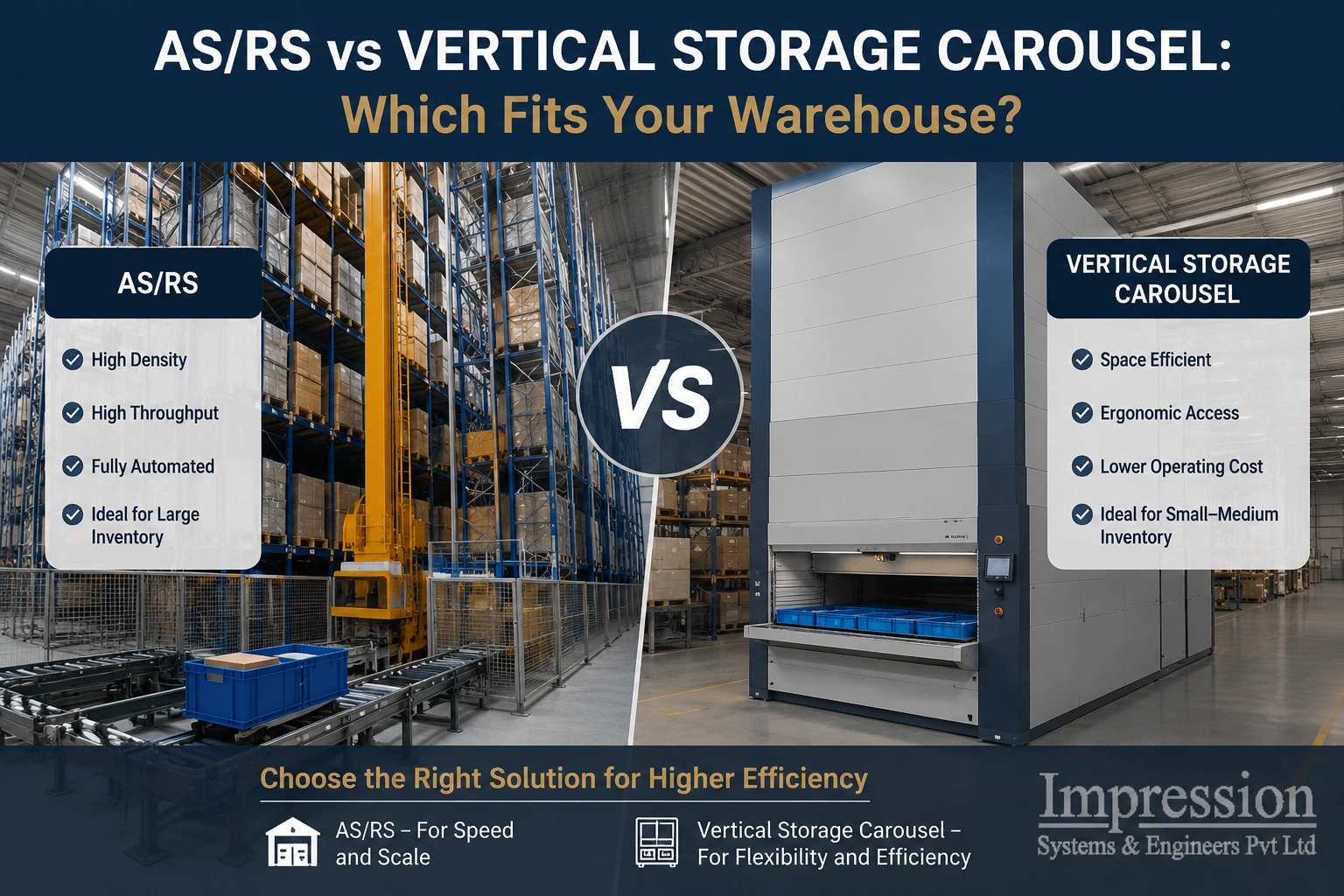
One important technology is the Automated Storage and Retrieval System, or AS/RS.
AS/RS technology can be used to automate the storage and retrieval of materials while supporting high-density storage.
The appropriate system depends on factors such as:
- Product dimensions
- Product weight
- Storage capacity
- Throughput
- Retrieval frequency
- Available facility space
- Integration requirements
Businesses should evaluate these factors before selecting a storage automation system.
End-of-Line Automation Solutions
End-of-line automation focuses on processes performed near the end of production or packaging.
These processes may include:
- Product transfer
- Packaging
- Pallet handling
- Product accumulation
- Inspection
- Finished-goods transportation
End-of-line automation can create a connection between manufacturing and warehouse operations.
How Industrial Automation Solutions Support Industry 4.0
Industry 4.0 is associated with connected, intelligent, and data-driven industrial operations.
Traditional automation primarily focused on controlling equipment.
Modern industrial automation increasingly connects equipment, software, data, and processes.
This creates opportunities for:
- Real-time monitoring
- Operational data collection
- Equipment diagnostics
- Process optimization
- Digital integration
- Improved traceability
- Predictive maintenance
- Data-driven decision-making
The National Institute of Standards and Technology (NIST) provides extensive research and resources related to smart manufacturing and advanced manufacturing technologies.
Industrial automation provides the physical and control infrastructure that can support these connected manufacturing environments.
However, Industry 4.0 should not be approached simply as a technology upgrade.
Businesses should first identify the operational problem they want to solve and then select the technologies that support that objective.
Benefits of Industrial Automation Solutions
1. Improved Industrial Productivity
Industrial automation solutions can automate repetitive activities and create consistent process cycles.
By reducing unnecessary manual movement and process interruptions, automation can help organizations improve productivity.
The actual improvement depends on the system design, process characteristics, throughput, equipment performance, and operational environment.
2. Better Process Consistency
Automated equipment follows predefined control logic and operating parameters.
This can help businesses achieve greater consistency in repetitive processes.
For manufacturing operations where repeatability is important, automated control can provide significant operational value.
3. Reduced Manual Material Movement
Material transportation can consume considerable time in factories and warehouses.
Automated conveyors, RGVs, AMRs, lifts, and storage systems can reduce certain types of repetitive material movement.
This allows employees to spend more time on activities requiring supervision, quality control, maintenance, problem-solving, and decision-making.
4. Better Warehouse Space Utilization
Storage automation can help businesses organize available space more efficiently.
High-density storage solutions can use available vertical space and structured storage locations.
This can be particularly useful for businesses that need additional storage capacity without immediately expanding their facility footprint.
5. Improved Operational Visibility
Connected automation systems can provide information about equipment and processes.
Depending on the system architecture, businesses may monitor:
- Equipment status
- Material movement
- Production information
- Alarms
- Process conditions
- System performance
Better visibility can help teams identify problems and respond more quickly.
6. Improved Safety
Automation can reduce the need for people to perform some repetitive or physically demanding material handling activities.
Automated systems can also incorporate safety devices and controlled operating zones.
Safety must nevertheless be addressed throughout the engineering, installation, commissioning, operation, and maintenance lifecycle.
The Occupational Safety and Health Administration (OSHA) provides resources and requirements related to workplace safety, including machinery and industrial operations.
7. Greater Scalability
Industrial facilities often change over time.
Production volumes can increase, product ranges can change, and warehouse requirements can expand.
A scalable automation architecture can make it easier to accommodate future requirements.
Businesses should therefore consider not only today’s needs but also expected future capacity.
Industrial Automation Solutions for Material Handling and Intralogistics
Intralogistics refers broadly to the movement and management of materials within a facility.
A typical automated material flow can look like:
Receiving → Storage → Retrieval → Production → Assembly → Packaging → Finished Goods → Dispatch
Different technologies can be used at different stages.
For example:
- Conveyors can move products between fixed locations.
- AS/RS can automate storage and retrieval.
- RGVs can transport materials along predefined routes.
- AMRs can provide flexible mobile transportation.
- PLCs can coordinate equipment.
- HMIs can provide operator interfaces.
- Software integration can connect automation with warehouse and business systems.
The goal is to make these technologies work together rather than treating each system as an isolated machine.
Imensys specializes in industrial automation solutions related to material handling and storage automation, providing turnkey and standalone solutions for industrial applications.
Conveyor Systems in Industrial Automation Solutions
Conveyor systems are widely used in industrial material handling.
They can transport products, components, cartons, pallets, and other materials between different locations.
Conveyor system design depends on:
- Product size
- Product weight
- Required speed
- Material characteristics
- Transfer requirements
- Accumulation requirements
- Facility layout
- Process sequence
A conveyor should therefore be designed around the complete material flow rather than as an isolated piece of equipment.
For businesses evaluating automation, conveyor systems can provide an important connection between production, storage, packaging, and dispatch areas.
RGV Automation Solutions
Rail Guided Vehicles, commonly known as RGVs, are automated transportation systems that move materials along predefined rail-guided routes.
RGV systems can be suitable for applications requiring controlled and repeatable material transportation.
Potential applications include:
- Pallet movement
- Production-line transportation
- Warehouse transportation
- Storage-system integration
- Inter-zone transportation
The correct RGV configuration depends on factors such as:
- Required throughput
- Load characteristics
- Travel distance
- Number of destinations
- Route design
- Integration requirements
Imensys identifies RGVs as one of the technologies included within its advanced transportation solutions.
AMR Automation Solutions
Autonomous Mobile Robots, or AMRs, can be used for flexible material transportation inside suitable industrial and warehouse environments.
AMRs can potentially support:
- Component transportation
- Line-side delivery
- Warehouse movement
- Internal logistics
- Repetitive material transportation
AMRs may offer greater route flexibility than some fixed transportation systems.
However, the choice between an AMR, RGV, conveyor, or another technology should be based on the application’s actual requirements.
There is no single automation technology that is ideal for every industrial environment.
Industrial Automation Solutions Across Different Industries
Different industries have different products, processes, facility layouts, throughput requirements, and material handling challenges.
Industrial automation therefore needs to be adapted to each application.
Imensys identifies several industry segments for its automation products and solutions, including automotive, logistics, food and beverage, warehousing, pharmaceuticals, railways, appliances, and metal industries.
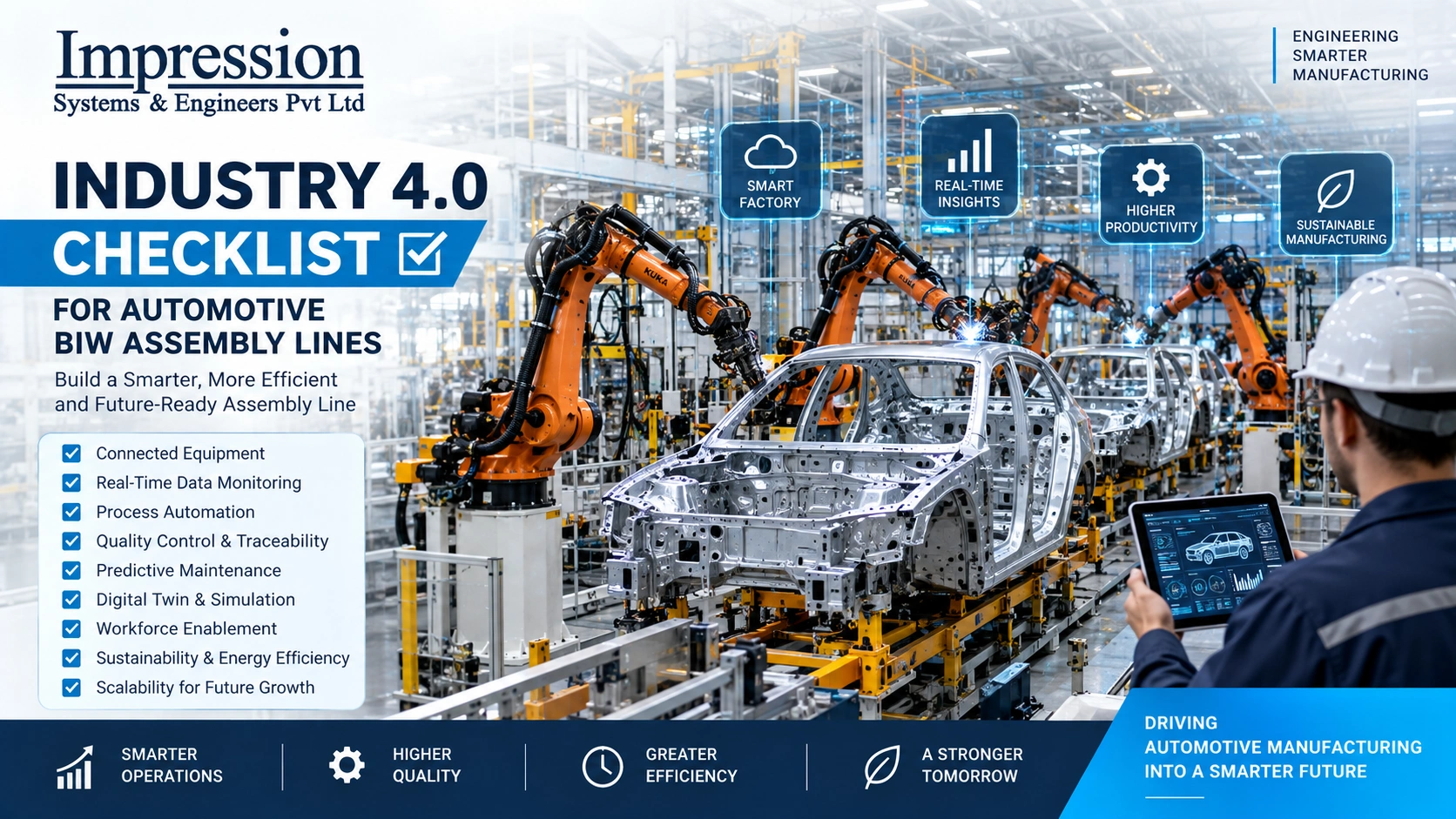
Automotive Automation Solutions
Automotive manufacturing involves complex production and material flows.
Industrial automation can support:
- Component movement
- Production-line handling
- Assembly operations
- Testing loops
- Pallet transportation
- Storage
- End-of-line handling
Imensys states that its automotive solutions cover both passenger vehicle and commercial vehicle applications.
Food and Beverage Automation Solutions
Food and beverage facilities require efficient handling of products from production through packaging, storage, and dispatch.
Automation can support:
- Pallet handling
- End-of-line operations
- Warehouse transportation
- Storage
- Material movement
Imensys specifically highlights end-of-line and warehouse automation for palletized goods within the food and beverage industry.
Appliance Industry Automation Solutions
Appliance manufacturing may involve large and sensitive products.
Automation can support:
- Production-line handling
- Assembly-line transportation
- Testing loops
- Packaging
- Material movement
Handling systems can be designed to reduce unwanted product marks or scratches.
Imensys describes its appliance-industry solutions as covering production, assembly, testing, and packaging-line handling.
Metal Industry Automation Solutions
Metal processing can involve heavy and large materials such as:
- Plates
- Pipes
- Coils
- Slabs
Automated material handling systems can support controlled movement of these materials within industrial facilities.
Imensys highlights material movement solutions for metal-industry applications involving plates, pipes, coils, slabs, and similar materials.
Pharmaceutical Automation Solutions
Pharmaceutical operations can benefit from structured material flow, organized storage, controlled processes, and traceability.
Automation can connect production, storage, packaging, and distribution processes.
The system design should consider the specific regulatory, environmental, product-handling, and operational requirements of the facility.
Warehouse and Logistics Automation Solutions
Logistics facilities need efficient material movement, storage, retrieval, and dispatch.
Warehouse automation can connect:
Receiving → Storage → Picking → Packing → Dispatch
Depending on requirements, this can involve conveyors, storage automation, RGVs, AMRs, control systems, and software integration.
How to Select the Right Industrial Automation Solutions
Selecting an automation system should begin with the process—not the equipment.
Step 1: Analyze the Existing Process
Document the current workflow.
Identify:
- Material entry points
- Storage locations
- Production areas
- Material movement paths
- Bottlenecks
- Manual activities
- Delays
- Repetitive operations
This creates a baseline for automation planning.
Step 2: Define Your Automation Objectives
Determine what the project needs to achieve.
Potential objectives include:
- Higher throughput
- Reduced manual handling
- Improved storage capacity
- Better material traceability
- Improved safety
- Reduced downtime
- Better process consistency
- Future scalability
Clear objectives make it easier to measure project performance.
Step 3: Analyze Material Characteristics
The material being handled can significantly influence system design.
Consider:
- Weight
- Dimensions
- Shape
- Packaging
- Fragility
- Surface characteristics
- Pallet dimensions
- Handling requirements
For example, a system designed for lightweight cartons may be completely different from one designed for heavy metal coils.
Step 4: Calculate Throughput Requirements
Determine the expected material volume.
Important questions include:
- How many units must be moved per hour?
- What is the peak throughput?
- What cycle time is required?
- What is the expected future volume?
- Where are the process bottlenecks?
This information helps determine the appropriate automation capacity.
Step 5: Evaluate Facility Layout
The physical facility affects automation design.
Consider:
- Floor area
- Building height
- Existing equipment
- Production lines
- Storage zones
- Maintenance access
- Material entry and exit points
- Safety zones
A site survey and layout study can help identify the most practical configuration.
Step 6: Plan System Integration
Automation should integrate with the systems already used by the organization where required.
Potential integration points include:
- WMS
- WCS
- ERP
- Production systems
- PLC systems
- HMI systems
- Industrial IoT platforms
Imensys describes its automation approach as including end-to-end connectivity with WMS, ERP, and production lines.
Customized Industrial Automation Solutions vs Standard Systems
Not every industrial facility has the same requirements.
Standard automation products can be suitable for applications with predictable and commonly encountered requirements.
Customized industrial automation solutions can be more appropriate when the facility has:
- Complex layouts
- Unusual material characteristics
- Existing equipment that must be integrated
- Specific throughput requirements
- Multiple interconnected processes
- Specialized safety requirements
- Future expansion requirements
Imensys highlights custom-built automation designed around plant layout, workflow, and performance objectives.
The decision between standard and customized automation should therefore be based on the process and expected business value.
Installation and Commissioning of Industrial Automation Systems
A successful automation project does not end with equipment manufacturing.
Installation and commissioning are critical stages.
Installation
Equipment must be installed according to the approved engineering design and applicable safety requirements.
Commissioning
The complete system needs to be tested to verify that mechanical, electrical, controls, software, and safety functions operate correctly.
Training
Operators and maintenance teams should understand how to operate and support the system.
Handover
Documentation, training, system information, and operational procedures should be provided as part of the handover process.
Imensys lists installation and commissioning, maintenance support, and training and handover among its service offerings.
Maintenance and Lifecycle Support for Industrial Automation
Automation systems are long-term operational assets.
Regular maintenance can help organizations maintain equipment performance and reliability.
Maintenance activities may include:
- Preventive inspection
- Component checks
- Troubleshooting
- Replacement of worn components
- Software and control-system support
- Performance monitoring
Maintenance requirements should be considered during the initial automation design.
An automation system that is difficult to maintain can create unnecessary downtime and operating costs.
Common Industrial Automation Implementation Mistakes
Automating an Inefficient Process
Automation cannot automatically fix a poorly designed workflow.
The existing process should first be analyzed and optimized.
Ignoring Future Growth
A system designed only for today’s throughput may become inadequate as demand increases.
Future requirements should be considered during design.
Focusing Only on Initial Equipment Cost
The lowest purchase price does not necessarily represent the lowest lifecycle cost.
Businesses should also consider:
- Installation
- Integration
- Maintenance
- Spare parts
- Energy
- Downtime
- Training
- Future expansion
Treating Automation Equipment as Separate Systems
Disconnected equipment can create operational bottlenecks.
The overall system architecture should be planned before individual equipment is selected.
Ignoring Maintenance Access
Maintenance teams need practical access to equipment and components.
Maintenance requirements should therefore be incorporated into the facility layout and automation design.
Future Trends in Industrial Automation Solutions
Industrial automation continues to evolve.
Several trends are shaping the next generation of automated industrial facilities.
Industrial IoT
Connected sensors and devices can provide operational information that supports monitoring and analysis.
Artificial Intelligence
AI technologies can potentially support areas such as predictive analysis, inspection, process optimization, and decision support.
Robotics and Mobile Automation
Robotics and autonomous mobile systems can increase flexibility in suitable manufacturing and logistics applications.
Predictive Maintenance
Data from equipment can potentially help identify abnormal operating conditions before they result in major failures.
Cloud and Digital Connectivity
More industrial systems are being connected to digital platforms for monitoring, analytics, and operational management.
Flexible Automation
Manufacturers increasingly need systems capable of handling changing product types, production volumes, and process requirements.
The future of industrial automation is therefore moving toward systems that are not only automated but also connected, flexible, measurable, and adaptable.
Why Choose an Experienced Industrial Automation Company?
Industrial automation projects can involve mechanical engineering, electrical engineering, controls, software, material handling, safety, installation, and commissioning.
An experienced automation partner can help coordinate these disciplines.
When evaluating an industrial automation company, consider:
- Industry experience
- Engineering capabilities
- Customization capability
- Material handling expertise
- Controls and automation expertise
- Software integration
- Installation support
- Commissioning capability
- Maintenance support
- Training
- Long-term service
An integrated approach can reduce coordination challenges and help businesses develop solutions around their actual operational requirements.
Imensys was established in Pune in 2005 and describes itself as a supplier of industrial automation solutions for material handling and storage automation. The company states that it delivers solutions across India as well as international markets including Europe, the USA, and the Gulf region.
Industrial Automation Solutions from Imensys
Impression Systems & Engineers Pvt. Ltd. (Imensys) provides industrial automation products and solutions for material handling, storage automation, transportation, and other industrial applications.
Its portfolio includes:
- Material handling solutions
- Storage automation solutions
- Advanced transportation solutions
- Standard products
- Custom-built automation
- End-to-end integration
- Smart control systems
The company’s material handling solutions are designed to streamline movement of goods, while its storage automation solutions focus on high-density storage, faster retrieval, and integration with WMS/WCS platforms.
Its advanced transportation portfolio includes RGVs, AMRs, monorails, intelligent control systems, and IoT-enabled technologies for industrial intralogistics applications.
Imensys also highlights smart control systems using PLCs and HMI interfaces for monitoring, diagnostics, and system control.
Frequently Asked Questions About Industrial Automation Solutions
What are industrial automation solutions?
Industrial automation solutions are integrated systems that automate, control, monitor, and optimize industrial processes using technologies such as PLCs, HMIs, sensors, conveyors, automated storage systems, transportation systems, robotics, and industrial IoT.
What are the main benefits of industrial automation?
The main benefits can include improved productivity, process consistency, reduced manual material movement, better space utilization, improved visibility, enhanced safety, and greater scalability.
What industries use industrial automation solutions?
Industrial automation is used across industries including automotive, food and beverage, appliances, pharmaceuticals, logistics, warehousing, metal processing, railways, and manufacturing.
What is material handling automation?
Material handling automation uses automated equipment and control technologies to move materials, products, components, and pallets through an industrial facility with reduced manual intervention.
What is warehouse automation?
Warehouse automation uses automated equipment, software, and control systems to improve storage, retrieval, transportation, sorting, and movement of materials within a warehouse.
What is an AS/RS system?
AS/RS stands for Automated Storage and Retrieval System. It is an automated technology used to store and retrieve materials from designated storage locations.
What is an RGV system?
RGV stands for Rail Guided Vehicle. An RGV is an automated transportation system that moves materials along predefined rail-guided routes.
What are AMRs in industrial automation?
AMRs, or Autonomous Mobile Robots, are mobile robotic systems designed to transport materials within suitable manufacturing, warehouse, and logistics environments.
Can industrial automation solutions be customized?
Yes. Industrial automation solutions can be customized according to plant layout, material characteristics, throughput, existing equipment, integration requirements, safety considerations, and future expansion plans.
How do I choose the right industrial automation solution?
Start by analyzing your existing process, material flow, throughput, facility layout, bottlenecks, safety requirements, integration needs, and future capacity. Then select the technology and system configuration that best matches those requirements.
How does industrial automation support Industry 4.0?
Industrial automation provides the equipment, control systems, connectivity, and data infrastructure needed to create more connected and intelligent industrial operations.
What should I consider when selecting an industrial automation company?
Consider the company’s engineering experience, industry expertise, customization capabilities, system integration experience, installation and commissioning support, maintenance services, and ability to provide long-term lifecycle support.
Conclusion: Building a Smarter Automated Industrial Facility
Industrial automation solutions are becoming an important part of modern manufacturing, warehousing, material handling, and intralogistics.
The value of automation goes beyond replacing manual tasks.
A well-designed automation system can help organizations improve material flow, productivity, consistency, storage utilization, operational visibility, safety, and scalability.
Technologies such as PLCs, HMIs, conveyors, AS/RS, RGVs, AMRs, industrial IoT, and software integration can work together to create connected industrial environments.
However, successful automation starts with the process.
Businesses should identify their operational challenges, understand material and throughput requirements, evaluate the facility layout, define measurable objectives, plan system integration, and consider future growth before selecting equipment.
Choosing an experienced industrial automation partner can also help coordinate the engineering, integration, installation, commissioning, training, and maintenance requirements involved in a complete project.
For organizations planning to modernize manufacturing, material handling, warehousing, or intralogistics operations, the right automation strategy can create a foundation for more efficient and scalable industrial growth.
Imensys provides industrial automation, material handling, storage automation, advanced transportation, custom-built automation, and system integration solutions for industrial applications. Contact the Imensys team to discuss your automation requirements and explore a solution designed around your facility and operational goals.