Industrial Control Systems: A Complete Guide for Modern Manufacturing
Industrial Control Systems (ICS) are the foundation of modern manufacturing and industrial automation. They help businesses monitor, control, and optimise machines, production equipment, industrial processes, and facility operations. From automotive assembly lines and food processing plants to metal manufacturing and material handling facilities, industrial control systems play an important role in maintaining operational efficiency, product quality, reliability, and safety.
As manufacturing industries adopt smart technologies, connected equipment, robotics, and data-driven operations, the importance of reliable industrial control systems continues to grow. These systems combine hardware, software, sensors, communication networks, and control strategies to ensure that industrial processes operate according to defined requirements.
Whether a manufacturer operates a small production unit or a large automated facility, an appropriately designed control system can improve process consistency, reduce manual intervention, support faster troubleshooting, and provide better visibility into production activities.
This guide explains what industrial control systems are, how they work, their main components, different types, industrial applications, benefits, challenges, cybersecurity considerations, and the factors businesses should consider when implementing them.
1. What Are Industrial Control Systems?
Industrial Control Systems (ICS) are integrated systems of hardware and software used to monitor, manage, and control industrial processes, machinery, and equipment. They collect information from field devices, process that information through controllers, and send commands to equipment to maintain the required operating conditions.
Industrial control systems are used in manufacturing plants, power generation facilities, water treatment plants, oil and gas operations, chemical processing units, warehouses, and other industrial environments.
An industrial control system may perform simple functions, such as controlling a motor based on a sensor signal, or more complex operations, such as coordinating multiple production machines through a central supervisory control platform.
A typical system may include:
- Programmable Logic Controllers (PLCs)
- Supervisory Control and Data Acquisition (SCADA) systems
- Human-Machine Interfaces (HMIs)
- Sensors and transmitters
- Actuators, motors, and drives
- Industrial communication networks
- Distributed Control Systems (DCS)
- Industrial computers and control software
These components work together to maintain process conditions, execute production sequences, detect abnormal operating conditions, and provide operators with useful information.
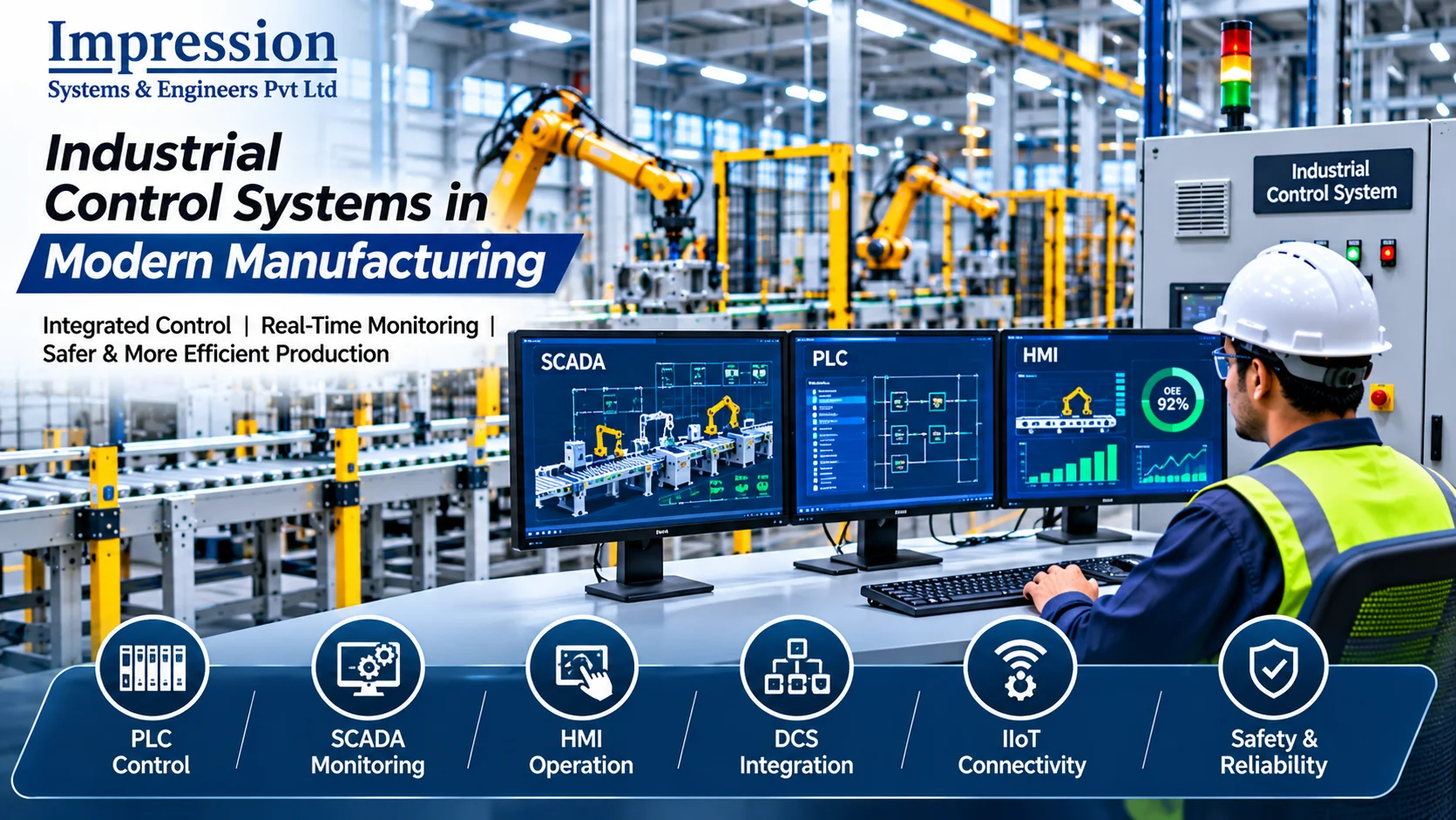
For example, in an automated packaging line, sensors can detect the presence of a product, a PLC can control the conveyor and packaging sequence, and an HMI can display machine status and production information. If a fault occurs, the control system can trigger an alarm and stop the relevant equipment according to the programmed safety and operating logic.
The exact architecture depends on the industry’s requirements, the size of the facility, process complexity, operational risks, and integration needs.
2. How Do Industrial Control Systems Work?
Industrial control systems work by collecting information from industrial equipment, processing it through controllers, and sending control signals to the relevant devices.
Although the architecture differs between facilities, most control systems follow a continuous cycle of sensing, processing, decision-making, and action.
Step 1: Data Collection Through Sensors
Sensors and measurement instruments collect information about physical conditions within an industrial process.
Common measurements include:
- Temperature
- Pressure
- Flow rate
- Liquid level
- Speed
- Position
- Vibration
- Humidity
- Product presence
- Machine operating status
For example, a temperature transmitter installed in an industrial furnace measures the current temperature and sends a signal to the control system.
Step 2: Processing Through Controllers
The controller receives information from sensors and evaluates it against programmed logic, operating limits, or process setpoints.
A Programmable Logic Controller (PLC) is commonly used for machine-level automation. It executes control instructions and determines which outputs should be activated.
For example, if a conveyor sensor detects a product, the PLC can initiate the next stage of a programmed sequence.
Step 3: Sending Commands to Equipment
After processing the input information, the controller sends output signals to devices such as:
- Motors
- Pumps
- Valves
- Conveyors
- Robotic equipment
- Pneumatic cylinders
- Variable Frequency Drives (VFDs)
These devices perform the required physical actions.
For example, a PLC may activate a motor starter to operate a conveyor or adjust a control valve to regulate liquid flow.
Step 4: Monitoring Through HMI and SCADA
Operators need to understand what is happening across the production process. HMI and SCADA platforms provide visual information about machine status, process values, alarms, and operating conditions.
An HMI typically provides an interface for interacting with an individual machine or process. SCADA can provide supervisory monitoring and control across multiple machines, processes, or geographically distributed assets.
Step 5: Feedback and Process Adjustment
Industrial control systems use feedback to determine whether the process is operating as expected.
For example, a temperature controller compares the measured temperature with the target temperature. If the measured value is below the setpoint, the controller can increase heating output according to its control strategy.
This cycle continues during operation, helping the system maintain the required process conditions.
3. Main Components of Industrial Control Systems
An industrial control system is made up of multiple components that perform specific functions. Selecting and integrating these components correctly is essential for reliable automation.
3.1 Programmable Logic Controllers (PLCs)
A Programmable Logic Controller is an industrial computer designed to control machines and automated processes.
PLCs receive input signals from sensors and switches, execute programmed logic, and control output devices. They are widely used because they are designed for industrial operating environments and can support continuous control tasks.
Common PLC applications include:
- Conveyor control
- Automated assembly operations
- Machine sequencing
- Motor control
- Packaging machinery
- Material handling systems
- Interlocking and process control
PLCs are particularly useful when equipment must follow repeatable sequences or respond to changing input conditions.
3.2 Supervisory Control and Data Acquisition (SCADA)
SCADA systems provide supervisory monitoring and control of industrial processes. They collect information from controllers, remote terminal units, sensors, and other devices, then present it through a central software interface.
SCADA applications commonly include:
- Monitoring equipment status
- Displaying real-time process values
- Generating alarms
- Recording historical data
- Presenting operational trends
- Supporting supervisory commands
- Monitoring remote industrial assets
SCADA is especially useful when operators need visibility across several machines, production areas, or geographically distributed facilities.
3.3 Human-Machine Interface (HMI)
An HMI is the interface through which operators interact with industrial machinery and processes.
It can display machine status, operating parameters, alarms, production information, and control options. Depending on the application, operators may use an HMI to start or stop equipment, select operating modes, adjust authorised parameters, or acknowledge alarms.
A well-designed HMI should provide clear information, consistent navigation, readable displays, and appropriate access controls.
3.4 Sensors and Transmitters
Sensors detect changes in physical conditions and provide information to the control system.
Examples include:
- Proximity sensors for object detection
- Photoelectric sensors for product detection
- Temperature sensors for thermal monitoring
- Pressure transmitters for pressure measurement
- Flow meters for liquid or gas flow
- Level sensors for tanks and vessels
- Encoders for position and speed feedback
The accuracy, range, installation method, and environmental suitability of these instruments directly affect the quality of control information.
3.5 Actuators and Final Control Elements
Actuators convert control signals into physical movement or action.
Examples include electric motors, pneumatic cylinders, hydraulic actuators, and control valves.
They allow the control system to operate equipment, move products, regulate process conditions, and execute automated sequences.
3.6 Industrial Communication Networks
Industrial communication networks allow controllers, sensors, drives, HMIs, SCADA platforms, and other devices to exchange information.
Common technologies and protocols include:
- PROFINET
- PROFIBUS
- EtherNet/IP
- Modbus TCP
- Modbus RTU
- EtherCAT
- OPC UA
The appropriate communication technology depends on response time, network architecture, interoperability, distance, reliability, and application requirements.
3.7 Distributed Control Systems (DCS)
A Distributed Control System is commonly used in complex continuous or batch processes where control functions are distributed across multiple controllers and process areas.
DCS architectures are frequently associated with industries such as chemicals, oil and gas, pharmaceuticals, and power generation.
They can support coordinated control, operator monitoring, process management, and integration across large industrial facilities.
4. Types of Industrial Control Systems
Industrial facilities use different types of control systems depending on process requirements, operating complexity, equipment architecture, and the level of automation needed.
4.1 Programmable Logic Controller-Based Systems
PLC-based systems are commonly used for machine automation, production lines, packaging operations, material handling, and equipment sequencing.
They are suitable for applications requiring deterministic logic execution, equipment interlocking, and coordinated machine operations.
A PLC-based architecture can control a single machine or multiple connected machines, depending on the design.
4.2 Supervisory Control and Data Acquisition Systems
SCADA systems are used when operators need centralised supervision of industrial processes and equipment.
They are often deployed in water treatment, energy distribution, utilities, manufacturing plants, and remote monitoring applications.
SCADA systems can collect data from multiple controllers and provide a common view of process conditions.
4.3 Distributed Control Systems
DCS platforms are designed for managing complex industrial processes through distributed control architecture.
They are particularly relevant when multiple process units must operate together while maintaining coordinated control and monitoring.
Examples include chemical processing, refining, power generation, and large process manufacturing facilities.
4.4 Remote Terminal Unit-Based Systems
Remote Terminal Units (RTUs) collect field information and communicate with supervisory systems. They are often used in remote or geographically distributed environments.
RTUs may monitor pressure, temperature, flow, equipment status, and other field conditions. They can also execute selected control functions depending on the application.
4.5 Hybrid Control Systems
Hybrid control architectures combine technologies such as PLCs, SCADA, DCS, industrial computers, and specialised controllers.
For example, a manufacturing facility may use PLCs for individual machines, SCADA for production-area monitoring, and an industrial software platform for collecting production information.
The objective is to select the right technology for each operational requirement rather than force every process into a single architecture.
5. Industrial Control Systems vs. Industrial Automation Systems
Industrial control systems and industrial automation systems are closely related, but they are not exactly the same.
Industrial control systems focus on monitoring and controlling equipment and processes. Industrial automation is a broader concept that includes control systems along with robotics, automated material movement, machine vision, production software, and other technologies used to reduce manual intervention.
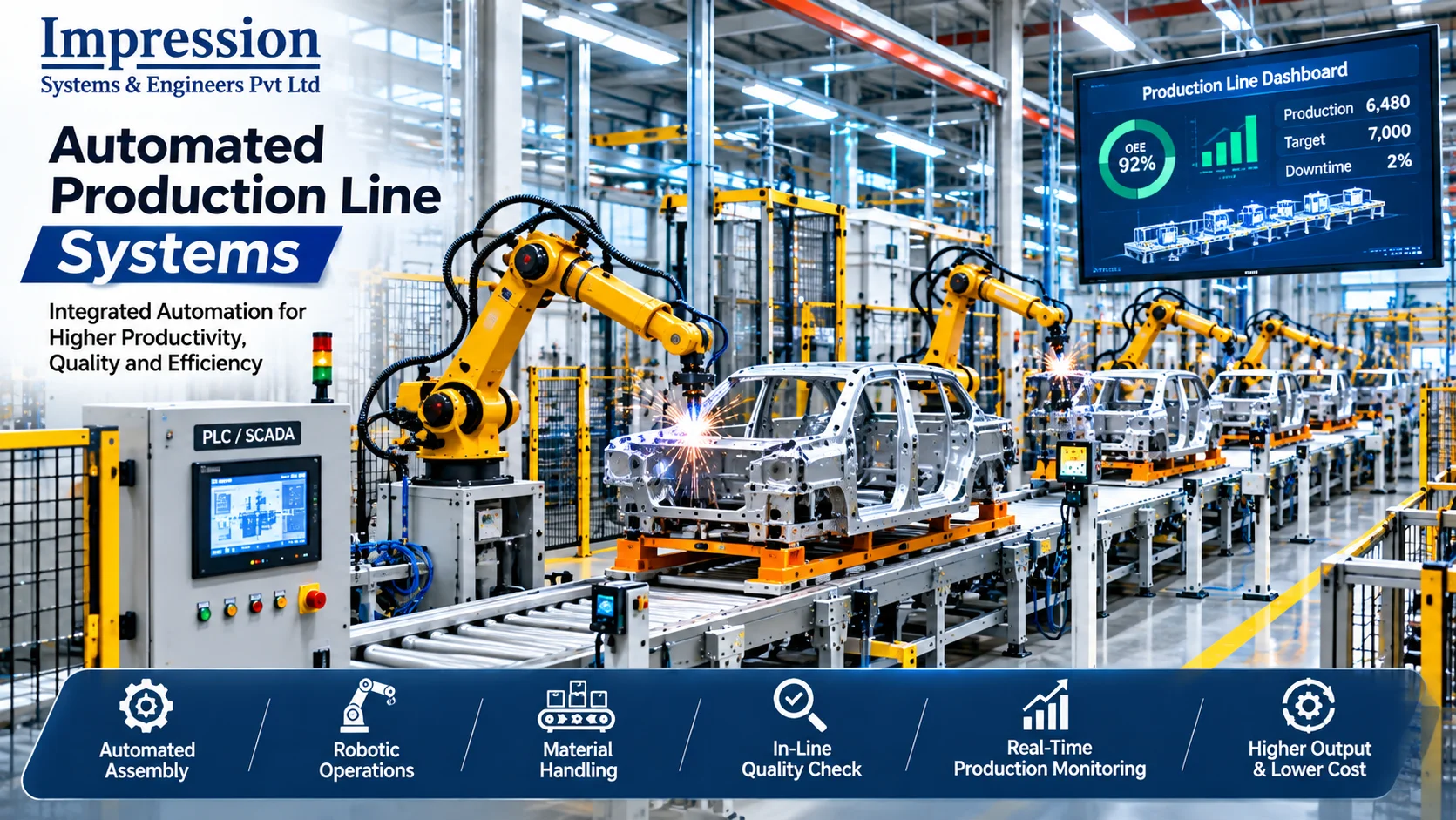
For example, an automated assembly line may include robotic arms, conveyors, sensors, PLCs, HMIs, and SCADA software.
The control system coordinates the equipment and process logic, while the wider automation solution includes the complete arrangement of machines, devices, and software.
Both concepts work together to create efficient and integrated manufacturing operations.
6. Applications of Industrial Control Systems in Manufacturing
Industrial control systems are used across a wide range of manufacturing and process industries. Their purpose is to maintain consistent operations, coordinate equipment, monitor production conditions, and support operational decisions.
6.1 Automotive Manufacturing
Automotive production facilities use control systems to coordinate assembly lines, welding stations, painting operations, robotic cells, conveyors, and inspection equipment.
PLCs can manage machine sequences and interlocks, while SCADA and other monitoring platforms provide visibility into equipment status and production operations.
Control systems also help coordinate communication between different production stages.
Explore Imensys Automotive Solutions for related industrial applications.
6.2 Food and Beverage Manufacturing
Food and beverage facilities use industrial control systems to monitor and control mixing, heating, cooling, filling, packaging, and conveying processes.
Temperature, pressure, flow, and level measurements can be used to maintain defined operating conditions.
Control systems can also support process recording and equipment monitoring, depending on the plant’s design and regulatory requirements.
Explore Imensys Food and Beverage Solutions for relevant industry applications.
6.3 Metal Manufacturing
Metal processing facilities use control systems in cutting, forming, rolling, material movement, furnace operations, and other production activities.
Sensors and controllers help coordinate machine sequences and monitor important operating parameters.
Automated control can improve process consistency and help operators identify abnormal equipment conditions.
Explore Imensys Metal Industry Solutions.
6.4 Home Appliance Manufacturing
Appliance manufacturing involves several connected production processes, including component assembly, testing, inspection, packaging, and material movement.
Industrial control systems can coordinate automated machines and production sequences while supporting monitoring across different manufacturing stages.
Explore Imensys Appliances Solutions.
6.5 Warehouse and Material Handling Operations
Industrial control systems also play an important role in automated warehouses and material handling environments.
They can coordinate conveyors, transfer systems, lifting equipment, automated storage equipment, and other material movement technologies.
Depending on the architecture, control systems may exchange information with warehouse management or manufacturing execution software.
7. Benefits of Industrial Control Systems
Implementing a suitable industrial control system can deliver operational benefits across manufacturing facilities.
7.1 Improved Production Efficiency
Control systems automate repetitive machine operations and coordinate equipment sequences.
This can reduce unnecessary delays, improve process coordination, and help production teams maintain consistent operating conditions.
7.2 Better Product Quality and Consistency
Automated monitoring and control help maintain defined process parameters.
For example, controlling temperature, pressure, speed, and material flow can support repeatable production conditions and reduce process variation.
However, the actual quality improvement depends on measurement accuracy, equipment condition, process design, and control strategy.
7.3 Reduced Manual Intervention
Industrial control systems can automate routine operations that would otherwise require continuous manual action.
Operators can focus more on supervision, troubleshooting, quality management, and process improvement.
7.4 Improved Equipment Monitoring
Monitoring systems can display machine conditions, operating values, alarm states, and equipment performance information.
This visibility helps maintenance and production teams understand equipment behaviour and identify issues more quickly.
7.5 Faster Fault Detection
Alarms and diagnostic information can help operators recognise abnormal operating conditions.
When configured correctly, alarms provide useful information about equipment faults, process deviations, and system status.
7.6 Better Process Repeatability
Automated sequences and feedback control help maintain consistent operating procedures.
This is especially important in production environments where process conditions must remain within defined limits.
7.7 Support for Data-Driven Decisions
Historical trends and production records can help teams analyse machine performance, process variation, downtime, and operating conditions.
These insights can support decisions about maintenance, process optimisation, and production planning.
7.8 Improved Operational Coordination
When control systems are integrated appropriately, different machines and production areas can exchange information.
This can help reduce isolated operations and support more coordinated manufacturing workflows.
8. Industrial Control Systems and Industry 4.0
Industry 4.0 refers to the increasing use of connected technologies, automation, data exchange, and intelligent systems in manufacturing.
Industrial control systems are an important part of this transformation because they connect physical industrial processes with digital monitoring and information systems.
Several technologies contribute to this development.
8.1 Industrial Internet of Things (IIoT)
IIoT connects industrial equipment, sensors, and other devices to systems that collect and analyse operational data.
It can provide additional visibility into machine conditions, production performance, and equipment behaviour.
IIoT solutions should be designed with appropriate network segmentation, security controls, and data governance.
8.2 Manufacturing Execution Systems (MES)
Manufacturing Execution Systems help manage and monitor production activities at the operational level.
MES platforms can exchange information with industrial control systems to connect machine-level activity with production management processes.
Depending on the implementation, this integration may support production tracking, work-order management, quality information, and performance reporting.
8.3 Enterprise Resource Planning (ERP) Integration
ERP systems manage broader business processes such as purchasing, inventory, finance, and production planning.
Integration between ERP and manufacturing systems can improve information flow between business operations and the factory floor.
The design should clearly define which system owns each data item and how information is exchanged.
8.4 Predictive Maintenance
Predictive maintenance uses equipment data and analytical methods to identify patterns that may indicate developing faults.
Industrial control systems can provide useful operational data, while additional sensors and analytics platforms may be required for more advanced condition monitoring.
Predictive maintenance does not eliminate equipment failures, but it can help maintenance teams make better-informed decisions.
8.5 Digital Twins
A digital twin is a digital representation of a physical asset, process, or system that can be updated using relevant operational data.
When connected to suitable industrial data sources, digital twins can support simulation, performance analysis, and process improvement.
Their value depends on the quality of the model, the available data, and the intended application.
9. Industrial Control System Cybersecurity
Industrial control system cybersecurity is an important consideration because modern facilities increasingly connect operational technology with enterprise networks, remote services, and digital platforms.
A cybersecurity incident can affect equipment availability, production continuity, process integrity, and in some circumstances physical safety.
Industrial environments have different operational requirements from ordinary office IT systems. Security measures must consider reliability, response time, equipment compatibility, and safety.
Important cybersecurity practices include:
9.1 Network Segmentation
Separate industrial control networks from general business networks wherever appropriate.
Use controlled communication pathways between network zones and restrict unnecessary connections.
9.2 Access Control
Provide individual user accounts and role-based permissions.
Limit administrative access and ensure that users receive only the permissions required for their responsibilities.
9.3 Secure Remote Access
Remote access should be approved, authenticated, monitored, and restricted to necessary systems.
Use secure connection methods and avoid exposing industrial control devices directly to the public internet.
9.4 Regular Backups
Maintain protected backups of PLC programs, HMI configurations, SCADA applications, engineering files, and other critical system information.
Test restoration procedures so that backups can be used effectively during recovery.
9.5 Patch and Vulnerability Management
Maintain an inventory of industrial assets and assess vulnerabilities.
Apply security updates through a controlled process that considers equipment compatibility, operational requirements, and downtime planning.
9.6 Monitoring and Incident Response
Monitor relevant network and system activity, establish incident response procedures, and define responsibilities for operational technology security.
For additional guidance, organisations can refer to recognised frameworks such as NIST guidance for operational technology security and the ISA/IEC 62443 series.
10. Challenges in Implementing Industrial Control Systems
Although industrial control systems provide significant operational value, their implementation requires careful planning.
10.1 Integration With Legacy Equipment
Many manufacturing facilities operate older machines and controllers that use different communication protocols or technologies.
Integrating these assets with newer systems may require protocol gateways, additional instrumentation, interface development, or equipment upgrades.
10.2 High Initial Investment
Costs may include controllers, sensors, drives, control panels, software, engineering, installation, commissioning, training, and maintenance.
A project should be evaluated using the expected operational benefits, lifecycle costs, and implementation risks.
10.3 System Complexity
Large control systems can involve multiple machines, controllers, networks, software platforms, and suppliers.
Poor documentation or unclear system architecture can make troubleshooting and future expansion difficult.
10.4 Downtime During Implementation
Installation, testing, and commissioning may require access to operating machinery or planned production interruptions.
A detailed implementation schedule and commissioning strategy can help minimise disruption.
10.5 Skills and Training Requirements
Industrial control systems require personnel with knowledge of automation, electrical systems, instrumentation, networking, programming, and process operations.
Training should be provided to operators, maintenance teams, engineers, and administrators according to their responsibilities.
10.6 Cybersecurity Risks
Connected systems introduce additional security considerations.
Organisations need to address access management, network architecture, backup practices, vulnerability management, and incident response throughout the system lifecycle.
11. Best Practices for Designing Industrial Control Systems
A reliable industrial control system begins with a clear understanding of the process and its operational requirements.
The following practices can help organisations plan and implement effective solutions.
11.1 Understand Process Requirements
Identify the production objectives, machine functions, operating conditions, required control accuracy, safety requirements, and expected system performance.
A process assessment should be completed before selecting hardware or software.
11.2 Select Suitable Control Architecture
Choose PLC, SCADA, DCS, RTU, or hybrid architecture based on process complexity and operational requirements.
The selection should consider scalability, maintainability, reliability, and compatibility with existing equipment.
11.3 Choose Appropriate Industrial Components
Select controllers, sensors, actuators, drives, communication devices, and control panels according to the application.
Environmental conditions, electrical ratings, measurement ranges, response requirements, and manufacturer specifications should all be considered.
11.4 Plan Communication and Integration
Define how equipment and software platforms will exchange information.
Document communication protocols, data structures, network responsibilities, and integration requirements.
11.5 Design Clear Operator Interfaces
HMI screens should present relevant information clearly and consistently.
Important operating conditions, alarms, and authorised control functions should be easy for operators to understand.
11.6 Include Safety From the Beginning
Identify process hazards and applicable safety requirements during the design stage.
Safety-related functions should be designed, implemented, and validated using appropriate standards and competent engineering processes. Ordinary PLC control logic should not automatically be treated as a substitute for a properly designed safety system.
11.7 Prepare Complete Documentation
Maintain electrical drawings, control architecture diagrams, I/O lists, PLC programs, HMI configurations, network diagrams, operating instructions, and maintenance documentation.
Good documentation supports troubleshooting, upgrades, and long-term system maintenance.
11.8 Test Before Production Deployment
Conduct appropriate factory testing, site testing, commissioning, and functional verification.
Testing should confirm that the system behaves as intended under normal conditions and relevant fault scenarios.
11.9 Provide Training and Handover
Operators and maintenance personnel should understand system functions, operating procedures, alarms, basic troubleshooting, and escalation processes.
A structured handover helps the organisation maintain the system after project completion.
12. How to Choose the Right Industrial Control System
Choosing an industrial control system is an important engineering decision. The right solution depends on the facility’s processes, equipment, business goals, and long-term operational requirements.
Consider the following factors.
1. Process type: Determine whether the operation involves discrete manufacturing, continuous processing, batch production, or a combination.
2. Scale of operations: Consider the number of machines, production lines, process areas, and locations that require monitoring or control.
3. Required control performance: Define the necessary response time, measurement accuracy, process stability, and availability requirements.
4. Existing infrastructure: Review existing PLCs, sensors, drives, communication networks, control panels, and software platforms.
5. Integration requirements: Identify whether the new system must connect with SCADA, MES, ERP, warehouse systems, or other operational platforms.
6. Expansion requirements: Consider future production capacity, additional machines, new process stages, and technology upgrades.
7. Cybersecurity: Evaluate access control, network segmentation, remote connectivity, backup, and monitoring requirements.
8. Lifecycle support: Assess documentation, spare parts, engineering support, maintenance, software updates, and staff training.
A well-selected system should meet current requirements while remaining maintainable and adaptable as production needs change.
13. The Future of Industrial Control Systems
Industrial control systems are evolving as manufacturers adopt connected equipment, advanced analytics, and more flexible production technologies.
Several developments are likely to influence industrial control system design and implementation.
13.1 Greater Industrial Connectivity
Industrial facilities are increasingly connecting machines, controllers, and software platforms to improve information sharing.
This creates opportunities for better production visibility but also increases the importance of secure network architecture.
13.2 Edge Computing
Edge computing allows selected data processing and applications to operate close to industrial equipment.
It can support applications that require local processing, reduce dependence on remote infrastructure for certain functions, and improve the handling of industrial data.
13.3 Artificial Intelligence and Advanced Analytics
AI and analytics can help identify patterns in machine data, support quality analysis, and provide insights into equipment performance.
These technologies should complement established control and safety functions rather than replace validated control logic without appropriate engineering assessment.
13.4 Flexible Manufacturing
Manufacturers increasingly require production systems that can accommodate product variations, changing demand, and new manufacturing processes.
Flexible automation and appropriately designed control architectures can help coordinate different production requirements.
13.5 Improved Industrial Cybersecurity
As industrial environments become more connected, cybersecurity will remain a major design and operational priority.
Security practices will increasingly need to be integrated into system design, commissioning, maintenance, and lifecycle management.
14. Why Industrial Control System Integration Matters
Industrial control systems deliver their full operational value when the different components work together as a coordinated solution.
A machine may have a PLC, sensors, motors, and an HMI, but the wider production process may also require communication with conveyors, robotic equipment, SCADA software, and production management systems.
Effective integration helps ensure that equipment exchanges the right information and performs the correct actions at the right time.
For example, an integrated production line may use sensors to identify incoming products, PLCs to coordinate machine sequences, drives to control conveyor speed, and an HMI to provide operator information.
A supervisory platform can then collect operating data and present an overview of the production process.
Successful integration requires careful engineering, appropriate communication design, functional testing, and clear documentation.
It should also consider cybersecurity, operational safety, future maintenance, and expansion requirements.
15. How Imensys Supports Industrial Automation Requirements
Industrial automation projects require more than selecting individual components. They involve understanding manufacturing processes, defining control requirements, selecting suitable technologies, coordinating equipment, and ensuring that the complete solution works reliably.
Imensys works in the industrial automation domain, supporting manufacturing-related requirements through its industrial solutions and services.
Businesses exploring industrial control systems can review the following resources:
- Imensys Services: Explore the company’s service information and identify relevant automation support.
- Imensys Products: Review product-related information relevant to industrial requirements.
- Automotive Industry: Explore automation requirements in automotive manufacturing.
- Food and Beverage Industry: Review solutions relevant to food and beverage operations.
- Metal Industry: Explore automation requirements in metal manufacturing.
- Maintenance Support: Review maintenance support information.
- Training and Handover: Explore training and handover-related information.
If your organisation is evaluating an industrial automation project, you can contact Imensys to discuss your requirements.
16. Conclusion
Industrial Control Systems are essential to modern manufacturing because they connect industrial equipment, sensors, controllers, software, and communication networks into coordinated operating environments.
From PLC-based machine control to SCADA monitoring and distributed control architectures, these technologies help manufacturers monitor processes, manage equipment, improve consistency, and support operational efficiency.
As industrial facilities adopt Industry 4.0, IIoT, MES integration, edge computing, and advanced analytics, industrial control systems will continue to play an important role in connected manufacturing.
However, successful implementation depends on more than technology selection. Businesses must consider process requirements, system architecture, cybersecurity, safety, integration, documentation, training, and long-term maintenance.
By adopting a structured engineering approach, manufacturers can develop industrial control systems that support current production requirements and provide a foundation for future automation improvements.
Planning an industrial automation project? Explore Imensys industrial automation services and contact the team to discuss your manufacturing requirements.
Frequently Asked Questions (FAQs)
1. What are Industrial Control Systems?
Industrial Control Systems are combinations of hardware and software used to monitor and control industrial equipment and processes. They commonly include PLCs, SCADA systems, HMIs, sensors, actuators, and industrial communication networks.
2. What are the main types of Industrial Control Systems?
Common types include Programmable Logic Controller (PLC) systems, Supervisory Control and Data Acquisition (SCADA) systems, Distributed Control Systems (DCS), Remote Terminal Unit (RTU)-based systems, and hybrid control architectures.
3. What is the difference between PLC and SCADA?
A PLC is a controller that executes machine or process control logic. SCADA is a supervisory platform used to monitor and manage industrial processes, collect data, display alarms, and provide operational visibility. They often work together.
4. What is the difference between ICS and DCS?
Industrial Control Systems is a broad term covering technologies used to control industrial operations. A Distributed Control System is one specific type of industrial control architecture, commonly used in complex continuous and batch processes.
5. Which industries use Industrial Control Systems?
Industrial Control Systems are used in automotive manufacturing, food and beverage processing, metal production, pharmaceuticals, chemicals, power generation, water treatment, oil and gas, and material handling operations.
6. How do Industrial Control Systems improve manufacturing efficiency?
They coordinate machines, automate repetitive operations, monitor process conditions, and provide information about equipment status. These functions can reduce manual intervention, improve process consistency, and help identify operational issues.
7. Are Industrial Control Systems part of Industry 4.0?
Yes. Industrial Control Systems provide the operational foundation for many Industry 4.0 applications. They can exchange information with IIoT platforms, MES, analytics systems, and other digital manufacturing technologies.
8. Why is cybersecurity important for Industrial Control Systems?
Cybersecurity helps protect industrial equipment, operational data, production availability, and process integrity. Network segmentation, secure access, backups, vulnerability management, and incident response are important security practices.
9. Can Industrial Control Systems be integrated with existing machines?
Yes. Integration may be possible through compatible communication protocols, interface devices, gateways, additional sensors, or controller upgrades. A technical assessment is needed to identify compatibility and implementation requirements.
10. What should businesses consider before implementing an Industrial Control System?
Businesses should assess process requirements, equipment compatibility, system architecture, communication protocols, safety, cybersecurity, integration needs, scalability, lifecycle support, and employee training.
11. What is the role of HMI in Industrial Control Systems?
A Human-Machine Interface provides operators with a visual interface for monitoring equipment, viewing process information, responding to alarms, and performing authorised control actions.
12. What is the future of Industrial Control Systems?
The future will involve greater industrial connectivity, edge computing, advanced analytics, AI-assisted monitoring, flexible manufacturing, and stronger cybersecurity practices. These developments will support more connected and data-driven industrial operations.