Automated Production Line Systems: A Complete Guide for Modern Manufacturing
Automated Production Line Systems are transforming modern manufacturing by helping businesses improve production efficiency, maintain consistent product quality, reduce repetitive manual activities, and manage increasingly complex manufacturing operations. As industries face growing demands for faster production, customized products, and reliable delivery, automation has become an important part of manufacturing strategy.
A production line consists of connected operations through which raw materials, components, or partially finished products move until they become finished goods. Traditionally, many of these activities depended on manual labour and individual machine operations. Modern production lines increasingly use programmable logic controllers (PLCs), industrial robots, conveyors, sensors, machine vision, and manufacturing software to coordinate different stages of production.
An automated production line is not simply a collection of machines working independently. It is an integrated system in which equipment, control technologies, material movement, and production information work together. The design must account for production volume, cycle time, product variation, quality requirements, safety, equipment compatibility, and future expansion.
This guide explains how automated production line systems work, their main components, different types, applications, benefits, challenges, implementation stages, and emerging technologies.
What Are Automated Production Line Systems?
Automated Production Line Systems are integrated manufacturing arrangements that use machines, control devices, software, and material handling equipment to perform a sequence of production operations with reduced manual intervention.
These systems coordinate activities such as feeding, positioning, processing, assembling, inspecting, transferring, and packaging products.
Depending on the application, automation may cover an entire production line or selected operations within an existing facility.
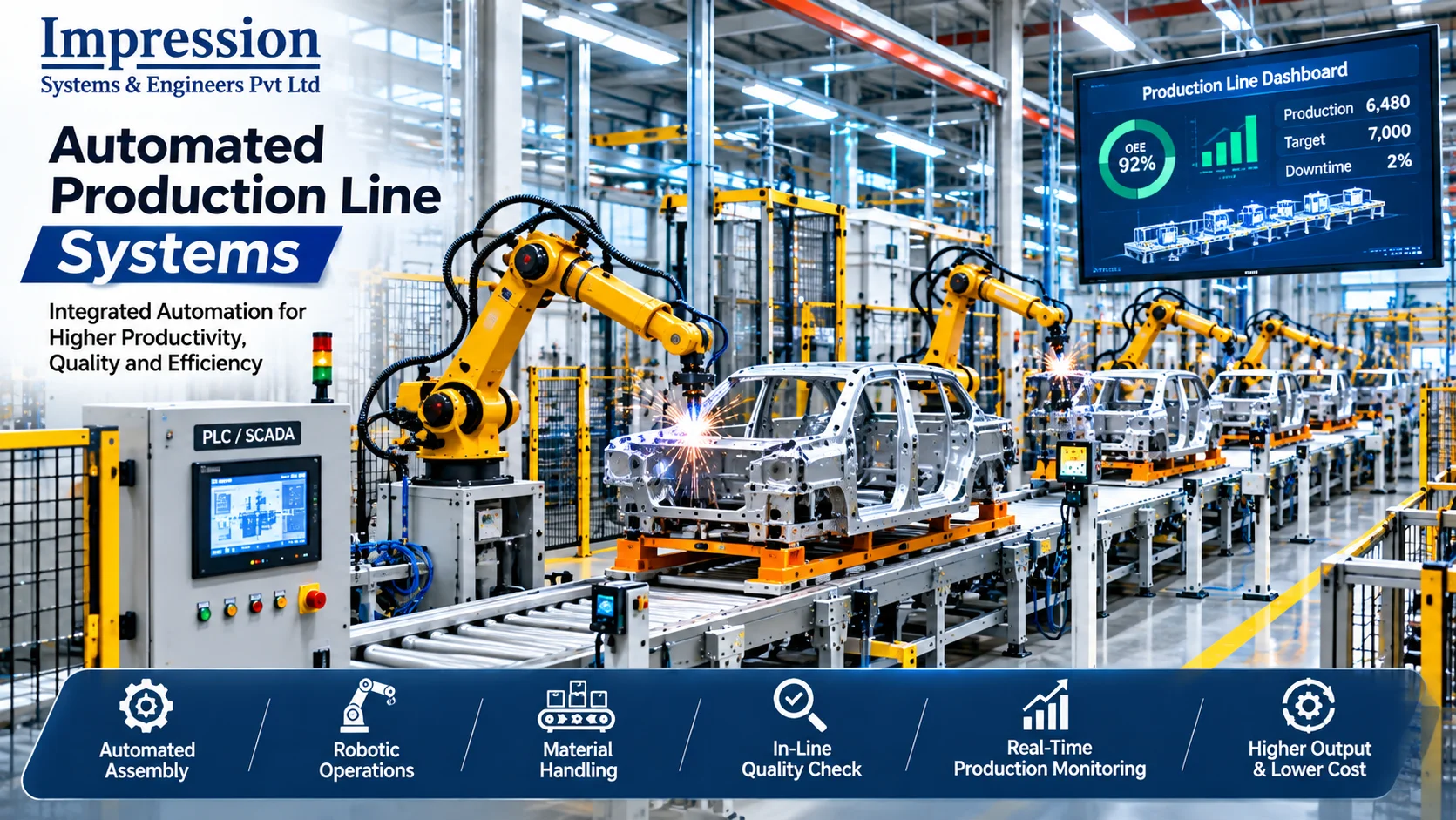
For example, an automotive component manufacturer may use an automated line in which components are supplied through conveyors, positioned by fixtures, assembled using automated equipment, inspected through sensors or vision systems, and transferred to the next production stage.
A typical automated production line may include:
- Industrial machines and processing equipment.
- Programmable Logic Controllers (PLCs).
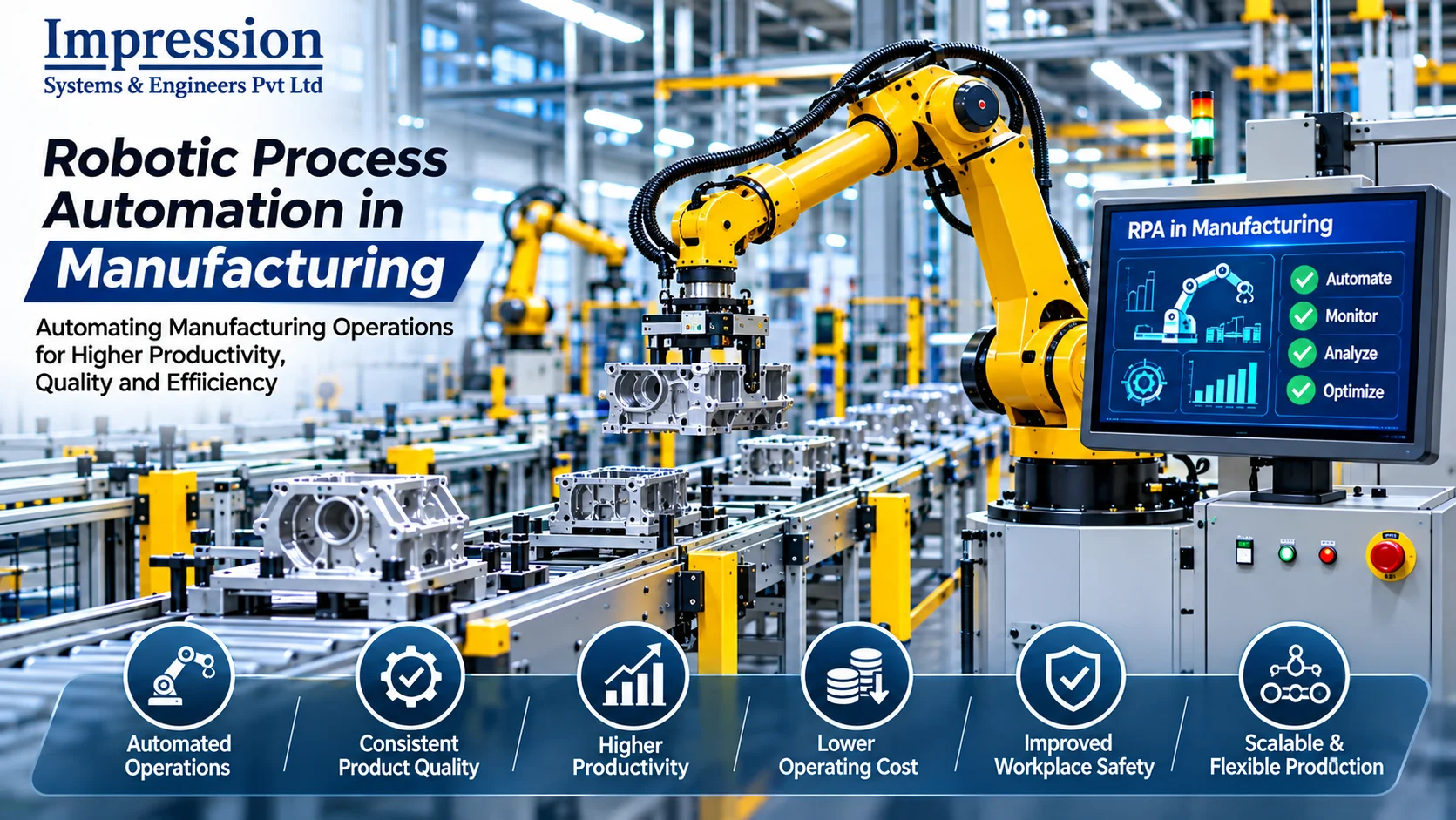
- Industrial robots and robotic workstations.
- Conveyor and material handling systems.
- Sensors and measurement devices.
- Human-Machine Interfaces (HMIs).
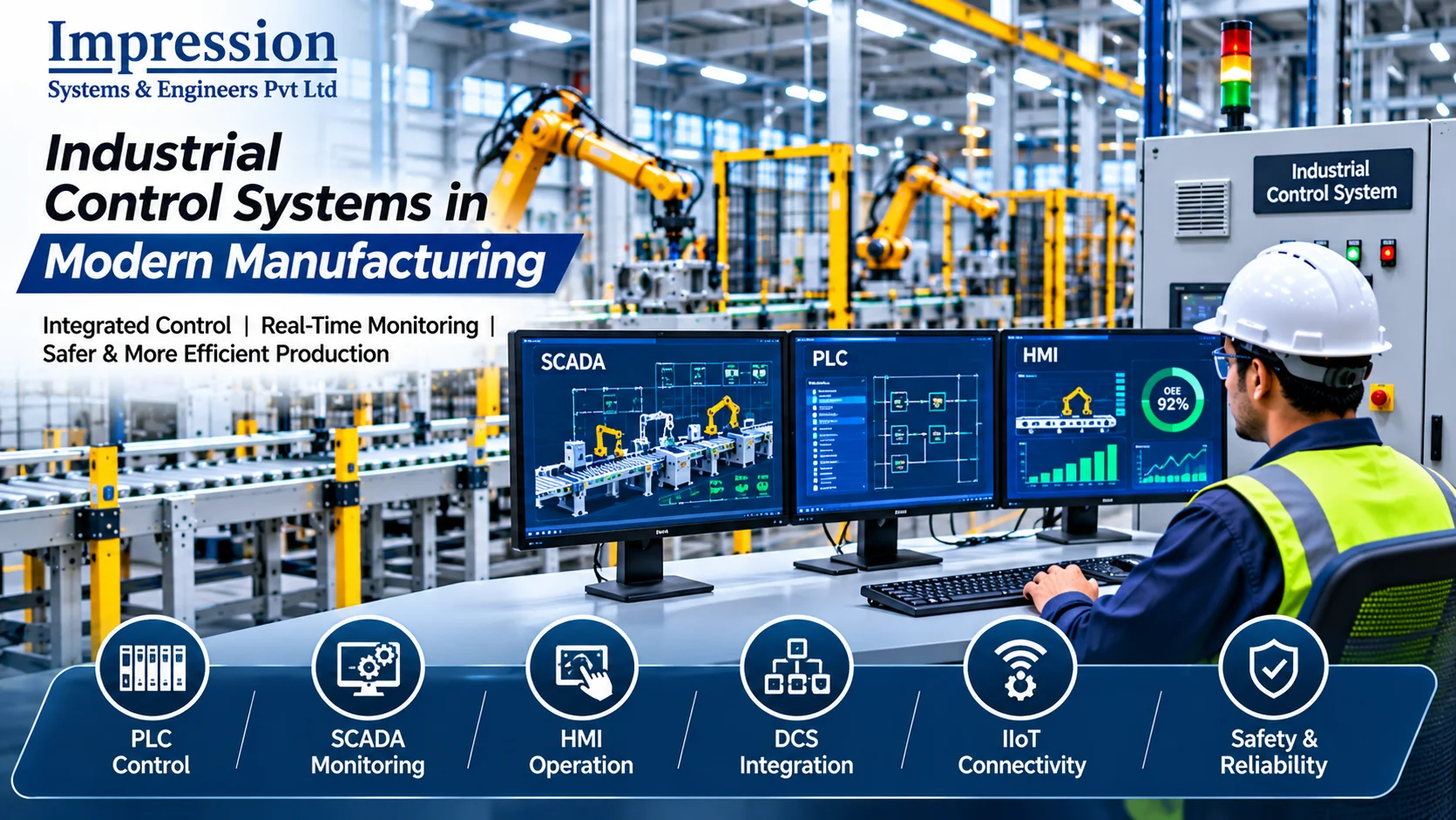
- Supervisory Control and Data Acquisition (SCADA) systems.
- Machine vision and inspection equipment.
- Electrical control panels.
- Manufacturing software and communication networks.
The configuration depends on the product, manufacturing process, required output, and operating environment.
The primary objective is to coordinate production activities in a repeatable, controlled, and efficient manner.
How Do Automated Production Line Systems Work?
An automated production line follows a predefined sequence of manufacturing operations. Individual machines and stations perform specific tasks, while control systems coordinate their activities.
Although each manufacturing application is different, most automated production lines follow a common operating structure.
1. Material Feeding
Raw materials or components are supplied to the production line using suitable feeding mechanisms.
These may include hoppers, feeders, pallets, conveyors, robotic loading systems, or manual loading stations.
Sensors can detect material presence and help prevent equipment from operating when required components are unavailable.
2. Positioning and Transfer
Components are moved between workstations through conveyors, transfer units, robotic systems, or automated guided vehicles.
Positioning devices and sensors help ensure that products reach the correct processing location.
3. Manufacturing or Processing
Machines perform the required manufacturing operations. These may include cutting, drilling, machining, welding, forming, filling, fastening, or other application-specific processes.
PLCs and machine controllers coordinate the equipment according to predefined operating sequences.
4. Assembly Operations
Where products contain multiple components, automated assembly stations perform activities such as component placement, fastening, joining, and fitting.
Robots may be used for repetitive operations that require consistent movement and positioning.
5. Inspection and Quality Control
Inspection systems evaluate selected product characteristics during or after production.
Depending on the application, these may use sensors, measuring devices, cameras, machine vision, or automated testing equipment.
Products that fail defined inspection criteria can be identified and directed for rejection or further review.
6. Packaging and Dispatch Preparation
Finished products may be transferred to automated packaging, labeling, sorting, palletizing, or wrapping stations.
Production information can also be recorded for traceability and inventory management.
7. Monitoring and Control
Control systems monitor equipment status, production sequences, alarms, and process conditions.
Operators can use HMI or SCADA interfaces to view operating information, respond to alarms, and perform authorized control actions.
This coordinated structure helps manufacturers manage the movement of products and information across the production line.
Main Components of an Automated Production Line
The performance of an automated production line depends on how its individual components are selected, configured, and integrated.
1. Programmable Logic Controllers (PLCs)
PLCs are industrial controllers used to manage machine operations and production sequences.
They receive signals from sensors and other input devices, execute programmed logic, and send commands to motors, actuators, valves, and other output devices.
Common PLC applications include:
- Conveyor control.
- Machine sequencing.
- Automated assembly.
- Motor and pump operation.
- Equipment interlocking.
- Packaging machinery.
- Production station coordination.
PLC selection should consider input/output requirements, processing capacity, communication interfaces, environmental conditions, expansion capability, and long-term support.
2. Industrial Robots
Industrial robots perform physical manufacturing operations with programmed movements.
They are used in applications such as:
- Welding.
- Painting.
- Pick-and-place operations.
- Machine tending.
- Assembly.
- Material handling.
- Palletizing.
- Packaging.
Robot selection depends on payload, reach, cycle time, repeatability, workspace, tooling, and operating conditions.
The robot must also be integrated with surrounding equipment, sensors, fixtures, and control systems.
3. Conveyor Systems
Conveyors move materials and products between production stations.
Different conveyor types are suitable for different loads, shapes, speeds, and operating environments.
Common examples include:
- Belt conveyors.
- Roller conveyors.
- Chain conveyors.
- Slat conveyors.
- Overhead conveyors.
- Modular plastic belt conveyors.
- Pallet transfer conveyors.
Conveyor selection should account for product dimensions, weight, transfer distance, speed, layout, accumulation requirements, and maintenance access.
4. Sensors and Instrumentation
Sensors provide information about the condition and position of products, equipment, and processes.
Common industrial sensors include:
- Proximity sensors.
- Photoelectric sensors.
- Temperature sensors.
- Pressure transmitters.
- Flow meters.
- Level sensors.
- Position sensors.
- Encoders.
- Vision sensors.
They support product detection, machine sequencing, process monitoring, and quality inspection.
5. Human-Machine Interface (HMI)
An HMI allows operators to interact with automated equipment.
It may display machine status, operating modes, production counts, alarms, process values, and maintenance messages.
A well-designed HMI should provide clear information and straightforward navigation so operators can understand system conditions and respond appropriately.
6. Supervisory Control and Data Acquisition (SCADA)
SCADA systems provide supervisory monitoring and control across machines and production processes.
They can collect operational information, display equipment conditions, manage alarms, and maintain historical records.
In a facility with multiple production lines, SCADA may provide a centralized view of selected operational information.
7. Electrical Control Panels
Electrical control panels contain the equipment needed to distribute power and coordinate machine operations.
They may include:
- PLCs and I/O modules.
- Motor starters.
- Variable Frequency Drives (VFDs).
- Circuit protection devices.
- Relays and contactors.
- Power supplies.
- Network switches.
- Safety-related components.
- Terminal blocks.
Panel design must consider electrical ratings, heat management, enclosure protection, wiring, accessibility, and applicable standards.
8. Machine Vision Systems
Machine vision uses cameras, lighting, image processing, and software to inspect or identify products.
Typical applications include checking product presence, identifying component orientation, reading codes, inspecting dimensions, and detecting selected surface defects.
The system must be designed around the product characteristics, inspection requirements, lighting conditions, and acceptable defect criteria.
9. Industrial Communication Networks
Industrial communication networks allow machines, controllers, sensors, and supervisory systems to exchange information.
Depending on the application, technologies may include PROFINET, EtherNet/IP, Modbus TCP, Modbus RTU, OPC UA, and other supported industrial protocols.
Network design should address device compatibility, performance, reliability, cybersecurity, and future expansion.
Types of Automated Production Line Systems
Manufacturers use different types of automation depending on product characteristics, production volume, process requirements, and flexibility needs.
1. Fixed Automation
Fixed automation uses dedicated equipment designed to perform a specific sequence of manufacturing operations.
It is commonly suitable for high-volume production where product designs and process requirements remain relatively stable.
Examples include dedicated assembly lines, automatic transfer machines, and specialized packaging systems.
Advantages:
- High production output for suitable applications.
- Repeatable operating sequences.
- Consistent process execution.
- Reduced repetitive manual activities.
Limitations:
- Limited flexibility.
- Product changes may require engineering modifications.
- Specialized equipment can involve significant initial investment.
2. Programmable Automation
Programmable automation allows machines to perform different operations through changes in control programs or production settings.
It is useful where manufacturers produce different batches or product variants.
Examples include CNC machines, programmable assembly equipment, and batch processing systems.
Its flexibility depends on machine capabilities, changeover requirements, and the time needed to configure different production programs.
3. Flexible Automation
Flexible automation allows production equipment to accommodate product variations with limited interruption.
It may use programmable machines, robotics, automatic tooling changes, and integrated material handling.
This approach is useful for manufacturers handling different product models or changing production requirements.
4. Integrated Automation
Integrated automation connects different production machines, material handling equipment, control systems, and manufacturing software into a coordinated environment.
It may combine PLCs, SCADA, robotics, production monitoring, and manufacturing execution systems.
The objective is to improve coordination and information exchange between production operations.
Benefits of Automated Production Line Systems
Well-designed automation can improve manufacturing performance when it is matched to actual production requirements.
1. Higher Production Efficiency
Automated machines can perform predefined operations consistently and coordinate production sequences.
This can reduce delays between workstations and help maintain a more continuous flow of materials.
The actual improvement depends on machine capacity, cycle time, changeover requirements, and system availability.
2. Improved Product Quality
Automation can support consistent manufacturing processes through repeatable machine movements, controlled parameters, and automated inspection.
Sensors and machine vision systems can identify selected process deviations and product defects.
However, product quality still depends on correct process design, calibration, maintenance, and suitable inspection methods.
3. Reduced Manual Handling
Automated conveyors, robots, transfer systems, and lifting equipment can reduce repetitive material movement.
This may help improve workflow efficiency and reduce employee exposure to certain physically demanding tasks.
4. Better Production Monitoring
Integrated control and monitoring systems can provide information about production counts, cycle times, machine conditions, alarms, and equipment availability.
This information can help supervisors understand performance and identify bottlenecks.
5. Improved Process Consistency
Automated sequences help equipment follow defined operating instructions.
This can reduce variation associated with repetitive manual operations, provided that equipment is maintained and operating parameters are correctly configured.
6. More Efficient Use of Resources
Automation can help manage material movement, machine operation, and process parameters.
Depending on the application, this may reduce unnecessary handling, rework, material waste, or energy consumption.
7. Support for Production Growth
A modular and scalable production line can make it easier to add workstations, machines, and additional functions as manufacturing requirements change.
Scalability should be considered during the original design rather than assumed after installation.
Applications Across Different Manufacturing Industries
Automated production lines are used across multiple sectors. Each industry requires a configuration based on its products, materials, manufacturing processes, and quality requirements.
1. Automotive Industry
Automotive manufacturing uses automation for body assembly, welding, painting, component fitting, material transfer, inspection, and final assembly.
Robotic workstations can perform repetitive welding and handling tasks, while conveyors move vehicle bodies and components between production stations.
PLCs coordinate equipment sequences, and inspection systems help verify selected manufacturing characteristics.
2. Food and Beverage Industry
Food and beverage production lines use automation for processing, filling, mixing, sealing, labeling, packaging, and palletizing.
Automation design must consider product characteristics, hygiene, cleaning requirements, temperature control, traceability, and applicable food safety regulations.
Sensors and control systems help maintain defined process conditions.
3. Metal Industry
Metal manufacturing uses automated equipment for cutting, forming, machining, welding, finishing, and inspection.
Robots and material handling systems can transfer heavy components between workstations, while CNC machines perform programmed operations.
The system design must consider load characteristics, machine safety, material dimensions, and process tolerances.
4. Home Appliances Manufacturing
Appliance production involves assembly, fastening, wiring, testing, inspection, and packaging.
Automated assembly stations can support repetitive operations, while testing equipment verifies selected electrical and mechanical product characteristics.
Integrated production systems help coordinate the movement of components through multiple assembly stages.
5. Pharmaceutical Manufacturing
Pharmaceutical production may use automated systems for material handling, processing, filling, packaging, labeling, and inspection.
These environments have specific regulatory, validation, cleanliness, traceability, and documentation requirements.
Automation must be designed and validated according to the relevant regulatory framework and the manufacturer’s quality system.
6. Electronics Manufacturing
Electronics manufacturing uses automation for component placement, soldering, inspection, testing, and packaging.
Precision machines and vision systems help perform operations that require accurate positioning and inspection.
The design must consider component size, handling sensitivity, production speed, and quality requirements.
7. Packaging Industry
Packaging lines use automation for product feeding, filling, sealing, labeling, coding, sorting, carton handling, and palletizing.
The appropriate system depends on packaging format, product size, required output, changeover frequency, and packaging material.
Step-by-Step Process for Implementing an Automated Production Line
A successful automation project requires planning across engineering, operations, maintenance, safety, and management teams.
Step 1: Analyze Production Requirements
Begin by studying the existing manufacturing process and defining the production objectives.
Important information includes:
- Product dimensions and characteristics.
- Required production volume.
- Target cycle time.
- Number of product variants.
- Existing machine capacity.
- Material flow.
- Quality requirements.
- Available floor space.
- Workforce and maintenance capabilities.
- Future production plans.
This information helps determine the level of automation required.
Step 2: Map the Production Workflow
Document the sequence of manufacturing operations from raw material input to finished product output.
Identify each workstation, transfer point, inspection stage, and manual activity.
A process flow diagram can help reveal bottlenecks, unnecessary movement, waiting time, and potential automation opportunities.
Step 3: Define the Automation Concept
Develop an initial system concept describing how machines, robots, conveyors, operators, and control systems will work together.
Consider whether the project requires a complete automated line, selected automated stations, or an upgrade to existing equipment.
The concept should include preliminary equipment arrangements, material flow, control architecture, and safety considerations.
Step 4: Select Suitable Equipment
Choose machines, robots, conveyors, sensors, motors, and control devices based on the application.
Evaluate technical specifications, compatibility, expected performance, environmental conditions, maintenance requirements, and supplier support.
Equipment should be selected as part of the complete system rather than as isolated purchases.
Step 5: Develop Mechanical and Electrical Designs
The mechanical design addresses machine structures, equipment layouts, fixtures, product positioning, and material transfer.
The electrical design covers power distribution, control circuits, protection, wiring, control panels, and field devices.
Project documentation may include:
- General arrangement drawings.
- Electrical schematics.
- Control panel layouts.
- Cable schedules.
- Input/output lists.
- Mechanical drawings.
- Pneumatic and hydraulic diagrams.
- Equipment specifications.
- Bill of materials.
Step 6: Develop the Control System
Control engineering defines how the production line operates.
PLC programming may cover machine sequences, start and stop conditions, interlocks, conveyor logic, motor control, alarms, and equipment communication.
The design should also define recovery procedures and system behaviour during faults, communication interruptions, and power failures.
Step 7: Integrate Machines and Material Handling
Connect the machines, robots, conveyors, sensors, and other equipment according to the approved system architecture.
The integration should ensure that products move between workstations in the correct sequence and that equipment exchanges the necessary operating information.
Step 8: Perform Testing and Validation
Testing verifies that the system meets its functional, operational, and safety requirements.
Depending on the project, testing may include:
- Individual machine testing.
- Input and output verification.
- PLC logic testing.
- Communication testing.
- Conveyor and robot sequence testing.
- Alarm and fault testing.
- Product inspection testing.
- Safety function validation.
- Production cycle testing.
Factory Acceptance Testing (FAT) may be performed before equipment is delivered, while Site Acceptance Testing (SAT) verifies the installed system at the manufacturing facility.
Step 9: Install and Commission the Production Line
Installation includes mechanical positioning, electrical connections, network configuration, equipment alignment, and system integration.
Commissioning checks whether the complete line operates according to the approved design.
Production trials should verify the required product handling, cycle times, process conditions, and quality criteria.
Step 10: Train Operators and Maintenance Teams
Operators need training on machine operation, system status, production changeovers, alarms, and emergency procedures.
Maintenance personnel need suitable documentation and training covering equipment inspection, troubleshooting, backups, and preventive maintenance.
Step 11: Monitor and Optimize
After production begins, monitor the system to understand its actual performance.
Review cycle time, equipment availability, downtime, rejection rates, production output, and maintenance requirements.
Use these measurements to identify improvement opportunities and refine the system where justified.
Challenges in Automated Production Line Implementation
Automation can improve manufacturing operations, but projects may face technical, financial, and operational challenges.
1. High Initial Investment
Automated production lines may require investment in machines, robots, control systems, installation, software, and engineering.
How to address it: Prepare a business case that evaluates total lifecycle costs, expected production benefits, maintenance requirements, and system utilization.
2. Integration with Existing Equipment
Older machines may use different communication technologies, electrical configurations, or control platforms.
How to address it: Conduct an equipment and compatibility assessment before finalizing the architecture. Identify suitable interfaces, retrofit options, and integration requirements.
3. Production Downtime During Installation
Installing or upgrading a production line can interrupt existing operations.
How to address it: Develop a realistic implementation schedule, plan installation windows, consider staged deployment, and prepare contingency arrangements.
4. Product Variation and Changeovers
Manufacturers producing multiple product variants may need flexible tooling, programmable settings, or different machine configurations.
How to address it: Consider product variation and changeover time during system design. Evaluate flexible automation where it is technically and commercially appropriate.
5. Maintenance and Technical Skills
Automated systems require trained personnel who can maintain mechanical equipment, electrical systems, controllers, networks, and software.
How to address it: Include training, documentation, spare-parts planning, and maintenance support in the project scope.
6. Safety Requirements
Robots, conveyors, machines, and automated transfer equipment introduce hazards that must be assessed.
How to address it: Conduct machinery risk assessments and implement appropriate guarding, safety interlocks, emergency stops, safe operating modes, and validated safety functions.
7. Cybersecurity Risks
Connected production systems may be exposed to unauthorized access, insecure remote connections, and vulnerabilities in industrial networks.
How to address it: Apply suitable network segmentation, access control, secure remote access, backup procedures, monitoring, and patch management.
Best Practices for Designing Efficient Automated Production Lines
Good engineering practices can improve the reliability and maintainability of an automated manufacturing system.
Define Measurable Production Goals
Identify the desired production output, cycle time, quality level, equipment availability, and other important performance requirements before selecting equipment.
Design for the Complete Process
Consider the flow of raw materials, components, work-in-progress, finished products, and rejected items.
A fast individual machine will not necessarily improve the complete line if other workstations cannot maintain the required production rate.
Balance Workstations
The capacity of individual stations should be evaluated to prevent bottlenecks and excessive waiting.
Cycle time, equipment availability, changeovers, and planned maintenance all affect the effective output of a production line.
Prioritize Safety
Safety should be considered throughout the design and implementation process.
Machine guarding, safe access, emergency stopping, risk reduction, and safety-related control functions should be assessed according to the application.
Plan for Maintenance Access
Equipment should be arranged to allow inspection, cleaning, servicing, and component replacement.
Maintenance access should be included in the layout rather than treated as an afterthought.
Use Standardized Components Where Appropriate
Standardized equipment, communication methods, documentation, and control practices can simplify maintenance and future modifications.
Design for Future Expansion
Consider spare control capacity, additional communication requirements, equipment space, and potential product changes.
A modular design can help accommodate future modifications without replacing the entire system.
Maintain Complete Documentation
Keep electrical drawings, mechanical layouts, software backups, equipment manuals, test records, and maintenance instructions updated.
Documentation is essential for safe operation and long-term support.
Important Technologies Used in Modern Production Line Automation
Modern production lines combine traditional industrial control technologies with advanced digital systems.
Industrial Internet of Things (IIoT)
IIoT connects industrial equipment and sensors to digital platforms that collect operational data.
This can support equipment monitoring, production reporting, and condition-based maintenance initiatives.
Machine Vision
Machine vision uses cameras and image processing to inspect products, verify component presence, identify orientation, and detect selected defects.
Robotics and Collaborative Robots
Industrial robots automate repetitive physical operations. Collaborative robots are designed for applications involving human-robot interaction under defined safety conditions.
The correct robot type depends on payload, reach, cycle time, application risk, and workspace requirements.
Manufacturing Execution Systems (MES)
MES platforms help manage and monitor production activities, including work orders, production tracking, work-in-progress, and quality records.
Integration between MES and automation systems can improve information flow across manufacturing operations.
Digital Twins and Simulation
Simulation tools can help evaluate production layouts, machine sequences, material flow, and potential bottlenecks before implementation.
A digital twin may use data from a physical asset or process to support analysis and monitoring.
Predictive Maintenance
Predictive maintenance uses equipment condition data and analytical methods to identify signs of possible failure.
When supported by appropriate sensors, data, and validated methods, it can help maintenance teams plan interventions.
How to Measure Automated Production Line Performance
Manufacturers should establish performance indicators before commissioning an automated production line.
Useful measurements include:
Production throughput: The number of acceptable units produced during a defined period.
Cycle time: The time required to complete a production cycle or operation.
Equipment availability: The proportion of planned operating time that equipment is available for production, using a clearly defined calculation.
Overall Equipment Effectiveness (OEE): A performance measure combining availability, performance, and quality.
Rejection rate: The proportion of products that fail defined quality criteria.
Downtime: The time during which equipment or the production line cannot perform its intended operation.
Changeover time: The time required to switch between products, tools, or production configurations.
Maintenance frequency: The frequency of planned and unplanned maintenance activities.
These indicators should be interpreted together. Increasing machine speed, for example, does not necessarily improve overall production if it increases defects or causes downstream bottlenecks.
Future Trends in Automated Production Line Systems
Manufacturing automation continues to develop as businesses adopt connected equipment, advanced robotics, and data-driven production methods.
1. Smart Manufacturing
Smart manufacturing connects machines, production systems, and digital platforms to improve operational visibility and coordination.
2. Artificial Intelligence in Quality Inspection
AI-based inspection tools can help identify selected product defects and patterns in image or process data.
Their effectiveness depends on suitable training data, validation, operating conditions, and human oversight.
3. Autonomous Mobile Robots
Autonomous Mobile Robots (AMRs) can transport materials within manufacturing and warehouse environments.
They may support flexible material movement between storage areas, production stations, and dispatch locations.
4. Flexible Manufacturing Systems
Flexible manufacturing systems are designed to accommodate product variations and changing production requirements through programmable equipment, automated handling, and coordinated controls.
5. Digital Production Monitoring
Manufacturers are increasingly using production dashboards and analytics to understand equipment performance, production output, and process conditions.
6. Greater Focus on Energy Efficiency
Automation design is increasingly considering energy consumption, efficient motor operation, idle-time reduction, and improved process control.
The benefits depend on the application and how the system is operated.
How to Choose the Right Automated Production Line Solution Provider
Selecting a suitable engineering partner is important because production line automation involves multiple interconnected disciplines.
Manufacturers should evaluate potential providers based on:
Industry experience: Look for an understanding of the relevant manufacturing processes, materials, production requirements, and operating conditions.
Engineering capabilities: Review experience with machine design, electrical engineering, PLCs, robotics, conveyors, control systems, and system integration where relevant.
Project planning: Confirm that the provider can explain the proposed scope, timeline, equipment requirements, testing approach, and commissioning process.
Safety awareness: Ensure that machinery risk assessment and relevant safety requirements are included in the engineering approach.
Documentation: Confirm that drawings, equipment details, software backups, operating instructions, and maintenance documentation will be provided.
Training and support: Evaluate operator training, troubleshooting support, maintenance services, and availability of technical assistance.
Scalability: Discuss how the proposed system can accommodate future production changes or expansion.
A suitable partner should understand the manufacturer’s actual requirements and propose an application-specific solution rather than a generic package.
Conclusion
Automated Production Line Systems play an important role in modern manufacturing by coordinating machines, material handling equipment, robots, sensors, and control technologies into an integrated production environment.
A well-designed production line can improve production consistency, support higher output, reduce repetitive manual handling, enhance monitoring, and provide better control over manufacturing operations.
However, successful automation requires more than installing advanced equipment. Manufacturers must understand their production requirements, analyze material flow, select suitable technologies, develop reliable control architecture, prioritize safety, and plan for maintenance and future expansion.
The implementation process should include requirement analysis, engineering design, equipment integration, testing, commissioning, operator training, and ongoing performance monitoring.
As technologies such as industrial robotics, IIoT, machine vision, MES, and digital simulation continue to develop, manufacturers have more opportunities to improve production processes and build flexible, connected manufacturing environments.
Planning to automate your manufacturing operations? Explore Imensys industrial automation services and contact the Imensys team to discuss your production line requirements.
Frequently Asked Questions (FAQs)
1. What are automated production line systems?
Automated production line systems use machines, robots, sensors, conveyors, controllers, and software to perform and coordinate manufacturing operations with reduced manual intervention.
2. What are the main components of an automated production line?
Common components include PLCs, industrial robots, conveyors, sensors, HMIs, SCADA systems, electrical control panels, machine vision equipment, and industrial communication networks.
3. What are the different types of production line automation?
The main types include fixed automation, programmable automation, flexible automation, and integrated automation. Each is suited to different production volumes and levels of product variation.
4. How do automated production lines improve manufacturing efficiency?
They can coordinate machine operations, reduce repetitive manual activities, improve material flow, support consistent production cycles, and provide operational information for performance monitoring.
5. Which industries use automated production line systems?
Automotive, food and beverage, metal processing, home appliances, pharmaceuticals, electronics, packaging, and many other manufacturing industries use automated production lines.
6. What is the role of PLCs in production line automation?
PLCs control machine sequences by receiving input signals, executing programmed logic, and sending commands to equipment such as motors, valves, actuators, and conveyors.
7. What is the difference between automated and manual production lines?
Manual production lines rely more heavily on people to perform and coordinate manufacturing tasks. Automated lines use machines and control systems to perform selected operations with reduced manual intervention.
8. How much does an automated production line cost?
The cost depends on production capacity, equipment selection, product complexity, number of workstations, robotics requirements, integration, installation, and safety provisions. A project-specific engineering assessment is needed for a reliable estimate.
9. What is the role of robotics in automated production lines?
Industrial robots can perform tasks such as welding, assembly, machine tending, material handling, packaging, and palletizing. Their use depends on application requirements and safety assessment.
10. How is an automated production line implemented?
Implementation generally includes production analysis, workflow mapping, automation concept development, equipment selection, engineering design, control programming, system integration, testing, commissioning, and training.
11. Can existing production lines be automated?
Yes. Existing lines may be upgraded through selected machine automation, conveyors, sensors, robots, control systems, or software integration. Feasibility depends on the existing equipment, layout, compatibility, and production requirements.
12. What is the future of automated production line systems?
Future developments include smart manufacturing, AI-assisted inspection, flexible automation, autonomous mobile robots, digital twins, connected production monitoring, and improved energy management.