Industrial Automation System Design: A Complete Guide for Modern Manufacturing
Industrial Automation System Design is a critical part of modern manufacturing, helping businesses improve production efficiency, maintain consistent product quality, reduce operational costs, and create safer working environments. As industries adopt advanced technologies and increasingly connected production processes, designing an effective automation system has become an important investment for manufacturers looking to remain competitive.
Industrial automation involves using control systems, machinery, sensors, software, robotics, and communication technologies to operate industrial processes with limited manual intervention. However, successful automation is not simply about purchasing machines or installing programmable logic controllers (PLCs). It requires a structured design approach that considers production requirements, equipment capabilities, process workflows, safety, integration, scalability, and long-term maintenance.
A well-designed automation system connects different machines and industrial processes into a coordinated operating environment. It allows manufacturers to monitor production activities, identify operational issues, collect useful data, and make informed decisions.
This guide explains the fundamentals of industrial automation system design, its main components, design stages, technologies, applications, benefits, challenges, and best practices for modern manufacturing facilities.
What Is Industrial Automation System Design?
Industrial Automation System Design is the engineering process of planning, developing, integrating, and configuring automated equipment and control technologies to perform industrial operations efficiently and reliably.
It involves understanding how a manufacturing process works and determining which activities can be automated. Engineers evaluate production requirements, select suitable equipment, define control strategies, develop electrical and mechanical designs, establish communication networks, and integrate the complete system.
The objective is to create an automation solution that meets the operational requirements of a facility while maintaining safety, quality, reliability, and cost effectiveness.
Industrial automation system design may include:
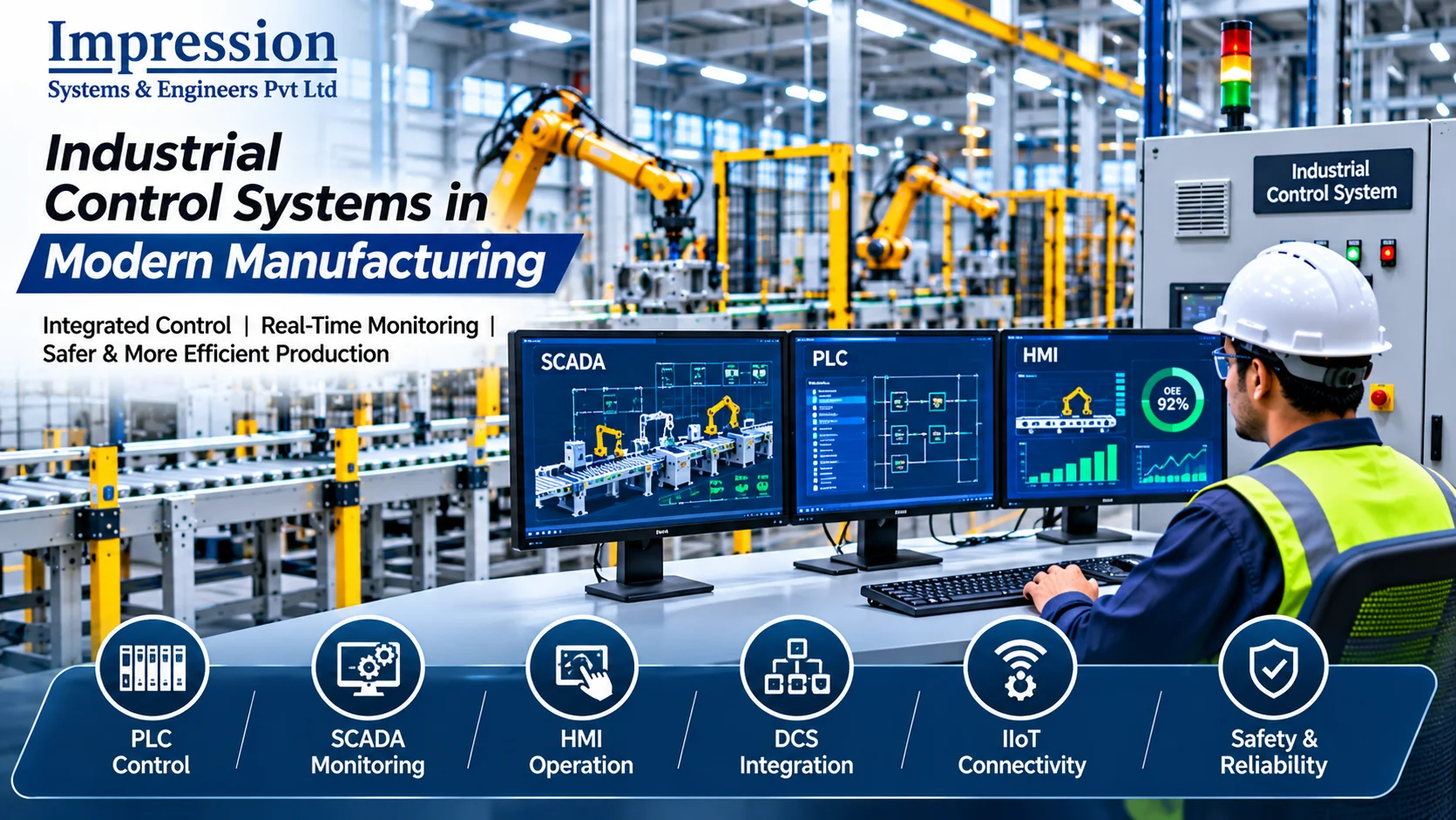
- Programmable Logic Controllers (PLCs)
- Supervisory Control and Data Acquisition (SCADA) systems
- Human-Machine Interfaces (HMIs)
- Industrial sensors and instrumentation
- Robotics and automated machines
- Conveyor and material handling systems
- Industrial communication networks
- Electrical control panels
- Manufacturing software integration
- Safety and monitoring systems
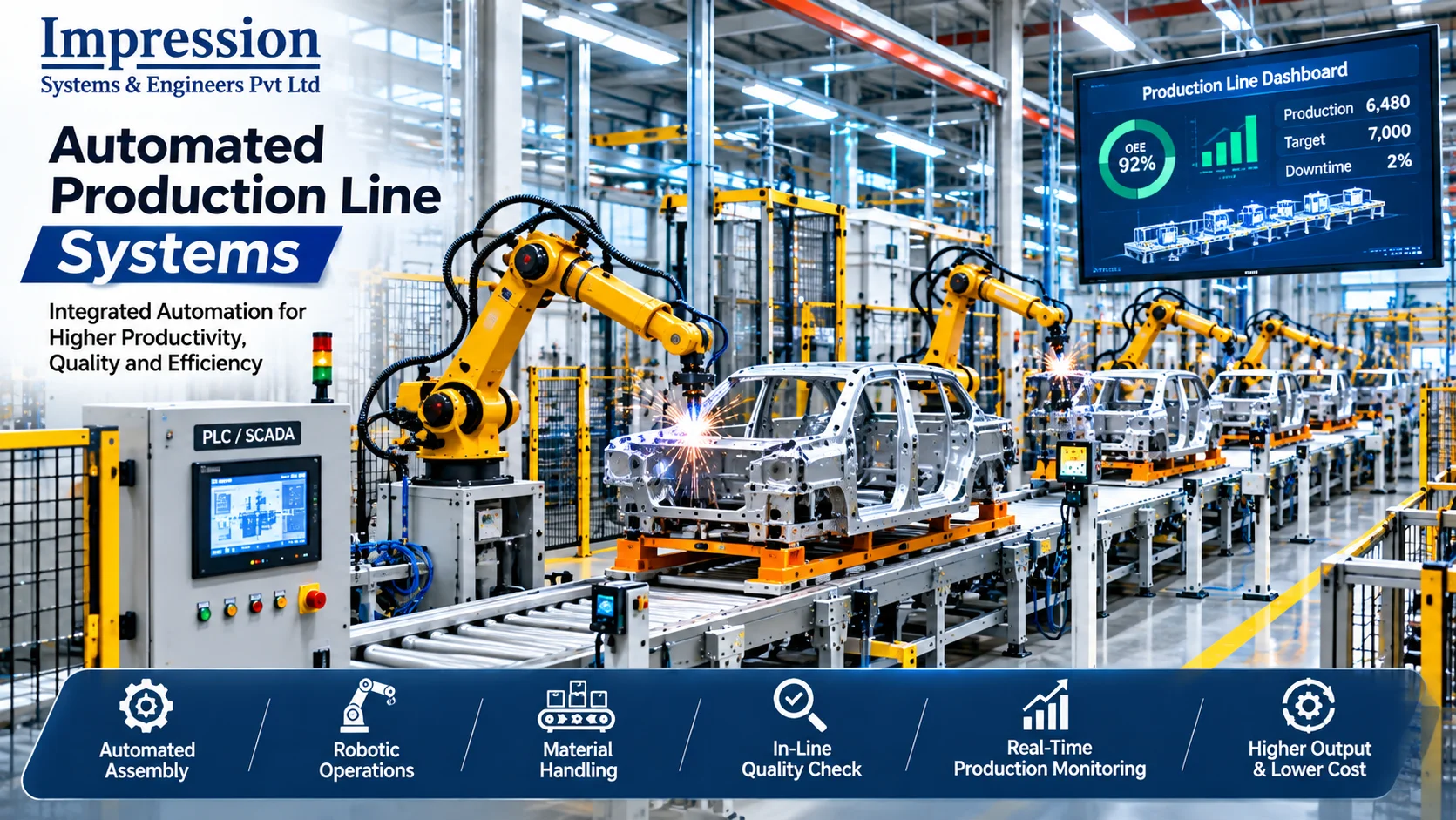
For example, an automotive manufacturer may require an automated assembly line in which robots perform welding operations, conveyors transport components, sensors detect product positions, and PLCs coordinate machine operations.
The design process ensures that every component works together as part of a reliable production system.
Why Is Industrial Automation System Design Important?
Manufacturing environments are becoming more complex because of increasing production demands, product customization, quality expectations, and competition. Traditional manual operations may struggle to deliver the speed, consistency, and visibility required by modern facilities.
Industrial automation system design helps manufacturers build systems that address these operational challenges.
1. Improves Production Efficiency
A properly designed automation system coordinates machines, equipment, and production activities to reduce unnecessary delays. Automated processes can operate consistently according to predefined instructions and production schedules.
For example, an automated material feeding system can supply components to production machines at the required time. This reduces manual material movement and helps maintain continuous production flow.
2. Improves Product Quality
Manual production activities can introduce variations because of differences in operator methods, fatigue, or inconsistent process conditions.
Automation systems use sensors, control logic, inspection equipment, and repeatable operating sequences to maintain process consistency.
Industrial vision systems and automated inspection equipment can also identify certain defects during production, allowing manufacturers to detect quality problems earlier.
3. Reduces Operational Costs
Automation can reduce costs associated with repetitive manual activities, material handling, production errors, and avoidable downtime.
However, cost savings depend on the application, system utilization, maintenance requirements, and initial investment. A proper design assessment should compare the total lifecycle cost of automation with the expected operational benefits.
4. Enhances Workplace Safety
Automation can reduce the need for workers to perform certain repetitive, physically demanding, or hazardous operations.
Robotic systems, automated transfer equipment, machine guarding, safety sensors, and emergency-stop arrangements can help reduce exposure to operational hazards when properly designed and implemented.
Safety must be considered from the beginning of the engineering process rather than added after installation.
5. Supports Better Production Monitoring
Integrated automation systems can collect operational information such as machine status, cycle times, production counts, alarms, and process conditions.
This information helps supervisors understand production performance and identify areas that require attention.
6. Supports Future Expansion
A scalable automation system can accommodate additional machines, production lines, sensors, and software connections without requiring a complete redesign.
Planning for future capacity is particularly important for manufacturers expecting production growth or changes in product requirements.
Key Components of an Industrial Automation System
An industrial automation system consists of multiple hardware and software components. Each component performs a specific function, and their coordination determines the overall performance of the system.
1. Programmable Logic Controllers (PLCs)
A Programmable Logic Controller is an industrial computer used to control machines and automated processes.
PLCs receive signals from input devices, execute programmed logic, and send commands to output devices.
Typical PLC applications include:
- Conveyor control
- Machine sequencing
- Motor operation
- Pump control
- Automated assembly
- Packaging machinery
- Interlocking and process control
PLCs are commonly selected for industrial applications because they are designed for reliable operation in demanding environments.
During system design, engineers consider the number of inputs and outputs, processing requirements, communication protocols, expansion capacity, environmental conditions, and maintenance needs.
2. Supervisory Control and Data Acquisition (SCADA)
SCADA systems provide supervisory monitoring and control of industrial processes.
They allow operators and supervisors to view process information, monitor equipment conditions, acknowledge alarms, and interact with supported control functions.
A SCADA system may include:
- Operator workstations
- Communication infrastructure
- Supervisory software
- Historical data storage
- Alarm management
- Process visualization
For example, a manufacturing facility with multiple production areas can use SCADA to monitor machine conditions and important process parameters from a central location.
SCADA design should consider system availability, access permissions, alarm priorities, data retention, communication reliability, and cybersecurity.
3. Human-Machine Interface (HMI)
An HMI is the interface through which operators interact with an automated machine or process.
It presents information in a visual format, allowing operators to monitor operating conditions and perform permitted control actions.
An HMI may display:
- Machine operating status
- Production counters
- Temperature and pressure values
- Alarm notifications
- Process diagrams
- Operating modes
- Maintenance information
A well-designed HMI should be easy to understand and should present important information clearly. Poorly designed screens can increase operator confusion and delay responses to abnormal conditions.
4. Sensors and Instrumentation
Sensors collect information from machines and industrial processes.
Common industrial sensors include:
- Proximity sensors
- Photoelectric sensors
- Temperature sensors
- Pressure transmitters
- Flow meters
- Level sensors
- Position sensors
- Encoders
- Vibration sensors
The selection of sensors depends on measurement requirements, operating environment, accuracy, response time, installation conditions, and compatibility with the control system.
5. Actuators and Control Devices
Actuators convert control signals into physical movement or action.
Examples include electric motors, pneumatic cylinders, hydraulic actuators, solenoid valves, and control valves.
The automation system uses these devices to operate machines, move materials, adjust process conditions, and execute production sequences.
6. Industrial Robots
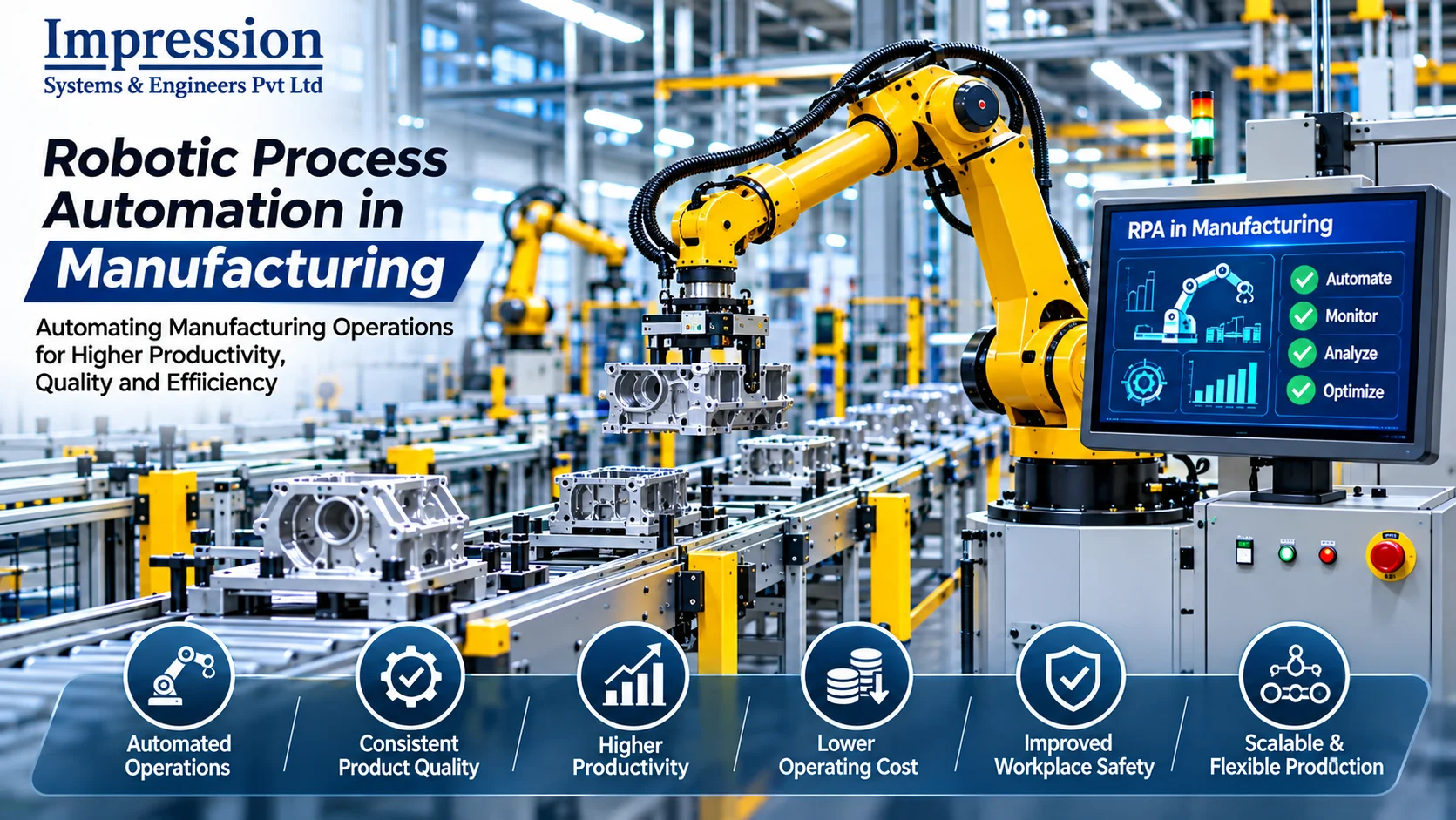
Industrial robots perform automated tasks such as welding, painting, material handling, assembly, machine tending, and palletizing.
Robot selection depends on payload, reach, speed, accuracy, workspace, operating environment, tooling, and safety requirements.
Robots must be integrated with surrounding equipment and control systems so that production activities occur in the correct sequence.
7. Industrial Communication Networks
Communication networks allow automation devices and software platforms to exchange information.
Depending on the application, industrial communication may use technologies and protocols such as PROFINET, EtherNet/IP, Modbus TCP, Modbus RTU, OPC UA, and other supported industrial interfaces.
The design should consider network topology, bandwidth, latency, device compatibility, redundancy, segmentation, and cybersecurity.
8. Electrical Control Panels
Electrical control panels contain the electrical and control equipment needed to operate an automation system.
They may include:
- PLCs and I/O modules
- Motor starters
- Variable Frequency Drives (VFDs)
- Circuit protection devices
- Power supplies
- Relays and contactors
- Network switches
- Terminal blocks
- Safety components
Panel design must consider electrical ratings, heat dissipation, protection, accessibility, wiring practices, and applicable standards.
Types of Industrial Automation Systems
Different manufacturing processes require different levels and types of automation. Understanding the production environment helps engineers select an appropriate solution.
1. Fixed Automation
Fixed automation is designed to perform a specific sequence of operations repeatedly.
It is commonly used in high-volume production environments where the product design and manufacturing process remain relatively stable.
Examples include dedicated transfer lines, automatic assembly equipment, and specialized packaging machinery.
Advantages:
- High production output
- Consistent operating sequences
- Reduced repetitive manual work
- Suitable for standardized production
Limitations:
- Limited flexibility
- Changes can require significant engineering modifications
- Higher initial investment for specialized equipment
2. Programmable Automation
Programmable automation allows equipment to perform different operations through changes in software or control programs.
It is suitable for manufacturers producing different product batches or using equipment for multiple production requirements.
Examples include CNC machines, programmable assembly equipment, and batch processing systems.
3. Flexible Automation
Flexible automation supports changes in product types or production requirements with limited interruption.
It is useful in manufacturing environments where product variations and changing customer requirements are common.
Examples include flexible manufacturing cells, robotic production systems, and automated equipment with programmable changeovers.
4. Integrated Automation
Integrated automation connects multiple machines, production processes, and software systems into a coordinated manufacturing environment.
It may combine PLCs, SCADA, robotics, manufacturing execution systems, enterprise software, and material handling equipment.
The objective is to improve information flow and coordination between different levels of manufacturing operations.
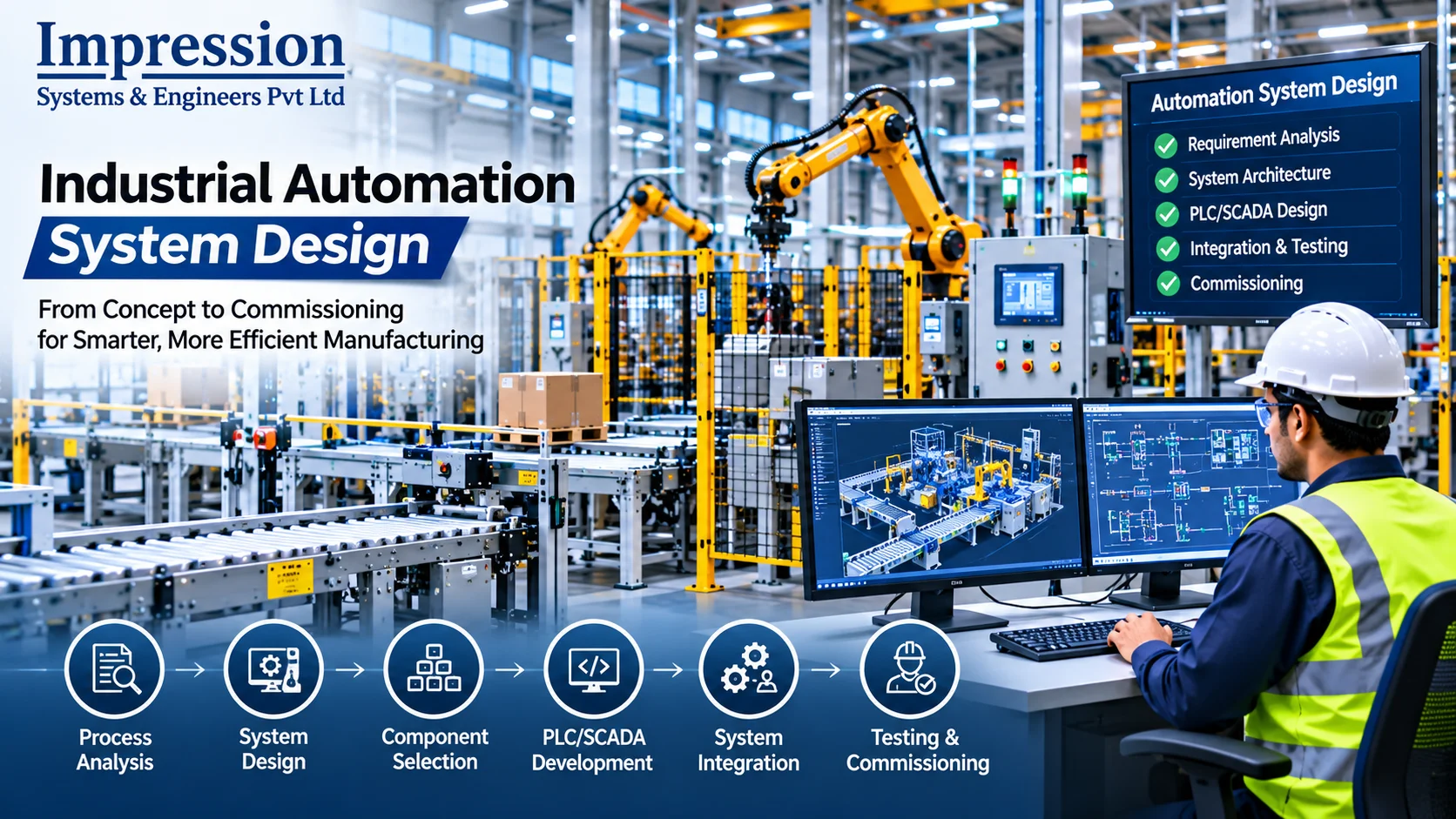
Step-by-Step Process of Industrial Automation System Design
Successful automation requires a structured engineering methodology. Each stage contributes to ensuring that the final system meets the required performance, safety, and operational objectives.
Step 1: Understand Production Requirements
The first stage is to understand the existing production process and identify the problems that automation should solve.
Engineers should examine:
- Current production capacity
- Production cycle times
- Product types and variations
- Existing equipment
- Manual operations
- Material movement
- Quality requirements
- Safety concerns
- Existing bottlenecks
- Expected future demand
Site visits, operator discussions, process observations, and production data can help create an accurate understanding of the facility.
The design team should also define measurable project objectives, such as improving throughput, reducing manual handling, increasing process consistency, or improving production monitoring.
Step 2: Conduct Process Analysis
After gathering production requirements, engineers analyze the complete process.
This may involve creating process flow diagrams, identifying machine sequences, reviewing material movement, and documenting the relationship between equipment and operators.
Important questions include:
- Which activities are repetitive?
- Where do production delays occur?
- Which operations require precise control?
- What information must be monitored?
- Which machines need to communicate?
- Where are safety risks present?
- What happens when equipment fails?
Process analysis helps prevent automation of an inefficient workflow without addressing its underlying problems.
Step 3: Define the Automation Architecture
The automation architecture describes how the system’s hardware, software, communication networks, and control functions will work together.
A typical architecture may contain:
- Field devices such as sensors and actuators.
- Control devices such as PLCs and distributed control systems.
- Supervisory systems such as HMIs and SCADA.
- Manufacturing-level applications such as MES.
- Enterprise-level applications such as ERP.
Not every project requires every layer. The architecture should be based on the process complexity, operating requirements, integration needs, and available budget.
A clearly documented architecture makes implementation, troubleshooting, and future expansion easier.
Step 4: Select Appropriate Hardware
Hardware selection is an important part of automation system design.
Engineers evaluate equipment based on technical specifications and application requirements.
For PLCs, important factors include:
- Number of digital and analog inputs and outputs
- Processing performance
- Communication interfaces
- Memory capacity
- Expansion modules
- Environmental ratings
- Product lifecycle and support
For sensors, engineers consider measurement range, accuracy, operating temperature, mounting conditions, and response time.
For motors and drives, they evaluate load requirements, speed control, starting characteristics, power ratings, and operating conditions.
Equipment should be selected based on compatibility and long-term suitability rather than price alone.
Step 5: Develop the Electrical and Mechanical Design
The electrical design defines power distribution, protection, wiring, control circuits, panel layouts, and field connections.
The mechanical design considers equipment arrangement, machine structures, material flow, mounting arrangements, and physical integration.
Depending on the project, engineering documentation may include:
- Electrical single-line diagrams
- Control schematics
- Panel layout drawings
- Cable schedules
- I/O lists
- Equipment layouts
- Mechanical drawings
- Pneumatic and hydraulic diagrams
- Bill of materials
Accurate documentation is essential for installation, commissioning, maintenance, and future modifications.
Step 6: Develop the Control Logic
Control logic defines how the automation system responds to input signals and executes machine operations.
PLC programming may include:
- Start and stop sequences
- Equipment interlocks
- Operating modes
- Timing functions
- Alarm conditions
- Fault detection
- Motor and actuator control
- Sequence management
- Communication with other devices
The control logic should be structured, documented, and tested. Engineers should also define how the system behaves during abnormal conditions, communication failures, and power interruptions.
Step 7: Design the HMI and SCADA Interface
The operator interface should make the system easy to monitor and operate.
Engineers identify which information operators need, which actions they are permitted to perform, and how alarms should be presented.
Good interface design should include consistent screen layouts, meaningful labels, clear status indications, appropriate alarm priorities, and understandable navigation.
The design should avoid unnecessary visual complexity and should help operators recognize abnormal conditions quickly.
Step 8: Integrate Communication and Software Systems
Modern manufacturing environments often require information exchange between machines, control systems, and business applications.
Integration may connect:
- PLCs with SCADA
- Sensors with control devices
- Robots with production lines
- Machines with MES
- Production systems with ERP
- Industrial equipment with reporting platforms
Integration should be based on compatible interfaces, defined data structures, access controls, and reliable communication.
The project team should identify which data must be exchanged, how frequently it is needed, and which system is responsible for each function.
Step 9: Perform Simulation and Testing
Before full deployment, the design should be reviewed and tested to identify errors and reduce commissioning risks.
Testing may include:
- Control logic simulation
- I/O verification
- Communication testing
- Alarm testing
- Equipment interlock testing
- Sequence testing
- Safety function validation
- Operator interface review
Factory Acceptance Testing (FAT) is often used to verify equipment and system functions before delivery or installation.
Site Acceptance Testing (SAT) checks the installed system under actual site conditions.
The exact testing scope should be defined in the project requirements.
Step 10: Installation and Commissioning
During installation, the engineering team coordinates electrical connections, mechanical installation, device configuration, network setup, and software deployment.
Commissioning verifies that individual components and the integrated system operate as intended.
The team should check:
- Power and electrical connections
- Sensor and actuator operation
- PLC program execution
- HMI and SCADA functions
- Communication between devices
- Equipment sequencing
- Alarm and fault handling
- Safety functions
- Production performance
Any issues identified during commissioning should be documented, corrected, and retested.
Step 11: Training and Handover
Operators and maintenance personnel need appropriate training before the automation system enters regular production.
Training should explain normal operation, operating modes, alarms, emergency procedures, basic troubleshooting, and maintenance requirements.
The handover package may include final drawings, software backups, operating manuals, maintenance instructions, equipment lists, test records, and training documentation.
Step 12: Monitor and Optimize Performance
Automation system design does not end with commissioning.
Manufacturers should monitor system performance and identify opportunities for improvement.
Useful performance indicators may include:
- Production throughput
- Machine availability
- Cycle time
- Downtime
- Rejection rate
- Energy consumption
- Maintenance frequency
- Overall Equipment Effectiveness (OEE)
The collected information can help manufacturers identify bottlenecks and prioritize improvements.
Important Technologies Used in Industrial Automation System Design
Industrial automation continues to develop as manufacturers adopt connected equipment, intelligent control, robotics, and data-driven technologies.
Programmable Logic Controllers
PLCs remain important for machine control, sequencing, and process automation. They provide a practical way to coordinate industrial equipment using programmed instructions.
Supervisory Control and Data Acquisition
SCADA provides centralized monitoring and supervisory control for industrial processes. It can help organizations improve operational visibility across production areas.
Industrial Robotics
Robotic systems automate repetitive and precision-based tasks. Their applications include welding, assembly, packaging, painting, and material handling.
Machine Vision Systems
Machine vision uses cameras, lighting, image processing, and software to inspect products or identify objects.
Applications include dimensional inspection, defect detection, component identification, and robot guidance.
Industrial Internet of Things (IIoT)
IIoT connects industrial devices and equipment to systems that collect and analyze operational information.
It can support remote monitoring, equipment condition analysis, production reporting, and predictive maintenance initiatives.
Manufacturing Execution Systems (MES)
MES platforms help manage and monitor production activities. Depending on the implementation, they may support production scheduling, work-in-progress tracking, quality records, and manufacturing performance monitoring.
Artificial Intelligence and Data Analytics
AI and analytics can help analyze production information, detect unusual patterns, support quality inspection, and identify potential equipment issues.
These technologies should be introduced when reliable data, appropriate infrastructure, and a clearly defined business objective are available.
Applications of Industrial Automation System Design Across Industries
Industrial automation is used across a wide range of manufacturing and processing sectors. The specific design depends on the production environment, equipment, safety requirements, and product characteristics.
1. Automotive Industry
Automotive manufacturing uses automation for body-in-white welding, painting, component assembly, material transfer, inspection, and final assembly.
Robots, PLCs, conveyors, sensors, and coordinated production systems help manage complex manufacturing sequences.
2. Food and Beverage Industry
Food and beverage facilities use automation for processing, filling, packaging, labeling, temperature monitoring, and material movement.
System design must consider hygiene, cleaning requirements, product handling, traceability, and applicable food safety requirements.
3. Metal Industry
Metal manufacturing uses automated systems for cutting, forming, welding, machining, handling, and inspection.
Automation can help maintain repeatable production operations while reducing exposure to certain demanding manual tasks.
4. Home Appliances Manufacturing
Appliance production may include automated assembly, fastening, component feeding, testing, inspection, and packaging.
Integrated automation helps coordinate multiple production stages and maintain consistent assembly processes.
5. Warehousing and Material Handling
Automated warehouses may use conveyors, automated storage and retrieval systems, robotic palletizers, automated guided vehicles, and autonomous mobile robots.
These systems can improve material movement and support better coordination between storage and production operations.
Benefits of a Well-Designed Industrial Automation System
A successful automation project can deliver operational and business benefits when the system is matched to actual manufacturing requirements.
Higher productivity: Automated sequences can reduce delays between operations and support consistent production cycles.
Improved quality: Repeatable processes and automated inspection can reduce certain sources of variation and help identify defects.
Reduced manual handling: Automated material movement can reduce the need for repetitive transportation and lifting tasks.
Better operational visibility: Monitoring systems provide information about equipment conditions, production activity, and process performance.
Improved process consistency: Standardized control logic helps machines follow defined operating sequences.
Support for data-driven decisions: Production information can help managers identify bottlenecks, review performance, and prioritize improvements.
Scalable operations: A modular design can make it easier to add equipment and functions as production requirements change.
The actual benefits should be evaluated against project costs, operating conditions, system utilization, and maintenance requirements.
Common Challenges in Industrial Automation System Design
Although automation can improve manufacturing operations, poorly planned projects can create technical and operational difficulties.
1. High Initial Investment
Automation projects may require significant expenditure on machinery, control equipment, engineering, installation, software, and training.
How to address it: Prepare a business case that considers the total cost of ownership, expected utilization, maintenance costs, and measurable operational improvements.
2. Integration with Existing Equipment
Older machines may use different communication interfaces, control platforms, or electrical configurations.
How to address it: Conduct an equipment audit before finalizing the design. Identify compatibility limitations and plan suitable interfaces, gateways, or retrofit solutions.
3. Lack of Skilled Personnel
Automation systems require trained engineers, operators, and maintenance teams.
How to address it: Include training, documentation, and knowledge transfer in the project scope. Consider whether the organization has the skills required to operate and maintain the proposed system.
4. System Downtime During Implementation
Installation and commissioning can interrupt normal production activities.
How to address it: Plan implementation schedules, installation windows, backup procedures, and staged deployment wherever practical.
5. Cybersecurity Risks
Connected industrial systems may face risks from unauthorized access, insecure remote connections, outdated software, and poorly managed network configurations.
How to address it: Apply industrial cybersecurity practices such as network segmentation, controlled access, secure remote connectivity, system backups, patch management, and monitoring.
6. Limited Future Scalability
An automation system designed only for current production requirements may become difficult to expand.
How to address it: Consider future production capacity, additional I/O requirements, network expansion, equipment compatibility, and modular architecture during the initial design stage.
Best Practices for Effective Industrial Automation System Design
Following established engineering practices helps reduce project risks and improves the long-term performance of automation systems.
Start with Clearly Defined Objectives
Every automation project should have measurable goals. These may include reducing cycle time, improving production throughput, increasing machine availability, or improving process monitoring.
Select Technology Based on the Application
Avoid choosing equipment simply because it is popular or advanced. The selected technology should match the process, operating environment, required performance, and available maintenance capabilities.
Prioritize Safety from the Beginning
Identify hazards during the early design stages. Consider machine guarding, safety interlocks, emergency stops, safe operating modes, and risk reduction measures as appropriate to the application.
Follow Relevant Engineering Standards
Applicable standards help guide the design, implementation, testing, and maintenance of automation systems.
Depending on the project, relevant references may include:
- IEC 60204-1 for electrical equipment of machines
- IEC 61508 for functional safety of electrical, electronic, and programmable electronic safety-related systems
- ISO 12100 for machinery safety risk assessment and risk reduction
- IEC 62443 for industrial automation and control system cybersecurity
- ISA-95 for integration between enterprise and control systems
The correct edition, applicability, local regulations, and contractual requirements should be confirmed by qualified engineering professionals.
Design for Maintenance
Equipment should be accessible for inspection, troubleshooting, and replacement. Maintenance teams should have suitable documentation, software backups, and spare-parts information.
Maintain Complete Documentation
Accurate drawings, device lists, software versions, communication details, and test records make future maintenance and modifications easier.
Plan for Cybersecurity
Security should be included in the architecture and lifecycle of the system. Access should be controlled, network boundaries should be defined, and remote connections should be managed securely.
Evaluate Lifecycle Cost
The lowest purchase price does not always produce the lowest long-term cost. Consider installation, energy consumption, maintenance, spare parts, downtime, upgrades, and training.
How to Choose the Right Industrial Automation System Design Partner
Selecting an experienced automation engineering partner can influence the quality, reliability, and maintainability of a project.
Manufacturers should evaluate potential partners based on their engineering approach and ability to understand the production environment.
Consider the following factors:
Industry understanding: The partner should understand the relevant manufacturing processes, operating conditions, and application requirements.
Engineering capabilities: Review their experience with control systems, PLCs, SCADA, electrical design, robotics, equipment integration, and commissioning where relevant.
System integration approach: A suitable partner should be able to explain how the proposed solution will communicate with existing equipment and software.
Safety and compliance awareness: The partner should understand the applicable engineering and safety requirements and know when specialist assessment is necessary.
Documentation and handover: Confirm that drawings, software backups, operating instructions, and maintenance information will be provided.
After-sales support: Ask about troubleshooting, maintenance support, training, spare parts, and future system modifications.
Project planning: Review how the partner manages scope, timelines, testing, installation, and commissioning.
A structured evaluation helps manufacturers select a solution provider based on technical suitability and long-term project needs.
Future Trends in Industrial Automation System Design
Industrial automation is evolving as manufacturers look for greater flexibility, visibility, and operational efficiency.
1. Smart Factory Integration
Smart factories connect production equipment, control systems, and manufacturing software to improve information flow across the facility.
This approach can support more coordinated production planning and performance monitoring.
2. Collaborative Robotics
Collaborative robots are designed for applications where human-robot interaction is intended within defined safety conditions.
Their use requires application-specific risk assessment, suitable safeguarding measures, and compliance with relevant standards.
3. Digital Twins
A digital twin is a digital representation of a physical asset, process, or system that can use operational data to support monitoring, analysis, and simulation.
In suitable applications, digital twins can help evaluate process changes and understand equipment performance.
4. Predictive Maintenance
Predictive maintenance uses equipment condition data and analytical methods to identify signs of potential failure.
When supported by suitable sensors and reliable data, it can help maintenance teams plan interventions before certain failures occur.
5. AI-Enabled Manufacturing
AI-based tools can support visual inspection, process analysis, production optimization, and equipment monitoring.
Their effectiveness depends on data quality, suitable validation, integration, and appropriate human oversight.
6. Greater Focus on Industrial Cybersecurity
As industrial systems become more connected, cybersecurity is becoming an essential part of automation architecture.
Manufacturers are increasingly considering secure network design, identity management, access control, system monitoring, and recovery planning.
Conclusion
Industrial Automation System Design is an essential engineering discipline for manufacturers seeking to improve production efficiency, product quality, safety, and operational visibility. A successful automation system combines the right equipment, control technologies, communication infrastructure, software, and engineering practices to meet the specific needs of a production facility.
The process begins with understanding manufacturing requirements and analyzing existing workflows. It then moves through architecture development, hardware selection, electrical and mechanical design, control programming, system integration, testing, commissioning, and operator training.
Manufacturers should not view automation as simply installing advanced machinery. It is a long-term investment that requires careful planning, application-specific engineering, safety assessment, documentation, and ongoing optimization.
By selecting appropriate technologies and working with a capable engineering partner, organizations can develop automation systems that support current production requirements while providing a foundation for future growth.
Looking to improve your manufacturing operations with industrial automation? Explore the automation and engineering solutions offered by Imensys to understand how a suitable system can support your production requirements. Visit Imensys or contact the team to discuss your project.
Frequently Asked Questions (FAQs)
1. What is industrial automation system design?
Industrial automation system design is the engineering process of planning and developing automated manufacturing systems using control equipment, sensors, machinery, software, and communication technologies.
2. What are the main components of an industrial automation system?
The main components include PLCs, SCADA systems, HMIs, sensors, actuators, industrial robots, communication networks, electrical control panels, and relevant manufacturing software.
3. What are the different types of industrial automation?
The main types are fixed automation, programmable automation, flexible automation, and integrated automation. Each type is suitable for different production volumes and manufacturing requirements.
4. What is the role of a PLC in industrial automation?
A PLC receives signals from input devices, executes programmed control logic, and sends commands to output devices. It is commonly used to control machines, motors, conveyors, and industrial processes.
5. What is the difference between PLC and SCADA?
A PLC performs direct machine or process control, while SCADA provides supervisory monitoring, visualization, alarm management, and control functions across industrial equipment.
6. How is industrial automation system design implemented?
Implementation typically involves requirement analysis, process assessment, architecture development, hardware selection, electrical and mechanical design, programming, integration, testing, commissioning, and training.
7. Which industries use industrial automation systems?
Automotive, food and beverage, metal processing, home appliances, pharmaceuticals, packaging, warehousing, and many other manufacturing and processing industries use automation systems.
8. What factors should be considered before automating a manufacturing process?
Important factors include production requirements, process complexity, equipment compatibility, safety, system integration, investment, maintenance, scalability, and workforce training.
9. How does industrial automation improve productivity?
Automation can reduce repetitive manual activities, coordinate machine operations, improve process consistency, support continuous production, and provide operational information for better decision-making.
10. What is the future of industrial automation system design?
Future developments include smart factory integration, industrial IoT, robotics, digital twins, AI-based analytics, predictive maintenance, and stronger industrial cybersecurity practices.