Pallet Handling Automation: A Complete Guide for Modern Industries
Pallet handling automation is becoming an essential part of modern manufacturing, warehousing, logistics, and material handling operations. As businesses manage higher production volumes, tighter delivery schedules, increasing labor costs, and growing demands for inventory accuracy, manually moving pallets from one location to another can create significant operational challenges.
Pallet handling automation uses automated equipment, conveyors, sensors, robotic systems, warehouse control software, and intelligent material-flow technologies to move, position, store, retrieve, and transport pallets with minimal manual intervention. These systems can connect production lines with warehouses, storage areas, dispatch zones, and other material-handling processes.
For manufacturers and warehouse operators, the objective is not simply to replace manual labor. A properly designed automated pallet handling system creates a controlled and predictable material flow while improving productivity, safety, space utilization, inventory visibility, and operational consistency.
This guide explains what pallet handling automation is, how it works, its major components, benefits, applications, implementation considerations, and how businesses can select the right solution.
What Is Pallet Handling Automation?
Pallet handling automation is the use of automated mechanical and digital technologies to move and manage pallets within manufacturing plants, warehouses, distribution centers, and logistics facilities.
A pallet may need to travel between several locations during its lifecycle:
Production → Inspection → Buffer Storage → Warehouse → Picking/Dispatch → Loading
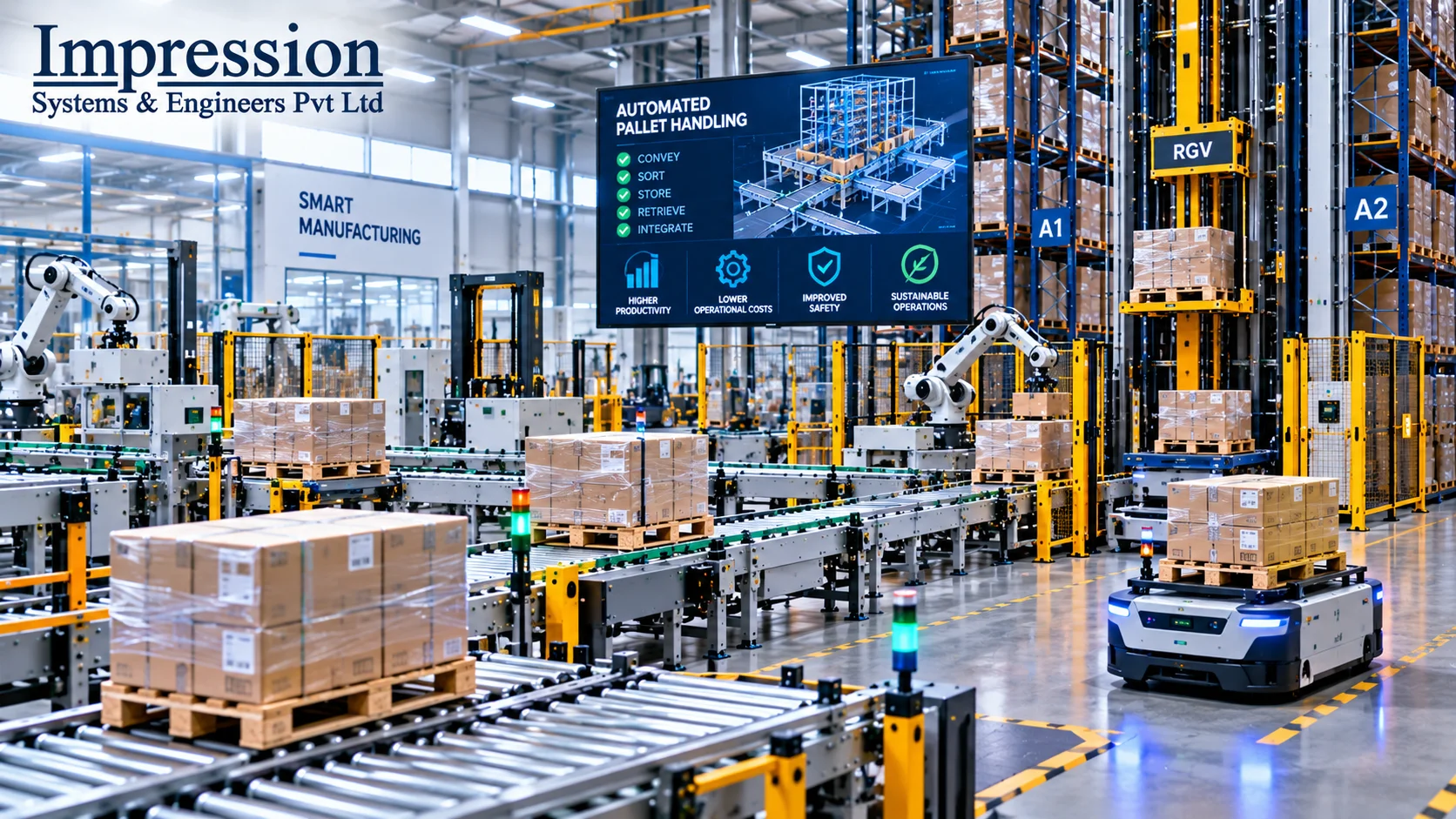
Traditionally, forklifts and manual operators perform much of this movement. With pallet handling automation, equipment such as pallet conveyors, roller conveyors, transfer units, lifts, automated guided vehicles, robotic systems, and automated storage and retrieval systems can perform these operations.
A typical automated pallet handling system may:
- Receive pallets from a production line
- Identify pallets using sensors or barcode/RFID technology
- Transport pallets through conveyors
- Change pallet direction
- Lift or lower pallets between levels
- Buffer pallets temporarily
- Transfer pallets between production and warehouse areas
- Store pallets automatically
- Retrieve pallets based on production or dispatch requirements
- Route pallets to specific destinations
- Connect with warehouse and production control systems
The result is a coordinated material flow with less dependency on manual pallet transportation.
Why Is Pallet Handling Automation Important?
Pallet movement is often one of the most repetitive activities inside a manufacturing or warehouse environment.
When pallet transportation depends entirely on forklifts or manual handling, businesses can encounter:
- Traffic congestion
- Forklift-related safety risks
- Material movement delays
- Operator dependency
- Inconsistent transportation times
- Product damage
- Limited tracking visibility
- Higher labor requirements
- Difficulty scaling operations
Pallet handling automation addresses these challenges by creating predefined and controlled transportation routes.
For example, instead of a forklift operator manually transporting a pallet from production to storage, an automated system can detect the pallet, identify its destination, and automatically route it through a conveyor or vehicle-based transportation system.
This creates a more predictable and measurable material-handling process.
How Does Pallet Handling Automation Work?
The exact process depends on the application and equipment configuration, but a typical automated pallet handling workflow includes several stages.
1. Pallet Entry
The pallet enters the automated handling system from a production line, forklift station, palletizer, wrapping machine, or receiving area.
Sensors verify that the pallet is correctly positioned before transportation begins.
2. Pallet Identification
The system may identify the pallet using:
- Barcode scanners
- RFID tags
- Vision systems
- Production data
- Warehouse management system information
Identification allows the control system to determine where the pallet needs to go.
3. Automated Transportation
The pallet is transported using equipment such as:
- Roller conveyors
- Chain conveyors
- Pallet conveyors
- RGV systems
- AGVs
- AMRs
- Transfer cars
- Vertical lifts
The transportation technology depends on the distance, load characteristics, layout, speed, and operational requirements.
4. Routing
The control system determines the pallet’s destination and selects an appropriate route.
For example, one pallet may be routed to finished-goods storage while another is sent to a production buffer.
5. Storage or Processing
The pallet may then enter:
- Automated storage
- Production buffer
- Inspection
- Picking
- Packaging
- Dispatch
- Loading
6. Retrieval
When a pallet is required, the automation system retrieves it and sends it to the appropriate destination.
This process can be coordinated with production schedules, warehouse management systems, or dispatch requirements.
Major Components of Pallet Handling Automation
A successful pallet handling automation project typically combines mechanical equipment, sensors, controls, software, and safety systems.
Pallet Conveyors
Pallet conveyors are among the most common components.
Depending on the application, systems may use:
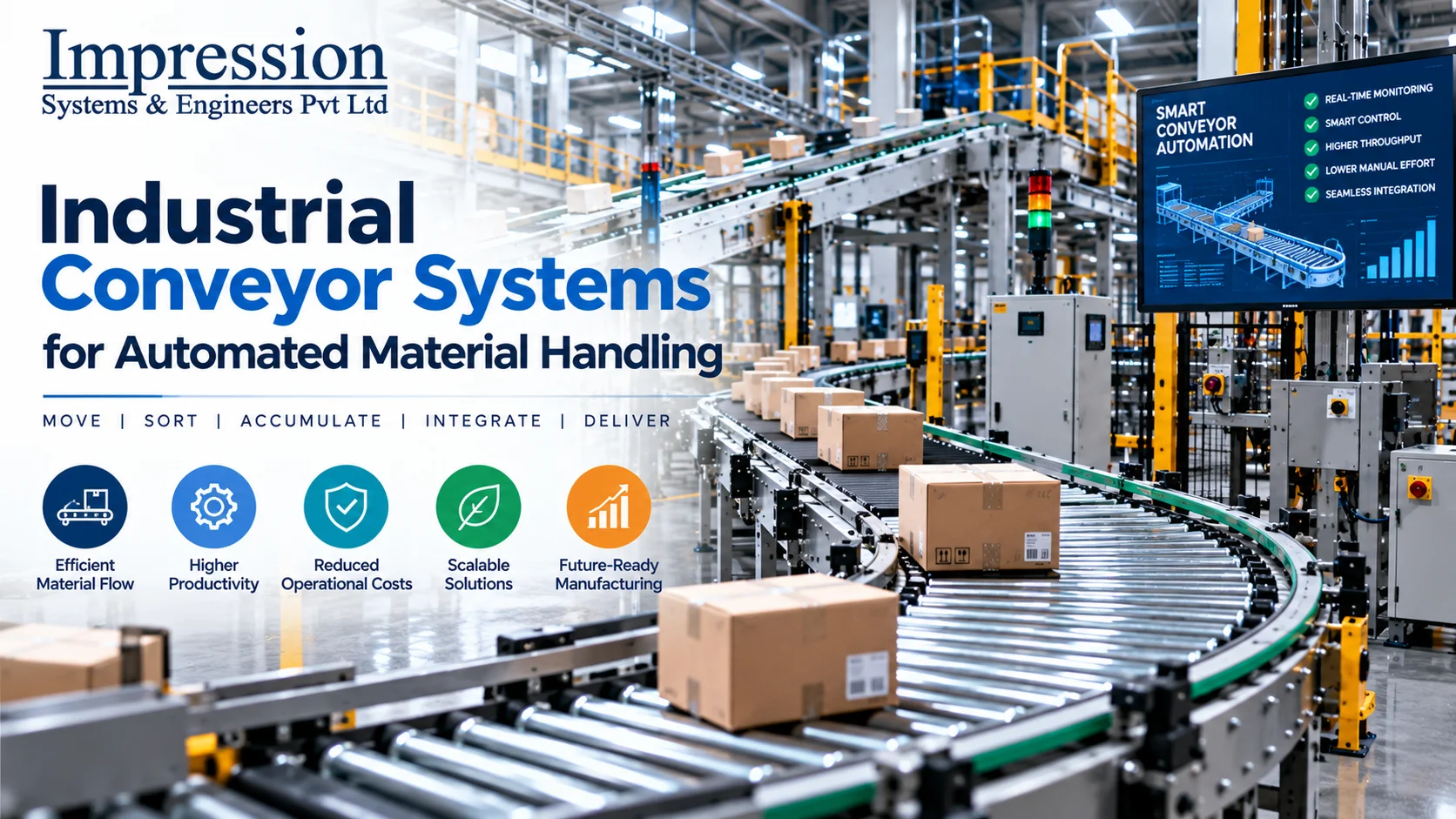
- Roller conveyors
- Chain conveyors
- Belt conveyors
- Pallet transfer conveyors
- Accumulation conveyors
They provide controlled pallet transportation between different process areas.
Roller Conveyor Systems
Powered roller conveyors are widely used for transporting pallets horizontally.
They are particularly useful when pallets have standardized dimensions and weights.
Applications include:
- Production lines
- Warehouses
- Buffer areas
- Dispatch zones
- Storage systems
Chain Conveyors
Chain conveyors are suitable for heavy pallets and demanding industrial environments.
They can provide reliable movement where the pallet design and operating conditions require positive engagement with the conveyor.
Transfer Units
Transfer units allow pallets to move between conveyor lines.
They can change the direction of pallet movement, helping designers create efficient layouts while minimizing unnecessary floor space.
Vertical Lifts
Vertical pallet lifts move pallets between different elevations.
They are useful when production areas, mezzanines, storage systems, or warehouse levels operate at different heights.
RGV Systems
Rail Guided Vehicles, or RGVs, can transport pallets along predefined rail paths.
They are particularly useful for high-throughput environments where repeatable pallet transportation is required.
AGVs and AMRs
Automated Guided Vehicles and Autonomous Mobile Robots can transport pallets between locations without requiring conventional forklift operation.
AGVs generally follow predefined navigation methods, while modern AMRs can use more flexible navigation technologies.
Automated Storage and Retrieval Systems
AS/RS can automatically store and retrieve pallets from high-density storage locations.
Pallet handling automation and AS/RS are often integrated into larger warehouse automation projects.
Sensors and Safety Devices
Sensors help detect:
- Pallet presence
- Position
- Movement
- Obstructions
- Conveyor status
- Equipment conditions
Safety systems may include:
- Emergency stops
- Safety scanners
- Light curtains
- Guarding
- Interlocks
- Safety controllers
PLC and Control Systems
Programmable Logic Controllers coordinate machine-level operations.
The PLC can control:
- Conveyor motors
- Sensors
- Transfer mechanisms
- Lifts
- Diverters
- Safety interlocks
Higher-level software can coordinate the overall material flow.
Types of Pallet Handling Automation
Different facilities require different approaches.
1. Conveyor-Based Pallet Handling
Conveyor systems provide continuous or controlled pallet movement between fixed locations.
They are suitable for:
- Manufacturing
- Warehousing
- Packaging
- Distribution
- Production buffering
2. Vehicle-Based Pallet Handling
AGVs, AMRs, and other automated vehicles provide flexible transportation.
These systems can be useful when pallet destinations change frequently or when fixed conveyor infrastructure is not practical.
3. Robotic Pallet Handling
Robotic systems can automate pallet loading, unloading, stacking, depalletizing, and related operations.
Robotics can be integrated with conveyors and production equipment to create complete automated workflows.
4. AS/RS-Based Pallet Handling
AS/RS systems combine storage and automated retrieval.
They can significantly improve storage density while reducing manual movement between storage locations.
5. Hybrid Pallet Handling Systems
Many modern facilities use multiple technologies.
For example:
Production Line → Conveyor → RGV → AS/RS → Conveyor → Dispatch
A hybrid design allows each technology to perform the task it is best suited for.
Benefits of Pallet Handling Automation
Increased Productivity
Automated systems can move pallets continuously according to predefined operating schedules.
This reduces delays associated with waiting for forklift operators or manual transportation.
Improved Workplace Safety
Reducing unnecessary forklift traffic can help create a more controlled working environment.
Automated transportation can separate people and material movement where appropriate.
Safety should remain a fundamental part of system design rather than being treated as an additional feature.
For industrial safety guidance, organizations can refer to resources provided by OSHA.
Better Material Flow
Automation creates clearly defined material routes.
This makes it easier to control how pallets move between production, storage, and dispatch.
Higher Inventory Accuracy
When pallet movement is connected with identification technologies and warehouse software, businesses can improve visibility into pallet locations.
Reduced Manual Handling
Automation reduces repetitive transportation tasks and allows employees to focus on activities requiring decision-making, supervision, maintenance, and process management.
Better Space Utilization
Automated systems can support high-density storage and vertical movement.
This can help businesses use available warehouse space more effectively.
Consistent Operations
Automated equipment follows predefined processes.
This can create more consistent transportation times and reduce variability caused by manual processes.
Scalability
Well-designed automation systems can be expanded as production and storage requirements increase.
Applications of Pallet Handling Automation
Pallet handling automation is applicable across many industries.
Automotive Industry
Automotive plants frequently move:
- Components
- Subassemblies
- Finished products
- Packaging materials
- Production pallets
Automated pallet movement can connect production stations, storage buffers, and logistics areas.
Explore industrial applications through the Imensys Automotive solutions.
Food and Beverage
Food and beverage facilities often require efficient movement of packaged products and raw materials.
Automation can improve repeatability and reduce unnecessary manual handling.
Learn more about Imensys food and beverage solutions.
Metal Industry
Heavy materials and industrial components may require robust transportation systems.
Pallet conveyors, transfer systems, lifts, and automated vehicles can be designed according to load requirements.
See the Imensys metal industry solutions.
Appliances Manufacturing
Appliance manufacturing plants often manage components, subassemblies, finished products, and packaging.
Automated pallet handling can connect production and storage operations.
Explore Imensys appliance industry solutions.
General Manufacturing
Manufacturers can use automated pallet transportation for:
- Raw material movement
- Work-in-process transportation
- Finished goods
- Buffer storage
- Dispatch
Pallet Handling Automation and Industry 4.0
Modern pallet handling systems are increasingly connected to Industry 4.0 technologies.
A smart pallet handling system can collect operational information such as:
- Pallet identification
- Equipment status
- Movement history
- Cycle time
- Conveyor utilization
- Fault conditions
- System throughput
This information can support operational analysis and predictive maintenance.
Industry 4.0 integration can connect pallet handling equipment with broader manufacturing and enterprise systems.
Organizations interested in smart manufacturing standards and technology research can also explore resources from NIST.
Integration with WMS, MES, ERP and Other Systems
Pallet handling automation becomes more powerful when connected to business and production software.
Warehouse Management System
A WMS can determine:
- Where pallets should be stored
- Which pallets should be retrieved
- Inventory status
- Dispatch requirements
Manufacturing Execution System
MES integration can connect pallet movement with production activities.
For example, a pallet can be automatically transported to a production workstation when a manufacturing order reaches a particular stage.
Enterprise Resource Planning
ERP systems contain business-level information such as:
- Orders
- Inventory
- Production planning
- Procurement
- Dispatch
Integration allows material-handling operations to support broader business processes.
Warehouse Control System
A Warehouse Control System can coordinate automated equipment and manage real-time material flow.
How to Choose the Right Pallet Handling Automation System
There is no universal solution for every facility.
Before selecting equipment, businesses should analyze several factors.
Pallet Dimensions
Determine:
- Length
- Width
- Height
- Weight
- Pallet type
- Load distribution
Throughput Requirements
Calculate the required pallets per hour, shift, and day.
A system designed for low throughput may not be appropriate for high-volume operations.
Travel Distance
Short-distance transportation may be suitable for conveyors.
Longer or changing routes may favor AGVs, AMRs, or other vehicle-based solutions.
Facility Layout
Review:
- Available floor space
- Ceiling height
- Existing equipment
- Production lines
- Storage locations
- Human traffic
- Emergency routes
Future Expansion
The system should ideally accommodate future production growth.
Modular automation can make future expansion easier.
Integration Requirements
Determine which systems need to communicate with the automation:
- ERP
- WMS
- MES
- SCADA
- PLC
- Warehouse control software
Safety Requirements
Safety must be included from the earliest design stage.
A detailed risk assessment should identify potential hazards involving:
- Personnel
- Vehicles
- Conveyors
- Automated equipment
- Pallet loads
- Maintenance activities
Steps for Implementing Pallet Handling Automation
A structured implementation process can reduce project risk.
Step 1: Analyze Existing Material Flow
Map the current pallet movement process.
Identify bottlenecks, manual operations, waiting times, and unnecessary transportation.
Step 2: Define Automation Objectives
Establish measurable objectives such as:
- Required throughput
- Target cycle time
- Storage capacity
- Labor reduction
- Safety improvements
- Tracking requirements
Step 3: Design the System
Select appropriate equipment and develop the material-flow layout.
Step 4: Integrate Controls and Software
Connect sensors, PLCs, equipment controllers, and higher-level software.
Step 5: Test the System
Testing should verify:
- Normal operation
- Pallet positioning
- Routing
- Fault handling
- Safety functions
- Communication
- Recovery procedures
Step 6: Commission and Train
Operators and maintenance teams should receive appropriate training before production deployment.
Step 7: Monitor Performance
After commissioning, track system performance and identify opportunities for improvement.
Common Mistakes to Avoid
Choosing Equipment Before Understanding the Process
Automation should be designed around the material flow rather than selecting equipment first.
Ignoring Pallet Variability
Different pallet sizes, damaged pallets, unstable loads, and weight variations can affect system reliability.
Underestimating Integration
Mechanical equipment is only one part of a modern automated system.
Controls and software integration are equally important.
Neglecting Maintenance
Preventive and predictive maintenance should be incorporated into the operational strategy.
Designing Without Future Capacity
A system that meets today’s requirements but cannot support tomorrow’s production growth may become a limitation.
Maintenance of Pallet Handling Automation
Regular maintenance helps maintain system availability.
Maintenance activities may include:
- Conveyor inspection
- Motor inspection
- Chain and roller inspection
- Sensor cleaning
- Lubrication
- Electrical inspection
- Safety-device testing
- PLC diagnostics
- Software monitoring
- Replacement of worn components
Businesses can also establish preventive maintenance programs based on operating hours, cycles, equipment condition, and manufacturer recommendations.
For ongoing industrial support, explore Imensys maintenance and support services.
Training and Knowledge Transfer
Automation projects should include operator and maintenance training.
Training can cover:
- System operation
- HMI usage
- Alarm handling
- Emergency procedures
- Basic troubleshooting
- Preventive maintenance
- Safety procedures
Proper knowledge transfer helps teams operate the system confidently after commissioning.
See Imensys training and handover services.
Why Work with an Experienced Automation Partner?
Pallet handling automation involves more than installing conveyors or automated vehicles.
A successful project requires coordination between:
- Mechanical engineering
- Electrical engineering
- Controls
- Software
- Safety
- Production
- Warehouse operations
- Maintenance
An experienced automation partner can analyze the complete material flow and develop a solution around the facility’s operational requirements.
This approach can help prevent isolated automation projects that fail to integrate effectively with existing processes.
Pallet Handling Automation at Imensys
Imensys specializes in industrial automation and material-handling solutions designed to improve manufacturing and logistics processes.
For companies evaluating pallet handling automation, the solution can be designed around factors such as:
- Production requirements
- Pallet specifications
- Throughput
- Storage requirements
- Facility layout
- Material-flow requirements
- Automation level
- Software integration
- Safety requirements
- Future expansion
You can explore the company’s broader industrial automation solutions and products.
For a project-specific discussion, visit the Imensys contact page.
Future Trends in Pallet Handling Automation
The next generation of pallet handling systems is expected to become increasingly connected, flexible, and data-driven.
Important trends include:
Artificial Intelligence
AI can support predictive analytics, optimization, and intelligent decision-making.
Autonomous Mobile Robots
AMRs can provide greater flexibility for changing warehouse and manufacturing layouts.
Digital Twins
Digital-twin technologies can help businesses model material flows and evaluate system performance before physical changes are made.
Predictive Maintenance
Equipment data can be analyzed to identify potential failures before they cause significant downtime.
Cloud and Connected Systems
Connected automation platforms can provide centralized visibility into system performance.
Advanced Robotics
Robotic palletizing, depalletizing, transportation, and handling systems can increasingly work together as integrated automation cells.
Frequently Asked Questions About Pallet Handling Automation
What is pallet handling automation?
Pallet handling automation is the use of conveyors, automated vehicles, robotics, sensors, control systems, and software to automatically transport, route, store, and retrieve pallets with minimal manual intervention.
What equipment is used in pallet handling automation?
Common equipment includes pallet conveyors, roller conveyors, chain conveyors, transfer units, vertical lifts, RGVs, AGVs, AMRs, robotic systems, and AS/RS.
What are the benefits of pallet handling automation?
Key benefits include improved productivity, safer material movement, reduced manual handling, better material flow, improved inventory visibility, increased consistency, and more efficient use of warehouse space.
Can pallet handling automation connect with a WMS?
Yes. Automated pallet handling systems can be integrated with WMS platforms so that pallet locations, storage instructions, retrieval requests, and material movements can be coordinated.
Is pallet handling automation suitable for manufacturing?
Yes. It can connect production lines, buffer areas, warehouses, inspection stations, packaging areas, and dispatch operations.
What is the difference between pallet handling and pallet storage automation?
Pallet handling automation focuses primarily on transporting and routing pallets, while pallet storage automation focuses on automatically storing and retrieving pallets. The two systems are often integrated.
Can AGVs and AMRs be used for pallet transportation?
Yes. AGVs and AMRs can transport pallets between defined locations. The appropriate technology depends on layout, payload, navigation requirements, traffic conditions, and throughput.
How do I choose a pallet handling automation system?
Start by analyzing pallet dimensions, load weight, throughput, travel distance, facility layout, storage requirements, software integration, safety requirements, and future expansion plans.
Is pallet handling automation suitable for small facilities?
It can be. The appropriate level of automation depends on production volume, material flow, labor requirements, available space, and return-on-investment objectives.
Conclusion
Pallet handling automation provides a structured way to improve the movement of pallets throughout manufacturing plants, warehouses, and distribution environments. By combining conveyors, automated vehicles, lifts, robotic systems, sensors, controls, and software, businesses can create more predictable and efficient material flows.
The right solution depends on the facility’s pallet characteristics, throughput requirements, layout, storage strategy, safety requirements, and integration needs.
For businesses planning their next stage of industrial or warehouse automation, pallet handling should be considered as part of the complete material-flow strategy rather than as an isolated equipment purchase.
With the right engineering approach, pallet handling automation can support higher productivity, improved safety, better inventory visibility, optimized space utilization, and scalable operations.
Ready to explore pallet handling automation for your facility? Contact Imensys to discuss your material-handling and industrial automation requirements.