Industrial Automation Solutions in India: A Complete Guide for Manufacturers and Warehouses
If you’ve ever walked a factory floor at 11 PM during a peak production run, you already know the problem this blog is about. Someone is short-staffed on the night shift. A pallet is sitting exactly where a forklift needs to turn. Somewhere down the line, a box got scratched because a worker had to rush a manual transfer he’s done four hundred times that week. None of this is anyone’s fault — it’s just what happens when a growing operation is still being run the way it was run ten years ago.
This is exactly the gap industrial automation solutions in India are built to close. Not by replacing people, but by taking over the repetitive, physically demanding, error-prone parts of material movement so your team can focus on the parts of the job that actually need a human brain.
In this guide, we’ll walk through what industrial automation actually means in practice, why Indian manufacturers are investing in it now more than ever, the main types of systems available, how to choose the right one for your industry, what it realistically costs, and what results you can expect. Whether you’re evaluating your first automation project or upgrading an existing line, this is written to give you a genuinely useful decision-making foundation — not a sales pitch.
What Are Industrial Automation Solutions?
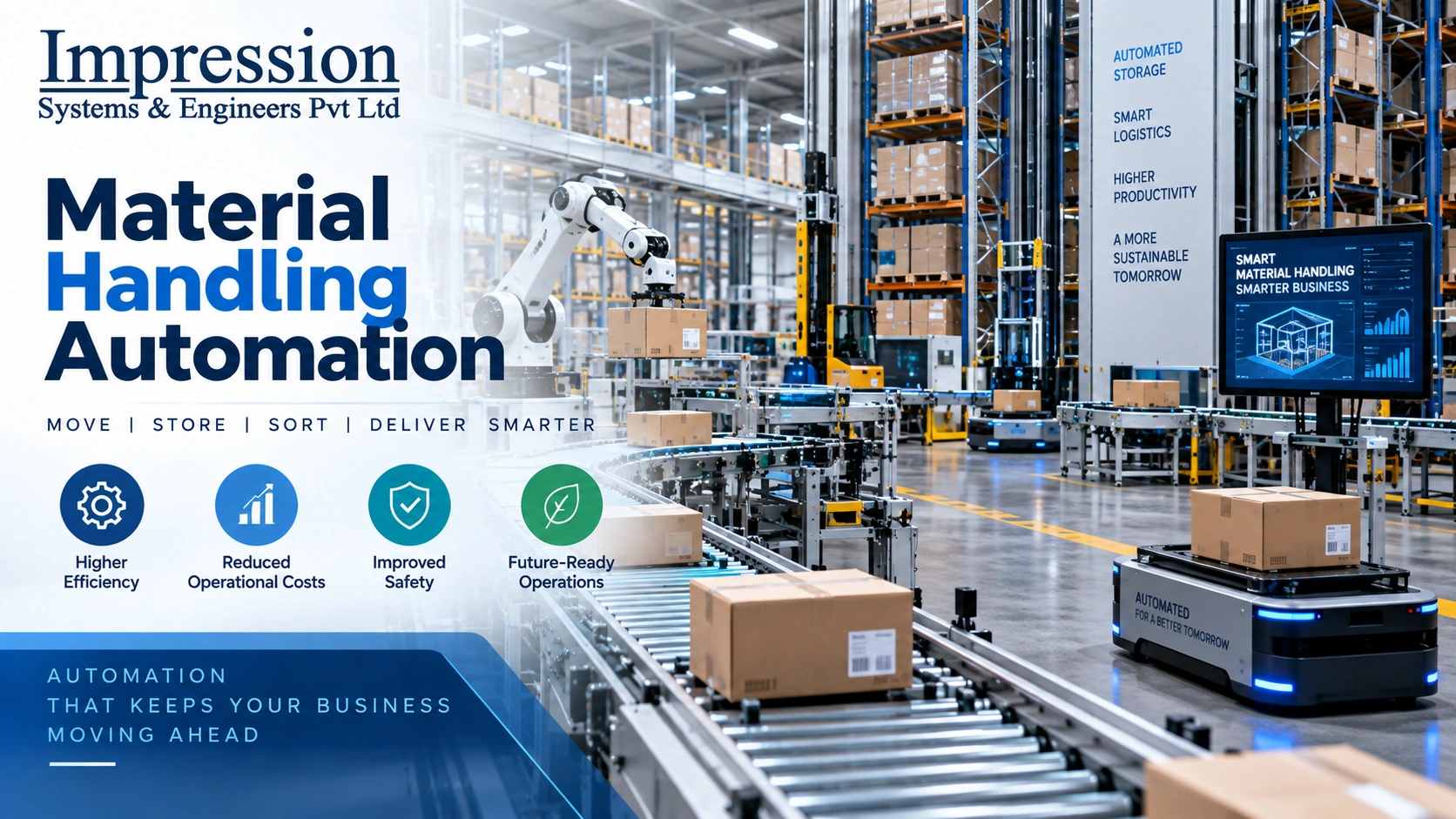
Industrial automation solutions are systems — mechanical, electrical, and software-driven — that move, store, sort, or process materials with minimal manual intervention, using conveyors, robotics, control systems, and sensors working together. In a factory or warehouse setting, this usually means replacing manual trolleys, forklift runs, and hand-stacking with conveyor systems, automated storage and retrieval systems (AS/RS), robotic guided vehicles (RGVs), autonomous mobile robots (AMRs), and the control software that ties them together.
It’s worth being precise here, because “automation” gets used loosely. There’s a real difference between:
- Mechanization — using machines to do physical work, but a person still operates or triggers each step.
- Automation — the system runs a defined sequence on its own, typically triggered by sensors, timers, or a central controller, with a person supervising rather than operating.
- Smart automation (Industry 4.0-aligned) — the system doesn’t just run on its own, it also collects data, reports performance in real time, and can be monitored or adjusted remotely through a Warehouse Management System (WMS) or Manufacturing Execution System (MES)
Most manufacturers don’t jump straight to the third stage. It’s usually a staged process — automate the most painful bottleneck first (often end-of-line palletizing or inter-department transfers), prove the ROI, then expand. That staged approach is exactly how a company like Imensys, which has delivered over 1,500 automation projects since 2005, typically structures a client’s first engagement — start with the highest-friction point on the floor, not the whole factory at once.
Why Are Indian Manufacturers Investing in Industrial Automation Now?
Indian manufacturers are automating faster than ever because of three converging pressures: rising labor costs and availability challenges, increasing export-quality expectations, and government-backed Industry 4.0 adoption through initiatives tied to schemes like Make in India and Production Linked Incentives. None of these pressures is new individually — but together, in 2026, they’ve made automation a competitiveness issue rather than an optional upgrade.
Here’s what’s actually driving the shift on the ground:
Labor availability is tightening, especially for repetitive physical roles. Warehousing and material handling roles have some of the highest attrition rates in Indian manufacturing. Training a new worker to move palletized goods safely and consistently takes weeks; losing that worker after two months is common. A conveyor system or AS/RS doesn’t have an attrition problem.
Export and OEM clients are demanding tighter consistency. If you’re supplying components to an automotive OEM or a global appliance brand, “mostly consistent” handling isn’t good enough anymore. Automated transfer systems remove the variability that comes from different workers handling the same task slightly differently — which matters enormously for anything with a scratch-sensitive or precision-sensitive surface.
The economics have genuinely shifted. Automation hardware and control systems have become more modular and less expensive to integrate than they were even five years ago. A mid-sized facility no longer needs to redesign its entire layout to add automation — modular conveyor sections, standard products, and scalable storage systems can be added incrementally.
Industry 4.0 is no longer a buzzword on a slide deck. Real-time monitoring, IoT-enabled equipment, and WMS/ERP integration are increasingly expected by clients doing due diligence on their suppliers’ operations — particularly in food & beverage, pharmaceuticals, and automotive, where traceability matters as much as speed.
This is exactly why an experienced systems integrator matters more than a hardware catalog. The right automation partner doesn’t just sell you a conveyor — they help you sequence the investment so each phase pays for itself before you commit to the next.
What Are the Main Types of Industrial Automation Solutions Available in India?
The core categories of industrial automation available to Indian manufacturers are conveyor systems, storage automation (AS/RS), advanced transportation solutions (AGVs, AMRs, RGVs, monorails), and standard automation components — each suited to a different part of the material flow, from receiving through storage to dispatch. Most real factories use a combination of two or three of these, not just one.
Here’s how they compare in practical terms:
| System Type | Best For | Typical Use Case | Relative Investment |
|---|---|---|---|
| Conveyor Systems | High-frequency, repetitive transfers along a fixed path | Moving goods between production, packaging, and dispatch; end-of-line palletized transfer | Low–Medium |
| Storage Automation (AS/RS) | Maximizing vertical warehouse space and retrieval speed | High-SKU-count warehouses needing fast, accurate picking | Medium–High |
| AGVs / RGVs (fixed or semi-fixed routes) | Predictable, repeated point-to-point transport | Moving pallets or bins between fixed zones on a factory floor | Medium |
| AMRs (autonomous mobile robots) | Flexible, changeable routes without fixed infrastructure | Facilities where layout or product mix changes frequently | Medium–High |
| Standard Automation Products | Filling specific gaps without a full custom system | Small-footprint upgrades, single-station automation, retrofits | Low |
A few things worth understanding about how these actually get chosen in practice:
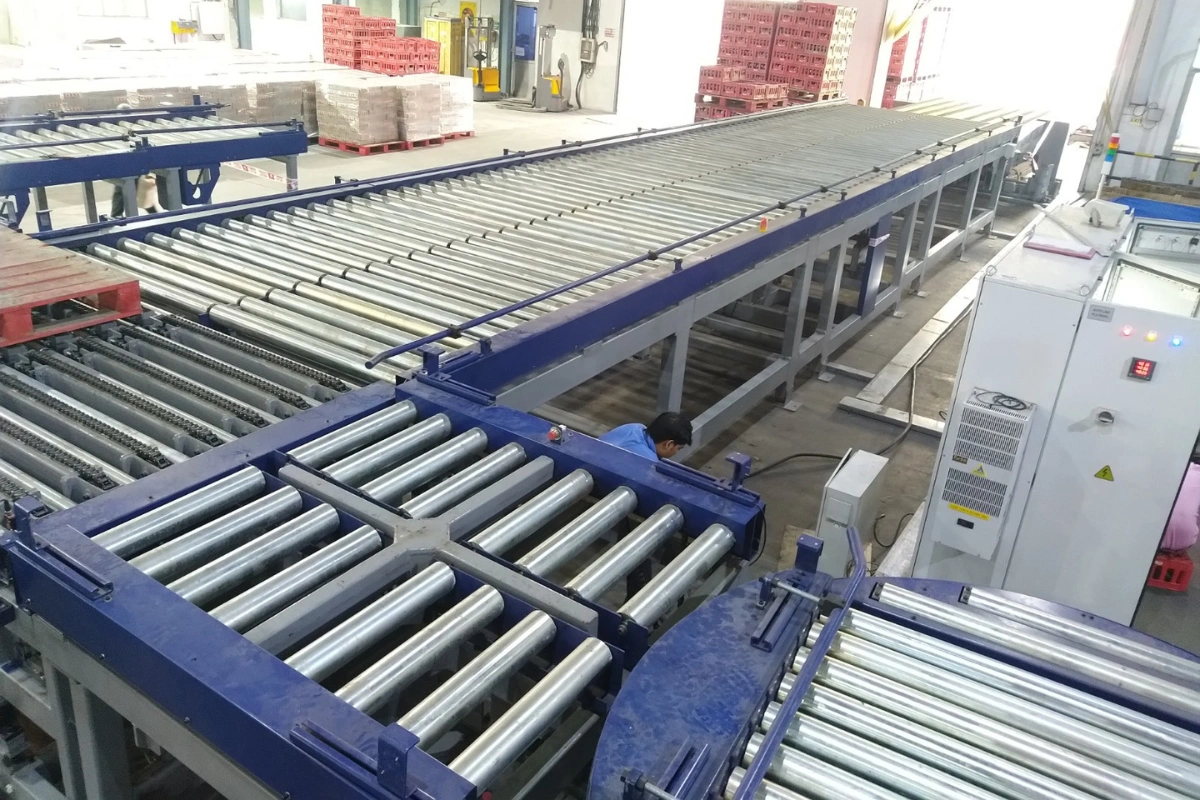
Conveyor systems are usually the entry point for most first-time automation projects, because they solve the most visible, most repetitive bottleneck — moving product from one stage to the next — with the lowest engineering complexity relative to the productivity gain.
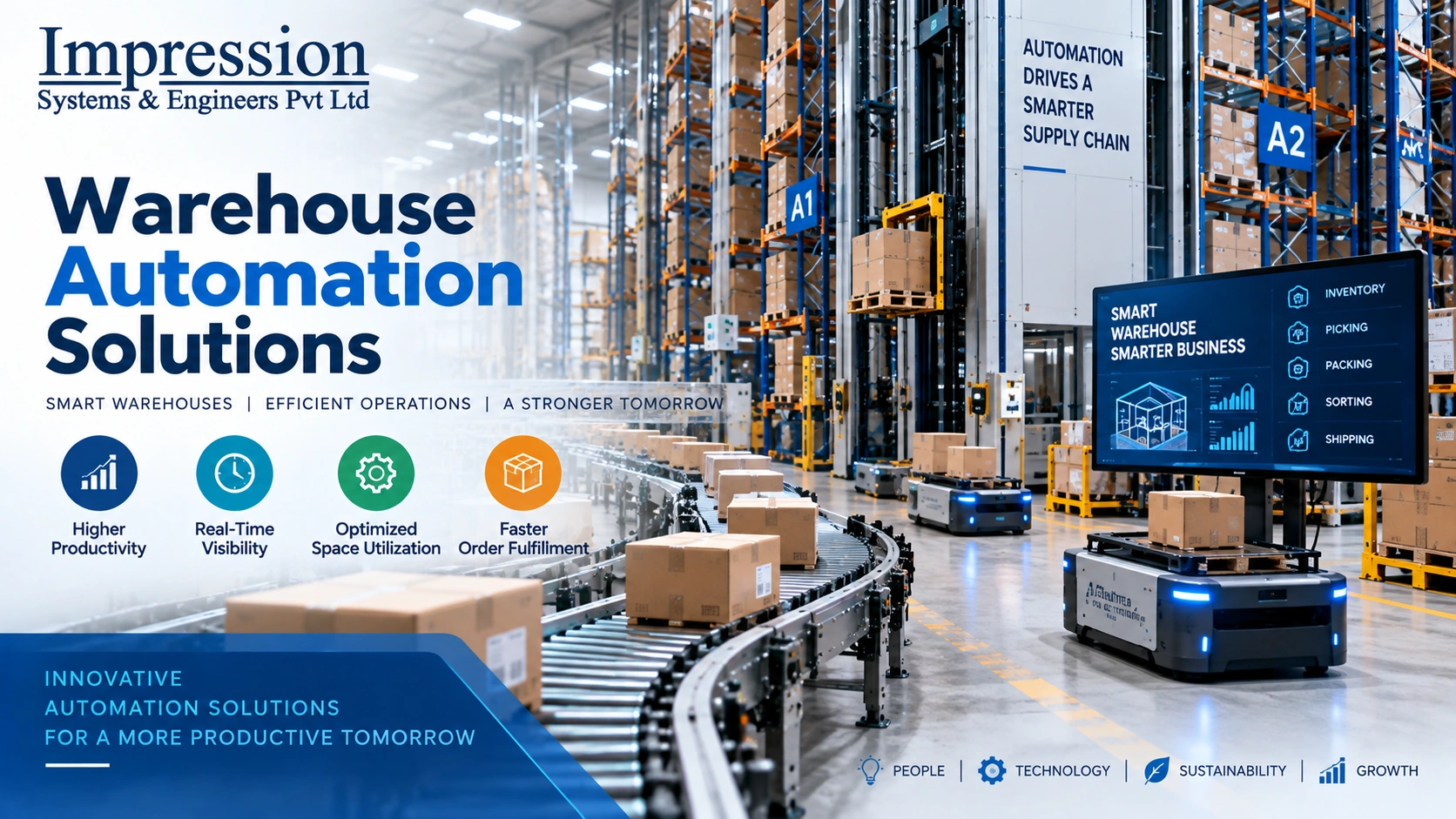
AS/RS (Automated Storage and Retrieval Systems) work by using a computer-controlled crane or shuttle mechanism running on fixed rails inside a racking structure to place and retrieve palletized or bin-stored goods automatically. The core value isn’t just speed — it’s space. A well-designed AS/RS can often store significantly more inventory in the same warehouse footprint compared to conventional racking with forklift access aisles, because the system doesn’t need wide aisles for a human-operated vehicle to maneuver.
The difference between AGVs and AMRs trips up a lot of first-time buyers, so it’s worth being direct about it: AGVs (Automated Guided Vehicles) and RGVs (Rail Guided Vehicles) follow a fixed or semi-fixed path — a magnetic strip, a rail, or a pre-programmed route — which makes them highly reliable for repetitive, unchanging transport tasks. AMRs (Autonomous Mobile Robots) use onboard sensors and mapping software to navigate dynamically, which makes them better suited to facilities where the layout, product mix, or transport routes change often. If your factory layout is stable and your transport routes rarely change, an AGV/RGV setup is usually more cost-effective. If you’re running a facility with frequent SKU changes or shifting zones, AMRs earn their higher price tag.
Standard automation products are the most underrated category. Not every problem needs a custom-engineered system — sometimes a single automated station, a standard transfer unit, or a modular component solves 80% of the bottleneck at a fraction of the cost and lead time of a full custom build.
How Do You Choose the Right Industrial Automation Solution for Your Industry?
Choosing the right industrial automation solution comes down to four practical factors: your actual throughput requirements, the variety and fragility of what you’re handling, your available floor space and layout constraints, and whether the system needs to integrate with an existing WMS or ERP platform. Industry context matters too — what works for automotive doesn’t necessarily work for food & beverage.
Here’s a practical framework, broken down by the kind of decisions that actually come up:
Start with throughput, not technology. Before evaluating any specific system, get a real number: units or pallets per hour at peak demand, not average demand. A lot of automation projects are oversized or undersized because they were planned around an “average day” instead of the busiest realistic day. Peak throughput is what actually determines whether you need a conveyor upgrade or a full AS/RS.
Match the system to what you’re actually handling.
- In food & beverage, palletized goods transfer and end-of-line automation are usually the priority, with hygiene-compliant materials and gentle handling to avoid product damage.
- In appliances, the priority is almost always damage prevention — scratches and dents during production, assembly, testing, and packaging stages are a real cost center, so handling systems need to be engineered specifically to minimize surface contact.
- In automotive, requirements differ sharply between passenger vehicle (car) lines and commercial vehicle (truck/bus) lines — the size, weight, and handling tolerances are different enough that a system designed for one rarely transfers directly to the other.
- In metal industries, handling plates, pipes, coils, and slabs involves significant weight and dimensional variation, which usually calls for purpose-built handling equipment rather than off-the-shelf conveyor sections.
Be honest about your floor layout constraints. Retrofit automation into an existing facility is a fundamentally different engineering problem than designing automation into a greenfield facility. If you’re retrofitting, the real constraint usually isn’t budget — it’s column spacing, ceiling height, and existing utility routing. An experienced integrator will want to see your actual floor layout before proposing a system, not after.
Check integration requirements early, not late. If your operation already runs on a WMS or ERP platform, confirm early whether your shortlisted automation system can exchange data with it directly, or whether you’ll need a middleware layer. This is one of the most common causes of budget overruns — discovering integration complexity after the hardware is already selected.
Plan in phases. The manufacturers who get the best return on automation rarely automate everything at once. They identify the single highest-friction bottleneck, automate that first, measure the actual result against their original numbers, and use that data to justify and design the next phase.
How Much Do Industrial Automation Solutions Cost in India?
Industrial automation project costs in India vary widely depending on system type and scale, but the biggest cost drivers are consistently the same: throughput capacity required, degree of customization versus standard components, integration complexity with existing software, and site-specific engineering needs like layout retrofits. There’s no honest single number that applies across projects — anyone who gives you one figure without asking about your facility first is guessing.
That said, here’s what actually moves the number up or down in a real quote:
- Standard vs. custom-engineered components. Standard products cost meaningfully less than a fully custom-engineered system, because there’s no design-from-scratch engineering time involved. If a standard product solves your problem, it will almost always be the faster and cheaper route.
- System type. As a rough ordering (not a fixed ratio), a single conveyor transfer section is typically the least capital-intensive entry point, followed by AGV/RGV point-to-point systems, with full AS/RS installations and complex multi-system integrations representing the higher end of the investment range, given the racking, controls, and software involved.
- Integration and controls. A system with PLC-based smart controls, real-time monitoring, and WMS/ERP integration costs more upfront than a purely mechanical system — but usually pays that difference back faster through reduced errors and better visibility into performance.
- Site conditions. Retrofitting into an existing building with layout constraints, older electrical infrastructure, or limited ceiling height typically adds cost compared to designing for a new facility from scratch.
- Maintenance and lifecycle cost. The cheapest system upfront isn’t always the cheapest system over five years. Low-maintenance design — a point Imensys specifically engineers for — reduces downtime cost and spare-part dependency over the system’s working life, which matters more the longer you plan to run the equipment.
The honest way to get an accurate number for your specific case is a site assessment, not a brochure price list — because the same “conveyor system” quote can vary several times over depending purely on length, load capacity, and control complexity. If you want a realistic figure for your facility, request a quote with your basic throughput and layout details, and expect a proper engineering conversation rather than a flat rate card.
What Results Can You Expect from Industrial Automation?
Manufacturers who automate material handling typically see three consistent categories of improvement: reduced manual handling time and labor dependency, fewer product-damage incidents, and more predictable, measurable throughput that’s easier to plan around. The exact percentage improvement depends heavily on how manual and bottlenecked the original process was — a facility replacing a genuinely chaotic manual process will see a bigger jump than one automating an already well-organized manual system.
What tends to hold true across most well-executed projects:
- Throughput becomes predictable, not just faster. The biggest operational win often isn’t raw speed — it’s consistency. A manual process has natural variability shift to shift, worker to worker. An automated system runs the same cycle every time, which makes production planning dramatically more reliable.
- Damage-related losses drop, especially in appliances and packaged goods. Reducing the number of times a product is manually touched, lifted, or transferred is one of the most direct ways to cut scratch, dent, and breakage-related losses.
- Labor gets redeployed, not just reduced. In most of the projects we’ve seen succeed long-term, the workers freed up from repetitive transfer tasks move into quality control, machine supervision, or other higher-value roles — rather than simply being cut. This also tends to improve retention, since fewer people are stuck doing the most physically repetitive work.
- Space utilization improves, particularly with storage automation. Vertical storage automation frequently allows a facility to store meaningfully more inventory in the same footprint compared to conventional racking, simply because the system doesn’t need wide human-accessible aisles.
Frequently Asked Questions
Q1. What is the difference between industrial automation and Industry 4.0?
A1. Industrial automation refers to machines and systems performing tasks with minimal manual input. Industry 4.0 goes a step further — it’s automation combined with real-time data, IoT connectivity, and software integration (WMS/ERP/MES) so the system doesn’t just run independently, it also reports and adapts based on live data.
Q2. Do small and mid-sized manufacturers actually benefit from automation, or is it only worth it for large factories?
A2. Smaller manufacturers benefit too, provided the project is scoped to a specific bottleneck rather than a full-facility overhaul. A single conveyor section or standard automation product targeting the worst pain point often delivers a faster, clearer return than trying to automate an entire line at once.
Q3. How long does a typical industrial automation project take, from planning to installation?
A3. Timelines vary by system complexity and site readiness, but the process generally includes a site assessment and layout review, system design and engineering, manufacturing or procurement of components, installation, and commissioning with staff training. Standard products install fastest; fully custom AS/RS or multi-system integrations take considerably longer due to design and racking/civil work involved.
Q4. Can automation systems be integrated with an existing WMS or ERP platform?
A4. Yes, in most cases — but this needs to be confirmed early in the design phase, not after equipment selection. A system with PLC-based smart controls and a properly defined data interface can typically exchange information with standard WMS/ERP platforms; the complexity depends on your specific software’s integration capability.
Q5. What industries in India use industrial automation the most?
A5. Automotive, food & beverage, appliances, pharmaceuticals, warehousing/logistics, and the metal industry are among the most active adopters, largely because each faces some combination of high throughput requirements, damage-sensitivity, regulatory traceability needs, or labor-intensive repetitive handling.
Q6. Is it better to automate an entire facility at once or in phases?
A6. Phased automation is generally the more practical and lower-risk approach for most manufacturers. Identifying and automating the single highest-friction bottleneck first allows you to measure real results, validate the ROI, and use that data to plan and justify the next phase — rather than committing a large capital budget to a full-facility redesign upfront.
Getting Started with Industrial Automation
Industrial automation in India isn’t a single decision — it’s a series of smaller, sequenced decisions, each one informed by real data from your own facility rather than a generic vendor pitch. Start with your worst bottleneck, get a proper site assessment, and let the first phase prove itself before committing further.
Imensys Systems & Engineers Pvt. Ltd. has been designing and delivering material handling and storage automation solutions since 2005, with over 1,500 projects completed across India, Europe, the USA, and the Gulf region. If you’re evaluating your first automation project — or your fifth — request a quote or view our brochure to start with a real conversation about your facility, not a generic catalog.
Written and reviewed by the Imensys engineering team, drawing on 20+ years of hands-on material handling and storage automation project experience across the automotive, food & beverage, appliances, and metal industries. For questions about this article or your specific facility, contact us at sales@imensys.net.